

Getting married in Singapore has two sides that people often mix up. There is the legal side, where the state formally recognises your union, and there is the celebration side, where family, food and tradition take over. This guide walks through both in plain terms, so whether you are a local couple, a newcomer settling in, or a foreigner marrying a Singaporean, you know roughly what to expect and where to check the details.
One thing to say up front: this is a general overview, not legal advice. Rules, fees and timelines change, and every couple’s situation is a little different. Always confirm the current requirements with the official body before you commit to dates or pay anything.
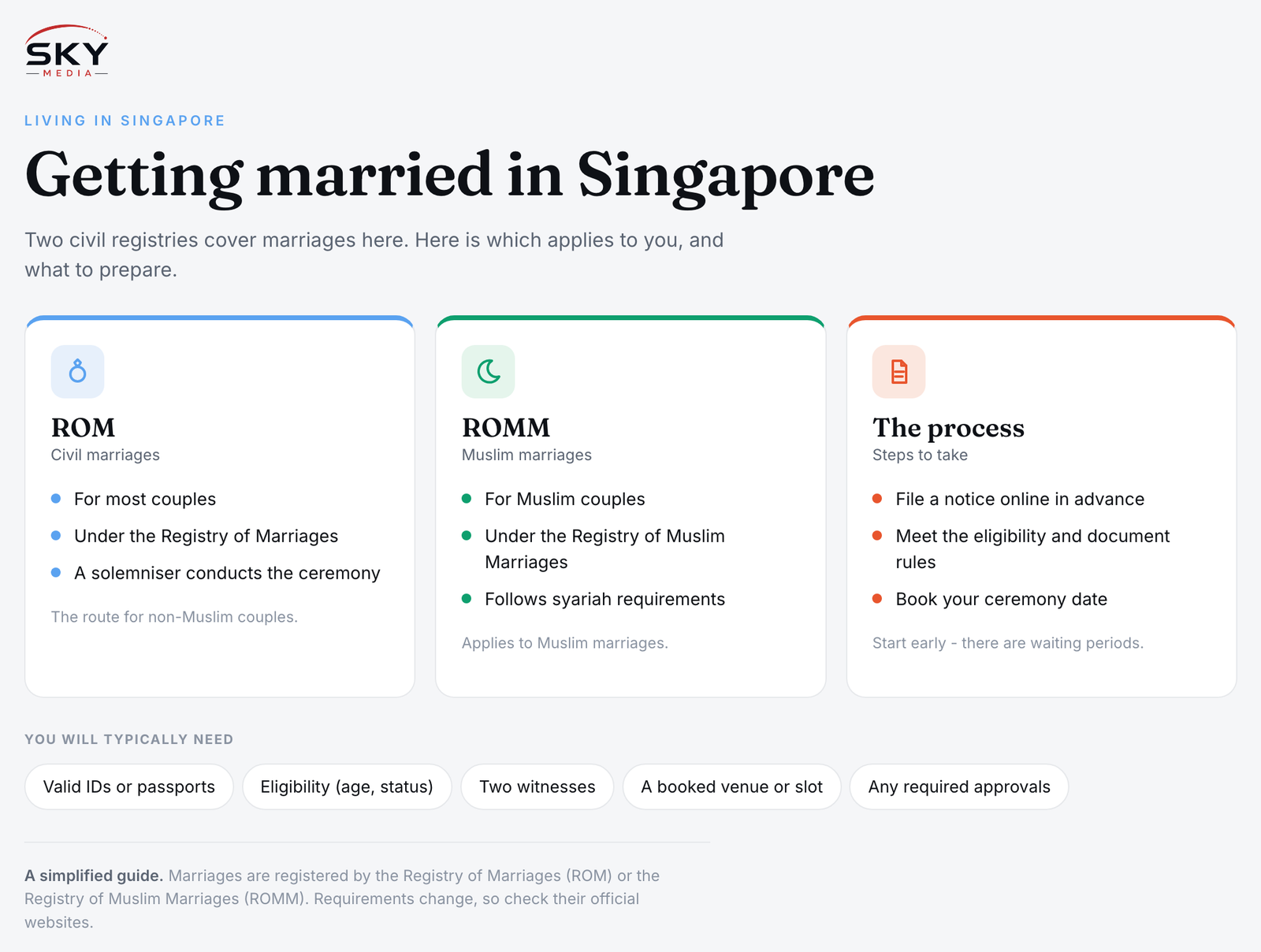
Two registries: ROM and ROMM
Singapore recognises marriage through two separate legal channels, and which one applies to you depends on religion, not preference.
- The Registry of Marriages (ROM) handles civil, non-Muslim marriages under the Women’s Charter. This is the route for most couples, including those of no particular faith and those in Chinese, Indian, Christian and other communities.
- The Registry of Muslim Marriages (ROMM) handles marriages where both parties are Muslim, under the Administration of Muslim Law Act. A Muslim marriage ROM process runs through ROMM rather than the civil registry.
The two systems have different forms, different officiants and different eligibility rules, so it matters that you start with the right one. If one partner is Muslim and the other is not, the situation is more involved and you should speak to ROMM directly early on. Getting married in Singapore starts with knowing which door you are walking through.
Here is how the two registries compare:
| ROM | ROMM | |
|---|---|---|
| Who it is for | Non-Muslim couples | Muslim marriages |
| Full name | Registry of Marriages | Registry of Muslim Marriages |
| Governing law | The Women’s Charter | The Administration of Muslim Law Act |
Eligibility and the notice period
Before any marriage can be registered, the couple has to meet basic eligibility criteria and give formal notice.
In broad terms, both parties usually need to be of a minimum age, must not already be married to someone else, and must not be too closely related. There is also typically a residency or physical-presence element, meaning at least one of you needs to have spent some time in Singapore before the marriage. Foreigners and citizens are treated slightly differently here, which we will come back to.
The notice period is one of the most misunderstood parts of the process. When you file your notice of marriage, the law builds in a waiting window between that filing and the actual solemnisation. The idea is to give a public, formal signal of intent before the marriage is sealed. Couples sometimes assume they can register and marry on the same afternoon; in practice you plan around that gap. There is usually a maximum validity window too, so you cannot file years in advance and marry whenever you feel like it.
Because the exact ages, waiting times, residency rules and any special-licence options can be adjusted over time, treat everything in this section as the shape of the process rather than the fine print. Check the current numbers with ROM or ROMM before you set a date.
Solemnisation, solemnisers and witnesses
The moment your marriage becomes legally real is the solemnisation. This is the short ceremony where you and your partner declare, in the required form of words, that you are marrying each other.
A few pieces have to be in place:
- A licensed solemniser. For civil marriages, this is an official authorised by the Registry of Marriages to conduct the ceremony. Many people are surprised to learn how wide the pool is: it can include community figures and appointed individuals, not only registry staff. For Muslim marriages, a Kadi or Naib Kadi officiates through ROMM.
- Witnesses. You will generally need witnesses present who meet the age and capacity requirements, and who are willing to sign the marriage record.
- The couple, present in person. Both parties attend and give their consent in the moment.
You can often choose where solemnisation happens. Couples marry at the registry itself, at licensed venues, in hotels, gardens and restaurants, or as part of a larger wedding event. The legal ceremony can be a quiet five-minute affair or the emotional centrepiece of a big celebration; the law cares about the declaration and the paperwork, not the flower arrangements.
A useful way to think about it: the solemnisation is the legal marriage, and the wedding is the celebration. They can happen on the same day or months apart, and plenty of couples deliberately split them.
Marrying as a foreigner or a mixed couple
If you are a foreigner marrying a Singapore citizen or permanent resident, or two foreigners hoping to marry here, the process is broadly open to you but comes with extra checks.
Expect requirements around valid passports, proof of immigration status, and sometimes evidence that you are legally free to marry, such as documentation that a previous marriage has ended. There may be residency or physical-presence conditions to satisfy, and in some cases couples need to obtain a special marriage licence rather than rely on the standard notice route. Where a partner has passed away or a prior marriage ended, you will usually need to show the relevant certificate.
For couples where one partner is Muslim and the other is not, or where a partner wishes to convert, the pathway runs through ROMM and can involve additional steps and counselling. This is exactly the kind of situation where a quick, direct conversation with the registry saves weeks of confusion. Do not rely on a friend’s experience from a few years ago, as the details shift.
If marriage is part of a bigger move to the country, it helps to get your wider admin in order at the same time. Our moving to Singapore checklist covers the passes, paperwork and practicalities that tend to surface alongside a marriage.
The celebration: weddings across communities
Once the legal side is handled, the fun and the family politics begin. Singapore’s mix of Chinese, Malay and Indian communities means weddings here look wonderfully different from one another, though almost all share a love of food, colour and a long guest list.
Chinese weddings
Chinese weddings in Singapore often blend old customs with modern touches. You may see a tea ceremony, where the couple serves tea to elders and receives blessings and red packets in return, and the exchange of a betrothal gift, sometimes called guo da li, between families. The centrepiece for many is the evening banquet, typically a multi-course dinner in a hotel or restaurant, with speeches, a march-in, and the couple visiting each table to toast guests. Guests traditionally give money in a red packet, or ang bao, rather than physical gifts.
Malay weddings
Malay weddings often centre on the solemnisation followed by a joyous celebration that may spill into void decks, community halls or homes. Traditions can include the bersanding, where the couple sits together on a decorated dais as honoured guests, and the sharing of generous spreads of food with an open, come-one-come-all spirit. Bright colours, live music and warm hospitality set the tone.
Indian weddings
Indian weddings, which vary by religion and region, are known for rich ritual, vivid dress and multi-day festivity. Depending on the community you might see henna ceremonies, ceremonies conducted before a sacred fire, and elaborate feasting. Music, dance and family involvement run through the whole event.
These are broad brushstrokes. Real weddings mix, match and modernise constantly, and plenty of couples design something that reflects two cultures at once.
Budgeting and planning tips
Wedding costs in Singapore vary enormously, so any single figure would mislead more than it helps. A small registry solemnisation with a handful of guests sits at one end, and a full hotel banquet with hundreds of guests, gowns, photography and a honeymoon sits far at the other. What matters is deciding early where your money and energy go.
Quick planning checklist:
- Confirm your legal route (ROM or ROMM) and current eligibility rules first, before booking anything.
- Note the notice period and work backwards from it when picking a solemnisation date.
- Line up your solemniser and witnesses early, especially for popular dates.
- Separate the legal ceremony from the celebration in your planning, even if they land on the same day.
- Set a rough budget and decide your non-negotiables (guest count, venue, photos) before the extras creep in.
- Keep digital and physical copies of every certificate and document you are asked for.
A calm approach beats a rushed one. The couples who enjoy the process tend to sort the legal paperwork early, then give themselves room to plan the celebration without a deadline breathing down their necks.
A final word
Getting married in Singapore is refreshingly systematic once you know the two-track structure: a civil path through the Registry of Marriages and a Muslim path through ROMM, each with its own eligibility rules, notice period, solemnisation and witness requirements. Around that legal core, you are free to build a wedding that honours whichever traditions matter to you, at whatever scale suits your budget.
Because official requirements do change, use this guide to understand the landscape, then verify the specifics with ROM or ROMM directly. And if a wedding is one milestone among several, you may find yourself thinking ahead to the next chapter. Our guide to having a baby in Singapore picks up where the honeymoon leaves off.
Explore more: Having a baby in Singapore · Moving to Singapore checklist