
If your dog drools, whines, trembles or throws up every time you head to the vet or the dog run, you are not alone, and neither is your dog. Dog car sickness is common, especially in puppies and young dogs, and it is often tangled up with anxiety about the car itself. The good news is that both the physical queasiness and the worry behind it usually improve a great deal with patience, gentle training and, where needed, help from your vet. This guide explains why it happens and how to rebuild your dog’s confidence for car trips around Singapore, whether you are heading to a clinic, a green space or across the Causeway.
This is general information, not veterinary advice. For diagnosis, medication and dosing, or if your dog is repeatedly unwell, distressed or refusing food, please see a licensed vet. Never give human anti-nausea or sedative medicines, which can be dangerous or toxic to dogs.
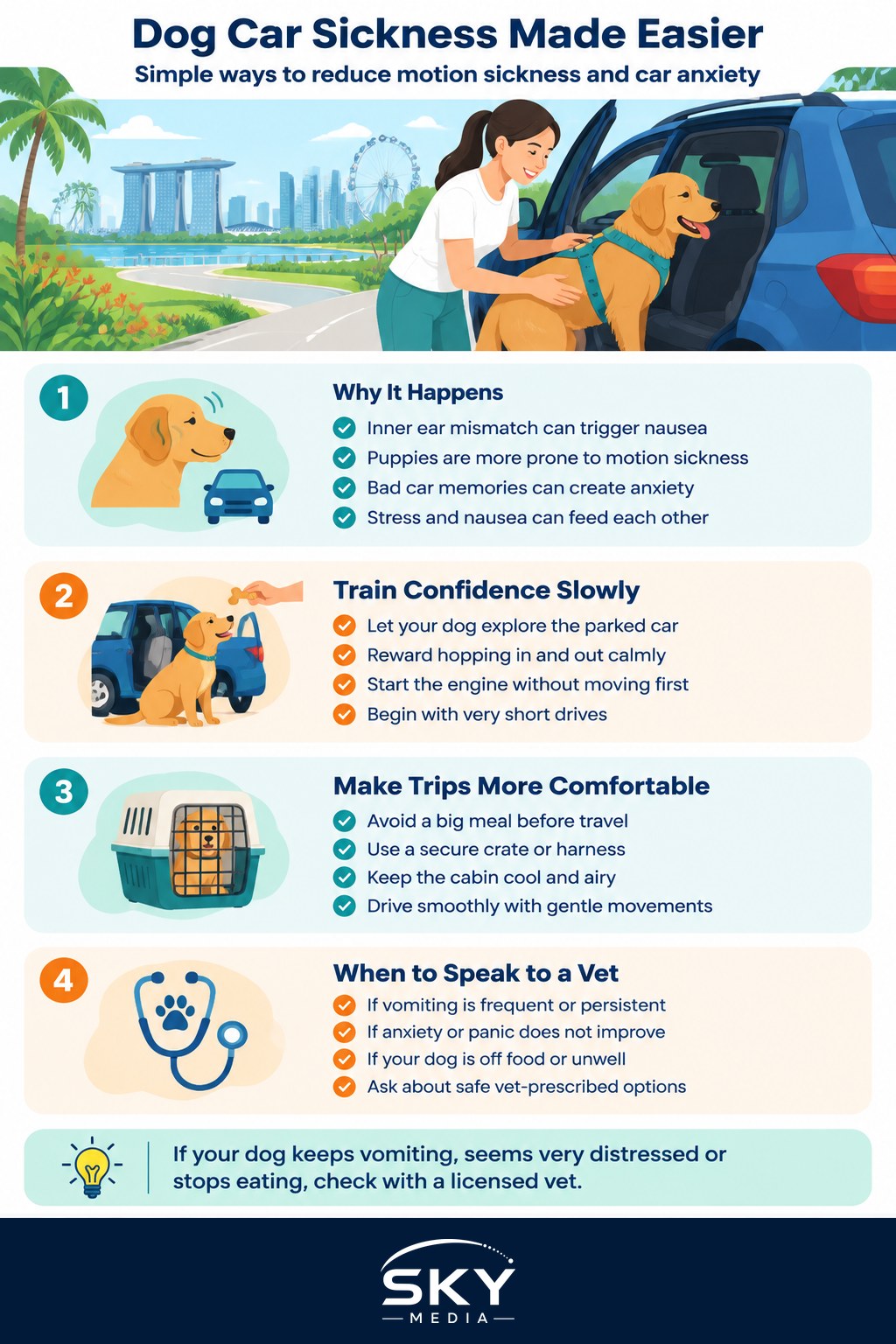
Why Dogs Get Car Sick and Anxious
Car sickness in dogs has two overlapping causes, and telling them apart helps you treat the right one.
- Physical motion sickness. Like children, many puppies have an immature inner ear, the organ that senses balance and motion. Conflicting signals between what the eyes see and what the inner ear feels trigger nausea. Many dogs grow out of the physical part as they mature.
- Anxiety and learned association. If early car trips only ever ended somewhere stressful, such as a clinic, or if a dog once felt sick in the car, the car itself becomes a trigger. Now the stress alone can cause drooling, panting and nausea before the engine even starts.
Common signs include excessive drooling, lip-licking, yawning, whining, restlessness or freezing, panting, trembling, and vomiting. Because the physical and emotional causes feed each other, the most reliable approach tackles both: calm the worry and reduce the queasiness together.
Rebuilding Confidence With Gradual Desensitisation
Desensitisation simply means introducing the car so slowly and so positively that your dog never tips into fear or sickness. You are rewriting the story from “the car means feeling awful” to “the car means good things happen.” Go at your dog’s pace and only move to the next step once they are relaxed at the current one.
- Make the parked car a happy place. Over several short sessions, let your dog approach the stationary car, sniff it, and receive treats or a favourite toy near it. Doors open, engine off. No trips yet.
- Reward getting in and out. Encourage your dog to hop in for a treat, then straight back out. Keep it brief and cheerful, building to calmly settling inside with the engine off.
- Add the engine, then tiny trips. Once your dog relaxes inside, start the engine without moving, and reward calm. Progress to a roll to the end of the carpark, then home. Keep the very first drives to a minute or two.
- Build up slowly to nicer destinations. Gradually lengthen trips, and make sure the car sometimes leads somewhere lovely, such as a park or a walk, not only the vet. This breaks the “car equals clinic” association.
- Step back if you see stress. Drooling, yawning or whining means you have moved too fast. Return to an easier step, and progress again more gently. Slow is fast here.
Patience over days and weeks beats any single trick. A dog that stays under its stress threshold learns; a dog that is flooded with fear does not.
Practical Comfort on the Day
Alongside training, small physical adjustments reduce nausea and help your dog feel secure on any given journey.
- Travel on a light or empty stomach. Withholding a big meal for a couple of hours before a trip can reduce vomiting. Ask your vet what suits your individual dog.
- Secure and steady the ride. A well-fitted crate or a crash-tested harness keeps your dog safe, stops sliding around, and gives many dogs a reassuring sense of a den.
- Face forward and see the horizon. Where safe and secured, a forward-facing view can ease the eye-versus-inner-ear mismatch that drives nausea. Avoid letting a dog lurch around unrestrained.
- Keep it cool and airy. Singapore’s heat makes queasiness and panting worse. Use air-conditioning or cracked windows, never leave a dog in a parked car, and keep the cabin comfortable.
- Bring familiar comforts. A favourite blanket or toy that smells of home, plus calm body language from you, tells your dog there is nothing to fear.
- Drive smoothly. Gentle acceleration, braking and cornering make a real difference to a sensitive stomach.
Home Comfort Versus When to See a Vet
Knowing what you can manage at home and what needs professional input keeps your dog safe and takes pressure off you. Use this as a general guide, not a diagnosis.
| Situation | Home comfort steps | When to involve your vet |
|---|---|---|
| Mild drooling or whining | Desensitise, shorten trips, ventilate | If it does not ease with gradual training |
| Occasional vomiting in the car | Empty stomach, smoother driving, secure dog | If vomiting is frequent, forceful or persistent |
| Clear anxiety, trembling, panic | Slow counter-conditioning, calm routine | Ask about anti-nausea or calming options |
| Long or essential journeys ahead | Practise beforehand, plan breaks | Discuss a tailored travel plan in advance |
| Off food, lethargic or unwell after | Rest, water, monitor closely | See a vet promptly to rule out other illness |
The pattern is simple: you handle the training and comfort, and your vet handles medicines and anything that looks like more than travel upset.
Talking to Your Vet About Nausea and Anxiety
If gentle training and comfort measures are not enough, your vet is your partner for the next step. There are safe, prescription anti-nausea and anti-anxiety options that can be genuinely life-changing for a severely affected dog, but they must be chosen and dosed by a licensed vet for your specific dog. Do not reach for human motion-sickness tablets, sedatives or supplements on your own, as some are ineffective, mask distress, or are outright toxic to dogs.
When you call or visit, it helps to describe:
- exactly what you see, and how soon it starts before or during a trip;
- how long and how frequent your trips are, and where you are usually going;
- whether the problem looks more like nausea, more like fear, or both;
- what you have already tried, such as desensitisation and shorter drives.
With that picture, your vet can rule out other causes, and where appropriate suggest medication to be used alongside, not instead of, your patient training.
Keeping Trips Positive for Life
Car comfort is not a one-off fix but an ongoing habit. Keep some journeys short and rewarding even once things improve, so the car keeps its happy associations. Reserve extra patience for stressful destinations like the clinic, and pair them with a treat or a favourite walk afterwards. In a small, warm, car-dependent city where a trip across town or over the Causeway is part of pet life, a dog that travels calmly is a gift to the whole family. With kind, gradual work and your vet alongside, most cases of dog car sickness ease enough for both of you to enjoy the ride.
Frequently Asked Questions
Can I give my dog human motion sickness tablets? No, do not give human anti-nausea or sedative medicines. Some are ineffective, mask distress or are toxic to dogs. Your vet can prescribe safe anti-nausea or anti-anxiety options, chosen and dosed for your specific dog.
Should my dog eat before a car trip? Withholding a big meal for a couple of hours beforehand can reduce vomiting, as travelling on a light or empty stomach helps. What suits your dog varies, so ask your vet. Keep water available and the cabin cool.
Will my puppy grow out of car sickness? Often the physical part eases as the inner ear matures, so many dogs do grow out of it. The anxiety side may not fade on its own and needs gradual, positive training. Keep some trips short and rewarding even after things improve.
Is a crate or harness better for a dog that gets carsick? Either works if well-fitted, as a crate or crash-tested harness keeps your dog steady and safe. Many dogs feel reassured by the den-like crate. Where it is safe and secured, a forward-facing view can also ease nausea.
When is dog car sickness a reason to see the vet? See a vet if vomiting is frequent, forceful or persistent, or if your dog is off food, lethargic or unwell afterwards. Also ask if gradual training is not helping. A vet can rule out other illness and discuss a travel plan.
Further reading: Helping Your Dog Cope With Fireworks and Thunder