

One of the hardest parts of investing is not choosing what to buy, but knowing when to buy it. Markets rise and fall, and trying to time them well is notoriously difficult even for professionals. Dollar-cost averaging is a simple strategy that sidesteps the whole problem. This guide explains what it is, why so many everyday investors use it, its trade-offs, and how to put it into practice in Singapore.
This is a general overview, not financial advice. Investing carries risk, including possible loss, and no strategy guarantees a profit. Consider your own situation and seek professional advice if unsure.
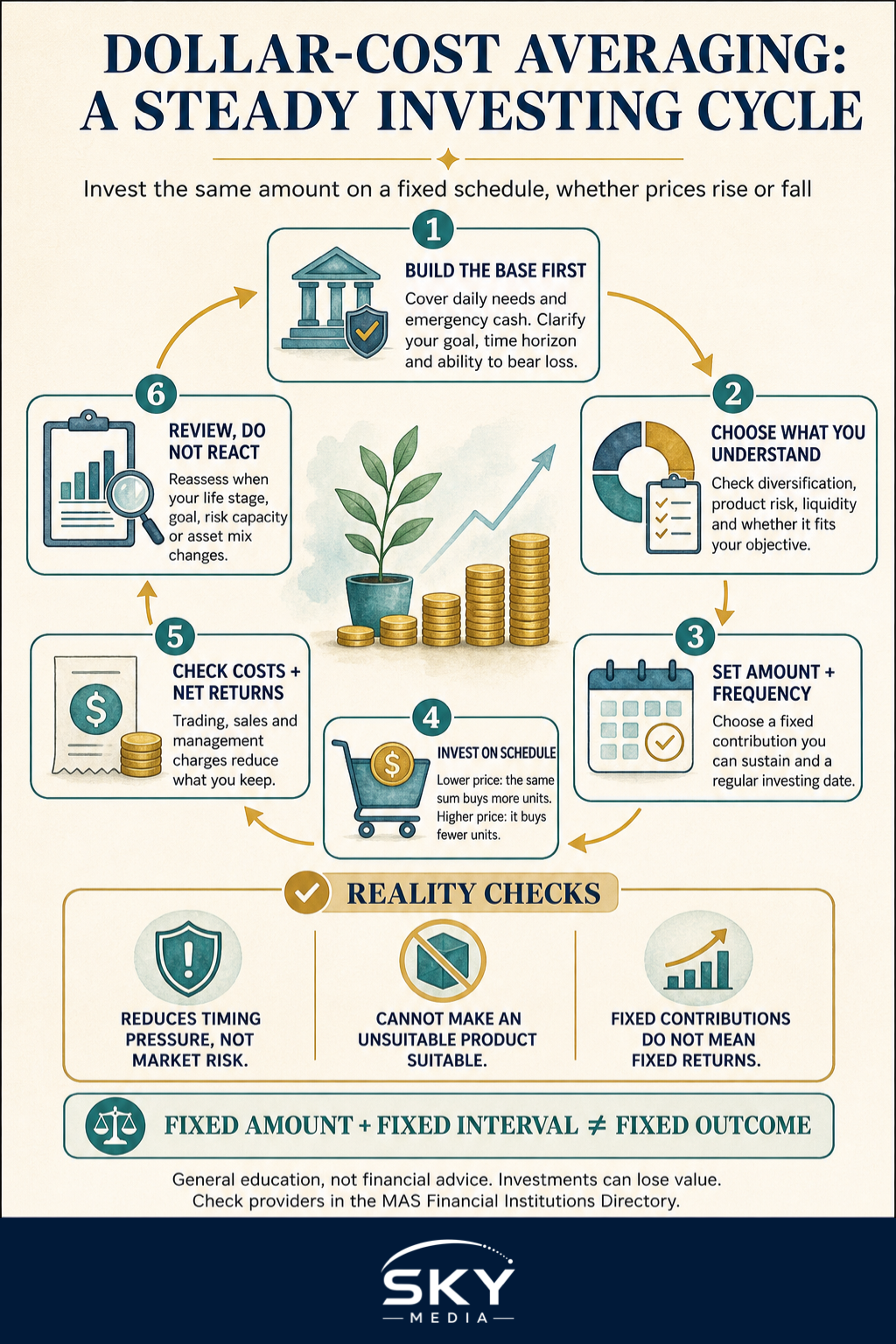
What dollar-cost averaging is
Dollar-cost averaging, often shortened to DCA, means investing a fixed amount of money at regular intervals, regardless of whether prices are high or low. For example, you might invest the same sum every month into a chosen fund or ETF. When prices are low, your fixed sum buys more units. When prices are high, it buys fewer. Over time, this averages out your purchase price and removes the pressure of picking the perfect moment.
The core appeal is discipline. You keep investing steadily through good times and bad, rather than freezing when markets wobble or piling in when everyone is euphoric.
Why it appeals to everyday investors
- It removes timing stress. You never have to guess whether today is a good day to buy.
- It builds a habit. Regular investing becomes automatic, like a bill you pay to your future self.
- It smooths out volatility. Buying at many different prices averages your cost.
- It suits regular income. Investing a slice of each paycheck fits naturally with how most people earn.
- It curbs emotion. By committing to a schedule, you avoid panic selling and greedy buying.
For someone building wealth gradually from a salary, DCA maps neatly onto real life.
The honest trade-offs
DCA is not magic, and it helps to understand its limits.
| Consideration | What to know |
|---|---|
| Lump sum can win in rising markets | If markets mostly rise, investing everything early may beat spreading it out |
| It does not remove risk | You are still invested, and values can fall |
| Requires consistency | The benefit comes from sticking with it through downturns |
| Small fees can add up | Frequent small purchases can incur trading costs, so check them |
The point is not that DCA always beats investing a lump sum, but that it reduces the risk of putting all your money in at an unlucky peak, and it keeps you invested when nerves might otherwise stop you.
How to start in Singapore
- Choose what to invest in. Many DCA investors use a broad, diversified ETF or fund rather than individual stocks.
- Decide your amount and frequency. A fixed monthly sum you can sustain is a common approach.
- Automate it. Regular savings plans, sometimes offered by brokers and platforms, can invest a set amount automatically each month, which removes the temptation to skip.
- Watch the costs. Make sure trading fees on each small purchase do not eat too much of your investment.
- Keep going. The strategy only works if you continue through downturns, which is precisely when it does its best work.
Staying the course
The greatest enemy of dollar-cost averaging is the urge to stop when markets fall. Yet a downturn is exactly when your fixed sum buys the most units, setting you up for the eventual recovery. Investors who pause during scary periods often miss the very purchases that would have helped them most. Automating your contributions helps, because it takes the monthly decision, and the emotion, out of your hands.
A calm way to build wealth
Dollar-cost averaging will not make you rich overnight, and it does not promise to beat every other approach. What it offers is something arguably more valuable for most people: a simple, low-stress, repeatable way to keep investing through all kinds of markets without needing a crystal ball. Pick a sensible investment, commit to a regular amount you can maintain, automate it, and let the years do the heavy lifting. For the majority of everyday investors, that steady rhythm is the difference between intending to invest and actually building wealth.
Common mistakes to avoid
Dollar-cost averaging is simple in theory, but a few habits can quietly undermine it. Being aware of them from the start helps you get the full benefit of the strategy.
- Setting the amount too high. An ambitious monthly sum feels good in a calm month, but if it strains your budget you will be tempted to stop the plan just when markets dip. Pick a figure you can comfortably sustain even in a lean month, and raise it later as your income grows.
- Chasing a single hot stock. DCA smooths your entry price, but it cannot fix a poor choice of investment. Feeding a fixed sum into one volatile counter still leaves you exposed to that single company. A broad, diversified fund or ETF spreads the risk far better.
- Ignoring the running costs. A flat trading fee that looks tiny against a large trade can be a big slice of a small monthly purchase. Compare platforms, and consider a regular savings plan built for small recurring amounts if your broker charges a minimum fee per trade.
- Stopping at the worst moment. Pausing contributions during a downturn cancels out the very purchases that make DCA work. If you feel that urge, it is usually a sign your monthly amount was too aggressive rather than a reason to quit.
- Never reviewing the plan. Automating your investing is sensible, but do glance at it once or twice a year to check the fund still suits your goals and the fees remain reasonable.
Where DCA fits alongside CPF and SRS
Dollar-cost averaging is a method, not a separate account, so it can sit inside the savings structures many Singaporeans already use. Your CPF contributions are themselves a form of steady, automatic saving from each paycheck, and some members choose to invest a portion of their CPF Ordinary Account through the CPF Investment Scheme in eligible products, often on a regular basis that resembles DCA. The rules, eligible instruments and any limits change over time, so check the current details with the CPF Board before committing.
The Supplementary Retirement Scheme (SRS) is another natural fit. Because SRS contributions may qualify for tax relief and the money is meant to stay invested for the long term, spreading your contributions and investments across the year through DCA can pair the tax planning with disciplined investing. Contribution caps, withdrawal conditions and tax treatment are set by the authorities, so confirm the latest position with IRAS and your SRS operator. Used this way, DCA becomes less a standalone tactic and more a rhythm that runs quietly through your wider financial plan.
Explore more: ETF investing for beginners · Investing basics in Singapore · Robo-advisors in Singapore