
If you have been wondering how to start investing in Singapore but the jargon keeps putting you off, this guide is for you. Whether you grew up here or arrived last month, the good news is that the building blocks of investing Singapore residents use are the same, and none of them require you to be rich or clever with numbers. This is a plain-English overview of the landscape: what to sort out first, the accounts and instruments you will hear about, and how to begin responsibly.
One thing before we go further: everything here is general education, not financial advice. Nothing below is a recommendation to buy any particular product or platform, and no one can promise you returns. For guidance on your own situation, speak to a MAS-licensed financial adviser and do your own research.
First things first: build your foundation
Investing is the step that comes after your finances are stable, not before. Rushing money into the market while you are one surprise away from a cash crunch is how people end up selling at the worst possible time.
Two things belong ahead of your first investment:
- An emergency fund. A common rule of thumb is three to six months of essential expenses kept in an easy-access savings account. This is your buffer for job changes, medical bills, or a broken appliance, and it means you never have to sell investments in a panic.
- High-interest debt cleared. If you are carrying credit card or personal loan balances, the interest usually costs far more than any realistic investment return. Paying those down is often the best “return” you can get.
Investing is a long game. The single biggest advantage most people have is time, so the point is to start steadily, not to time the market perfectly.
Once your buffer is in place and expensive debt is handled, you are ready to think about where money you will not need for several years can grow.
The accounts you will hear about
To invest, you generally need somewhere to hold your money and buy through. In Singapore, a few options come up again and again.
Brokerage accounts
A brokerage account lets you buy and sell listed investments yourself, such as shares and exchange-traded funds. To trade shares on the local exchange, you will also hear about a Central Depository (CDP) account, which holds Singapore securities in your own name, though many brokers also offer custodian accounts where the broker holds them for you. Fees, features, and minimums vary widely between brokers, so it is worth comparing.
Robo-advisors
A robo advisor is a service that builds and manages a diversified portfolio for you, usually low-cost index funds, based on your goals and comfort with risk. You answer a few questions, set up a regular transfer, and the platform handles the buying, rebalancing, and reinvesting. For people who want a hands-off start, a robo advisor removes a lot of the decision fatigue, though you still pay an annual management fee on top of the underlying fund costs.
CPF Investment concept
Many residents also hear about investing part of their CPF savings through the CPF Investment Scheme. In simple terms, this lets you use some of your CPF Ordinary or Special Account money to buy approved investments instead of leaving it to earn the standard CPF interest. It is not right for everyone, and the rules and eligible products are specific, so confirm the details with the CPF Board before considering it.
Common instruments, explained simply
Here are the building blocks most beginners come across, in plain terms.
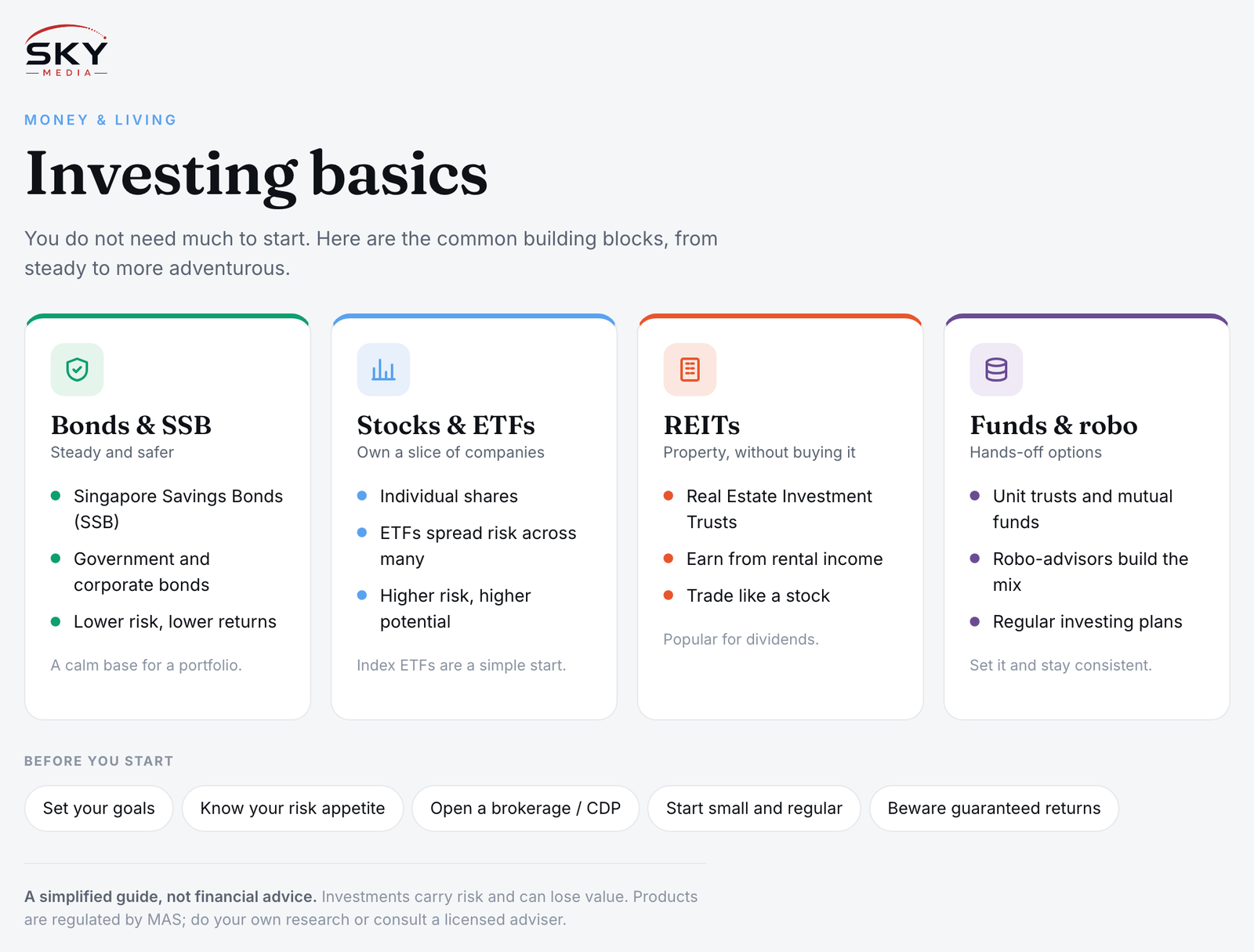
- ETFs (exchange-traded funds). An ETF holds a basket of many investments and trades like a single share. A broad market ETF gives you instant diversification across many companies in one purchase, which is why it is a popular starting point for hands-off investors.
- SGX stocks. Buying SGX stocks means owning shares in individual companies listed on the Singapore Exchange. This offers more control but also more risk, because your fortunes ride on those specific companies rather than a broad basket.
- Singapore Savings Bonds and T-bills. SSB and Treasury bills are issued by the government and are considered very low risk. An SSB lets you save with flexible terms and step-up interest, while T-bills are short-term instruments. Both suit money you want to keep safe rather than grow aggressively. Check the official issuance details before you buy.
- Unit trusts. These are professionally managed funds that pool investors’ money. They can be convenient but often carry higher fees than ETFs, so read the fee schedule closely.
Matching instruments to time and goals
A rough way to think about it: money you may need soon leans towards safer options like SSB, while money you can leave untouched for many years can take on more growth-oriented assets like a broad ETF. Your own mix depends entirely on your goals and risk tolerance, which is exactly the kind of thing a licensed adviser can help you weigh.
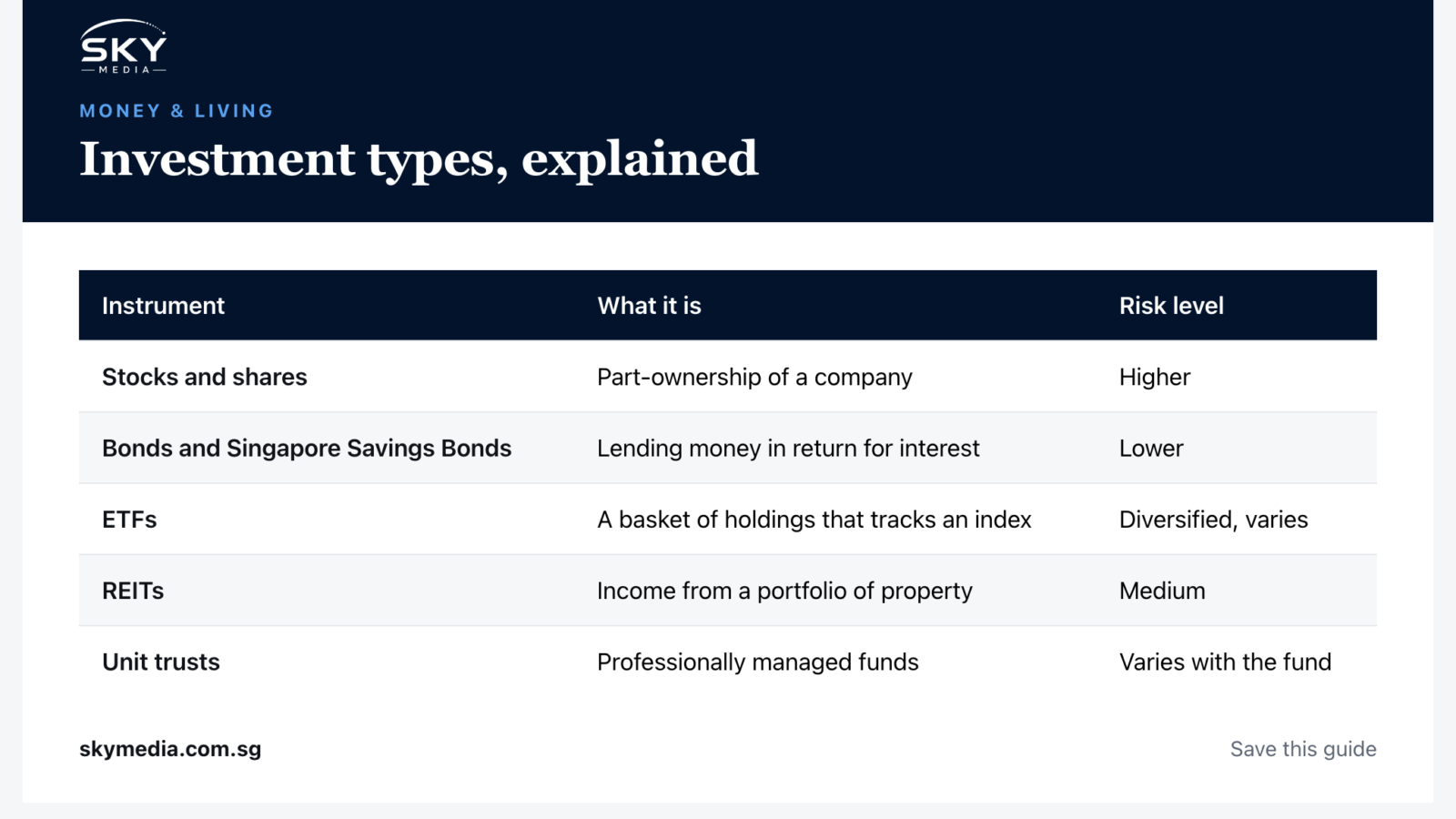
Here is a plain-English guide to the common instruments:
| Instrument | What it is | Risk level |
|---|---|---|
| Stocks and shares | Part-ownership of a company | Higher |
| Bonds and Singapore Savings Bonds | Lending money in return for interest | Lower |
| ETFs | A basket of holdings that tracks an index | Diversified, varies |
| REITs | Income from a portfolio of property | Medium |
| Unit trusts | Professionally managed funds | Varies with the fund |
Risk, diversification, and fees
Three ideas do most of the heavy lifting in sensible investing Singapore beginners can rely on.
Risk and reward travel together. Higher potential returns come with bigger swings in value and a real chance of loss. There is no safe route to high returns, and anything promising one deserves deep suspicion.
Diversification softens the blows. Spreading money across many companies, sectors, and even regions means one bad performer does not sink you. This is the core appeal of a broad ETF or a robo advisor portfolio: diversification is built in.
Fees quietly eat returns. Trading commissions, fund expense ratios, platform fees, and currency conversion costs all chip away at your results over time. A small yearly percentage sounds harmless, but compounded over decades it matters a great deal. Always know what you are paying.
Getting started responsibly
You do not need a big sum or perfect knowledge to begin. You need a plan and steady habits.
- Confirm your foundation. Emergency fund in place, high-interest debt cleared.
- Set a clear goal and timeline. Knowing why you are investing and for how long shapes every other choice.
- Start small and regular. Investing a fixed amount on a schedule, sometimes called dollar-cost averaging, smooths out the ups and downs and builds the habit.
- Keep it simple at first. Many beginners start with a broadly diversified, low-cost option before exploring anything more complex.
- Understand before you buy. If you cannot explain how a product works and how it makes money, that is a sign to keep learning first.
Quick tips checklist
- Never invest money you might need in the short term.
- Read the fee schedule before opening any account or buying any product.
- Be wary of anything promising guaranteed or unusually high returns.
- Check that any platform or adviser is regulated by MAS.
- Review your plan yearly, and avoid reacting to short-term market noise.
The bottom line
Learning how to start investing in Singapore is less about picking winners and more about laying a stable foundation, understanding a few honest building blocks, keeping costs low, and staying consistent over many years. Start with your emergency fund, get comfortable with the basics above, and treat your first steps as a long journey rather than a sprint. When you are ready to make decisions specific to your circumstances, do your own research and consult a MAS-licensed adviser.
Explore more: Budgeting in Singapore and CPF explained