
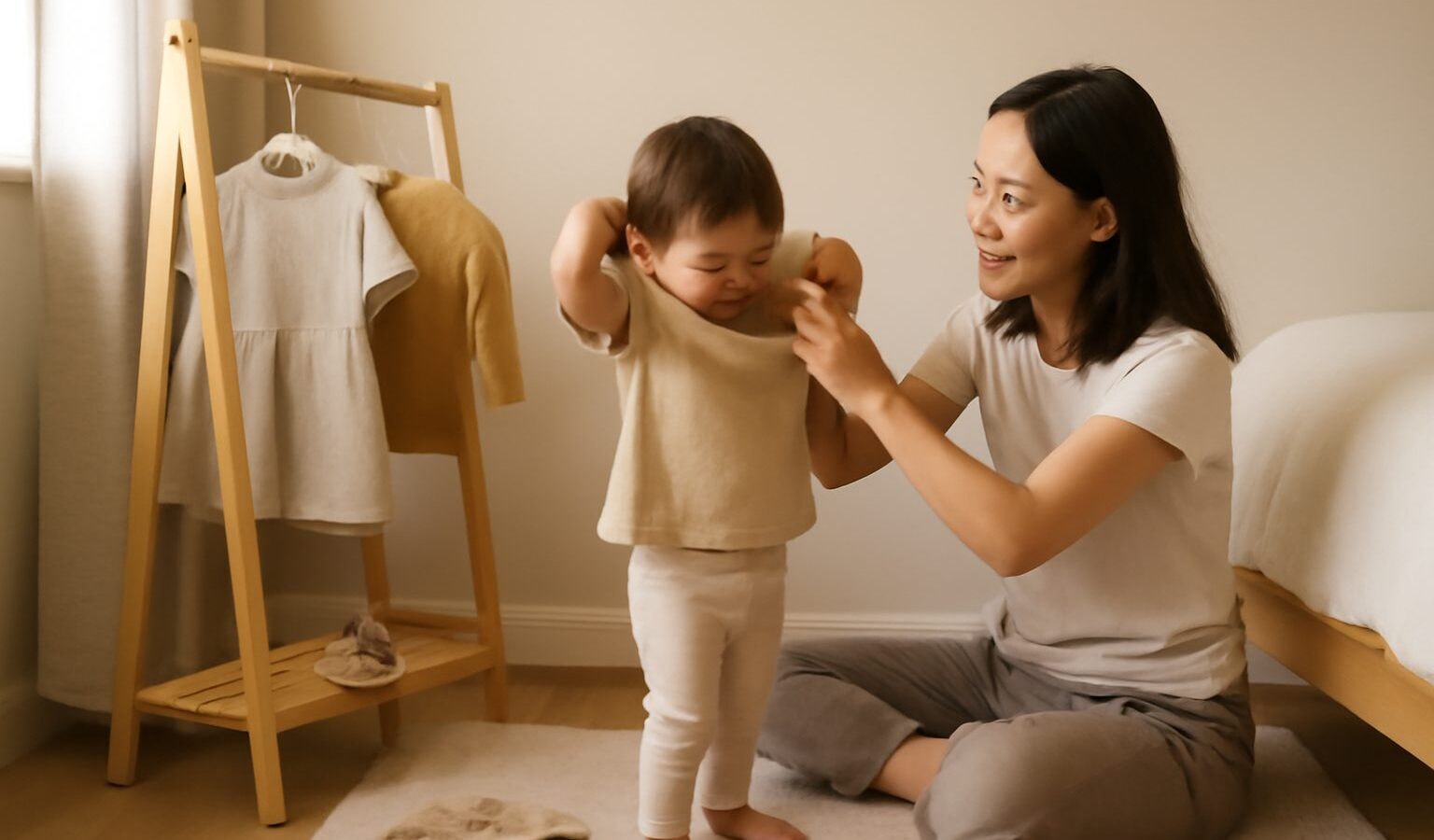
There is a special kind of morning chaos that only a toddler can create, usually while you are already late and holding a shoe. Getting dressed becomes a standoff, and it is tempting to just do it all yourself to save time. Yet learning to dress is one of the earliest, most satisfying ways a small child builds real skills. If you are keen to encourage toddler independence singapore parents can start right here, at the wardrobe, with a few easy clothes and a lot of patience. This guide shares gentle, practical steps to help your toddler dress themselves, without turning every morning into a battle.
Every child develops at their own pace, so treat this as general guidance rather than a fixed timetable. If you have concerns about your child’s movement, coordination, or development, do speak to your doctor, a paediatrician, or the team at KKH or a polyclinic.
Why Learning to Dress Matters More Than You Think
Pulling on a shirt looks simple, but for a toddler it is a rich little workout. Getting dressed builds fine motor skills through buttons and zips, gross motor skills through balancing on one leg, and problem-solving as they work out which hole the head goes through. It also grows confidence. Every time a child manages something on their own, they learn that they are capable, and that feeling spills over into other parts of their day.
Dressing is also a wonderfully low-stakes place to practise independence. Nothing terrible happens if the shirt goes on back to front or the socks do not match. That freedom to try, fail, and try again is exactly what young children need. Your calm, unhurried support matters far more than a perfectly turned-out child. In our warm climate you can also keep outfits light and simple, which happens to make them easier for small hands to manage too.
Setting Up for Small Wins
Toddlers rise to a challenge when the odds are stacked kindly in their favour. A little preparation removes most of the friction before it starts, so the moment feels like a success rather than a struggle. Start with clothing and a setup that work with your child’s ability, not against it.
Ways to make dressing easier from the start:
- Choose loose, stretchy clothes with wide necks, elastic waists, and few fiddly fastenings.
- Skip tight jeans, small buttons, and stiff fabrics while they are still learning.
- Lay clothes out the right way up so they can see how the pieces go on.
- Offer shoes with chunky hook-and-loop straps instead of laces.
- Keep a low drawer or basket of clothes your toddler can reach themselves.
- Dress in a warm, unhurried spot, sitting on the floor or a low stool for balance.
Timing helps as much as clothing. Trying to teach self-dressing when you are rushing out the door for childcare rarely ends well. Practise on unhurried mornings, lazy weekends, or even as a game after a bath, when there is no clock ticking and everyone is relaxed.
A Gentle Order for Building Skills
Children usually learn to take clothes off before they can put them on, and manage loose, simple items long before tricky ones. Knowing the rough order helps you pitch each step at the right level, so your toddler feels stretched but not defeated. The table below offers a loose guide, but follow your own child rather than the ages.
| Stage | What they can often manage | How you can help |
|---|---|---|
| Getting started | Pulling off socks, hat, and loose shoes | Cheer the effort, let them undress at bath time |
| Building up | Pushing arms and legs into clothes you hold | Hold the opening, guide their limbs, praise trying |
| Gaining skill | Pulling up trousers and elastic shorts | Start it, let them finish the last stretch |
| Getting confident | Putting on a wide-neck shirt, simple shoes | Step back, offer words instead of hands |
| Fine-tuning | Attempting large buttons, zips, and straps | Break it into steps, practise on toys and books |
A handy technique is backward chaining: you do most of a task and let your child complete the very last, easiest part, such as pulling a sock over the heel you have already started. As they master that, you hand over a little more. Finishing the job themselves gives them the win, and the motivation to keep going.
Handling the Hard Mornings Without a Meltdown
Even with the best setup, some mornings will simply be hard. Your toddler wants to do it alone, cannot quite manage it, and refuses your help all at once. This push and pull is completely normal and is a sign of a healthy, developing will, even when it tests your patience to the limit. Staying calm is not always easy, but it is what helps the storm pass fastest.
Practical ways to keep the peace:
- Build in extra time so you are not fighting the clock, which lowers everyone’s stress.
- Offer a small, safe choice, such as the red shirt or the blue one, to satisfy the urge for control.
- Break dressing into tiny steps and let them own just one at first.
- Use warmth and playfulness, turning a stubborn sock into a silly game.
- Resist correcting a back-to-front top; wearing it their way rarely matters.
- If a real meltdown hits, pause, get down to their level, and reconnect before trying again.
On days when there is genuinely no time, it is perfectly fine to help fully and simply say, “You have a go tomorrow.” One rushed morning will not undo their learning. In many local homes a helper or grandparents share the caregiving, so it helps if everyone agrees to let the child try rather than always stepping in to speed things up. Consistency across the adults makes independence stick.
Celebrating Effort and Knowing When to Ask for Help
Progress here is rarely a straight line. Your toddler may dress themselves brilliantly one week and demand to be carried and clothed the next, especially when they are tired, unwell, or going through a big change. Praise the effort rather than the result, notice the small wins out loud, and try not to compare your child to the neighbour’s. Confidence grows in an atmosphere of encouragement, not pressure or shame.
That said, trust your instincts if something feels off. If your toddler seems to struggle a lot with grasping, balancing, or coordinating both hands well beyond their peers, or if you have any wider worry about their physical or developmental progress, it is worth mentioning to your doctor, a paediatrician, or the team at KKH, NUH, or a polyclinic. Getting a professional view early is simply good parenting, and often brings reassurance. Most of all, remember that these fumbling, wonky, insisted-upon attempts are your child growing up right in front of you.
Explore More
Learning to dress is one thread in the bigger tapestry of a growing, capable toddler. To weave it into a calmer day, see how to build a toddler daily routine that leaves room for practice. When the urge for independence tips into big feelings, our guide to managing toddler meltdowns in public can help, and for another gentle lesson in sharing and taking turns, read teaching toddlers to share.