
Dunhuang is a legendary oasis town on the old Silk Road, where camel caravans once rested between the deserts of northwest China. Today it draws travellers for the astonishing Mogao Caves, the towering Singing Sand Dunes and the crescent shaped Yueyaquan lake. For a Singapore traveller craving big desert landscapes and deep history, planning dunhuang from singapore is an adventure worth the extra distance. Here is how to approach it honestly.
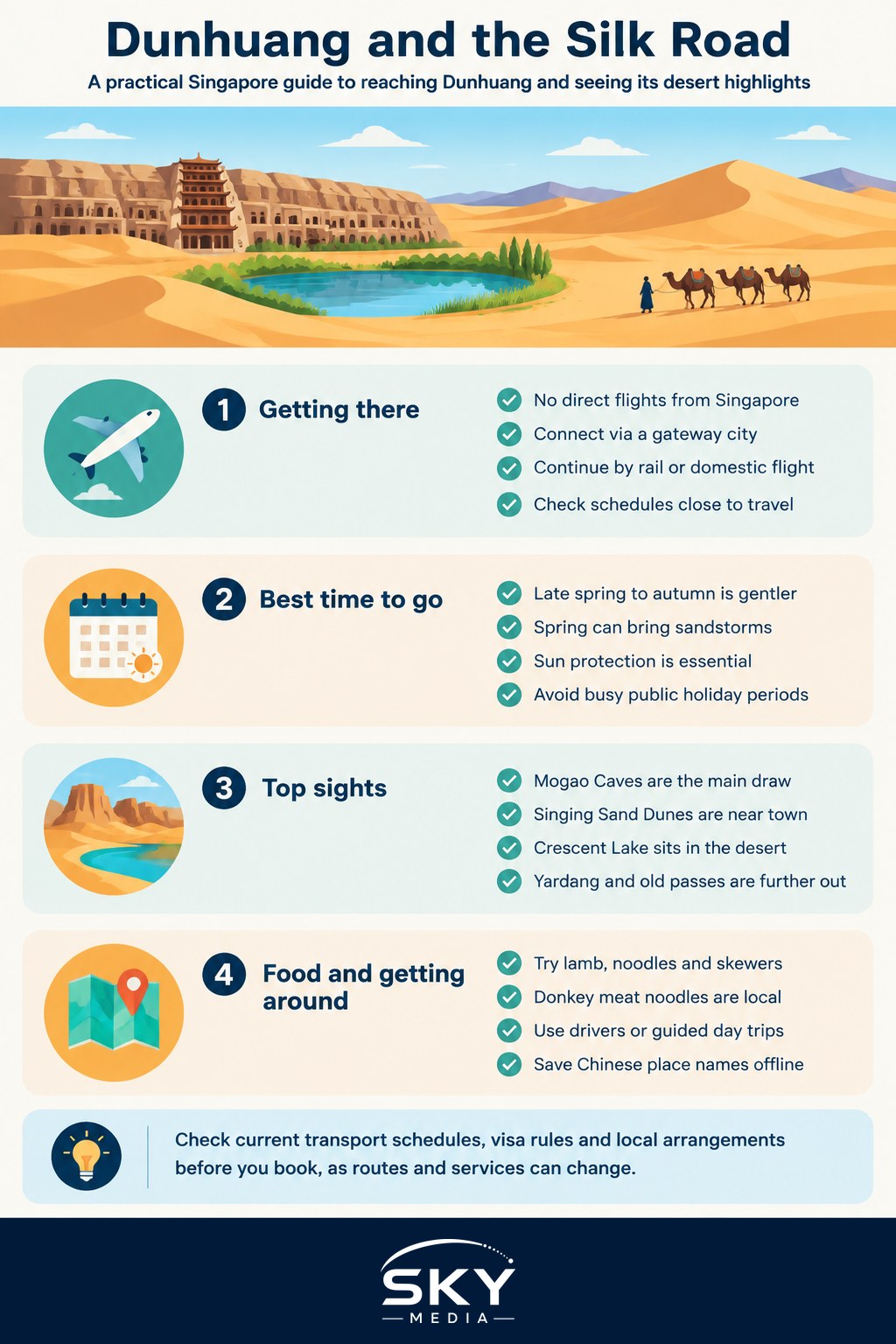
Getting There From Singapore
There are no direct flights from Singapore to Dunhuang. It lies deep in Gansu province in China’s far northwest, so every route involves connecting through a gateway city and then continuing by rail or domestic flight.
The classic Silk Road gateway is Xian, the eastern end of the ancient trade route and a superb destination in its own right. Fly into Xian from Singapore via a connecting hub, then travel northwest toward Dunhuang. From Xian you can continue by China’s rail network, which threads through the Hexi Corridor and Silk Road towns, or take a domestic flight to shorten the long distance. Many travellers string together several Silk Road stops on the way rather than going straight through.
Dunhuang has its own small airport with seasonal and domestic connections, and there is a railway station in the area, so the final leg is usually a domestic flight or a train from a larger hub. Because rail timings, flight routes and seasonal services change often, check current schedules close to your dates rather than trusting fixed durations. Do not assume a single fixed journey time.
For entry, China’s visa and transit rules change from time to time. Confirm the latest requirements for a Singapore passport with the Chinese embassy before booking, and check ICA guidance for your Singapore departure and return.
Best Time To Visit
Dunhuang has an extreme desert climate, worlds away from Singapore’s humidity. Days can be scorching in high summer and nights cool sharply, while winters are bitterly cold and windy. The most comfortable window is generally late spring through autumn, with the shoulder months offering pleasant days without the fiercest heat. Sandstorms are possible in spring. Whatever the season, the desert sun is intense, so sun protection is essential.
Chinese public holidays bring big domestic crowds to the caves and dunes. Travelling just outside these peaks makes a real difference.
Highlights
The Mogao Caves, also called the Thousand Buddha Grottoes, are the crown jewel. This UNESCO World Heritage site holds hundreds of caves filled with exquisite Buddhist murals and sculptures spanning many centuries. Visits are managed to protect the fragile art, so book ahead and follow the rules, including limits on photography.
Just outside town, the Singing Sand Dunes rise dramatically, and nestled among them is Crescent Lake, a spring that has survived in the desert for centuries. You can climb the dunes for sunset views. Any desert excursion carries real risks, so use licensed guides and reputable operators, carry plenty of water, and never wander off alone into the sands. Further afield lie the eroded rock formations of the Yardang landforms and the ancient Silk Road passes of Yumenguan and Yangguan.
Food
Dunhuang’s food reflects its frontier location, with plenty of lamb, hand pulled noodles, cumin spiced skewers and hearty flatbreads. Donkey meat noodles are a local speciality you will see advertised. Night markets are lively and a fun place to sample skewers and local snacks. As always when travelling, favour freshly cooked hot food and sealed or boiled drinks, and go easy on unfamiliar street items if your stomach is sensitive.
Getting Around
The town itself is small and walkable, but the desert sights and Silk Road ruins are spread out. Arrange a driver, tour or reputable operator to reach the caves, dunes and outlying passes. Distances between the far flung ruins are large, so a guided day trip is often the safest and simplest option. English is limited, so save destinations in Chinese characters and keep an offline translation app.
A Simple Itinerary Idea
Two to three days works well. On day one, visit the Mogao Caves in the morning and the Singing Sand Dunes and Crescent Lake for sunset. On day two, take a guided day trip to the Yardang landforms and the ancient passes, returning by evening. Add a third day if you want to slow down or fit in the night market and local museums. Dunhuang also pairs naturally with a longer Silk Road journey linking several Gansu towns.
Practical Tips
Carry water everywhere and never underestimate the desert heat and dryness. Bring layers for cold nights and strong sun protection for the day. Expect mobile payment to dominate, and check in advance how a foreign visitor can pay. Arrange solid cover with our travel insurance explained for Singapore travellers guide, and for fares see finding cheap flights from Singapore. For vaccinations and health advice, defer to a travel clinic rather than online rumour.
Dunhuang is remote, but its desert horizons and ancient art make the long journey feel like a genuine pilgrimage into the Silk Road past.
Frequently Asked Questions
How many days do I need for Dunhuang on top of the travel time? Two to three days on the ground works well, as the article’s plan shows. That covers the Mogao Caves, the dunes and lake, and a guided trip to the outer landforms and passes. Add the long journey in and out, and consider extra days if you want a slower pace.
Do I need to book the Mogao Caves in advance? Yes, plan to book ahead. Visits are managed to protect the fragile murals, so access is controlled and there are rules, including limits on photography. Check the official booking channels for current arrangements, because they can change with the season.
Is it safe to climb the Singing Sand Dunes on my own? Short climbs at the main dune area for sunset are common, but wandering into the sands alone is risky. Use licensed guides or reputable operators, carry plenty of water and tell someone your plans. Heat, dryness and shifting sand are easy to underestimate.
What is the weather like in Dunhuang compared with Singapore? Dunhuang is an extreme desert climate, very dry with strong sun, hot summer days and sharp drops at night. Winters are bitterly cold and windy, and spring can bring sandstorms. Bring layers, sun protection and a lot of water, whichever season you pick.
Can I combine Dunhuang with other Silk Road stops after flying from Singapore? Yes, many travellers link several Silk Road stops rather than going straight through. Xian is the classic starting point, and rail or domestic flights connect the towns along the Hexi Corridor. Check current timetables, since seasonal services and routes change often.
Further reading: Samarkand and Uzbekistan from Singapore