

Xian is where China’s imperial story begins. As the ancient capital of several dynasties and the eastern anchor of the Silk Road, this city gave the world the Terracotta Army and still wears its history in towering walls, drum towers and old quarters. For Singaporeans who want culture, deep history and some of the best street food in China, planning a trip to Xian from Singapore is a rewarding change from the region’s usual beach and shopping getaways. This guide covers getting there, when to go, the top sights and how to eat well, including halal-friendly options.
Getting to Xian From Singapore
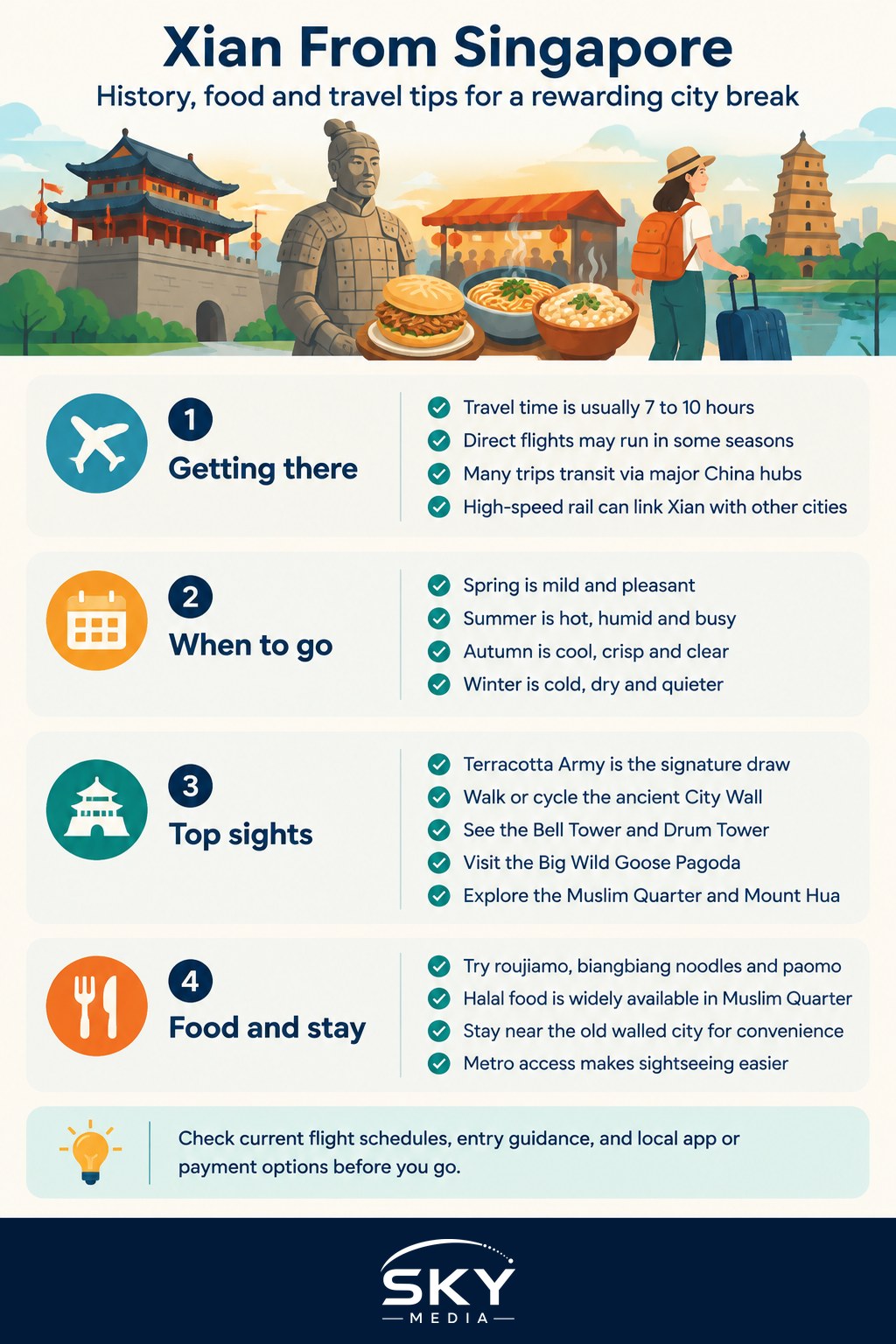
Xian sits in central China, so plan for a longer travel day than a short regional flight. Total travel time typically falls somewhere in the region of seven to ten hours depending on the routing. Some seasons offer direct services between Changi and Xian’s Xianyang International Airport, but many itineraries transit through a hub such as Guangzhou, Shenzhen, Shanghai, Beijing or Chengdu. Direct flights fluctuate with demand, so compare current schedules and fares before you book.
Xian is also a major stop on China’s high-speed rail network, which makes it easy to combine with other cities. Some travellers fly into a bigger gateway and take the fast train onward, or stitch Xian into a multi-city rail loop. Whichever way you arrive, leave a sensible buffer for any transit stop, especially if you need to clear immigration and recheck bags.
For entry requirements, check the latest official guidance rather than relying on old tips. China has revised its rules for Singapore passport holders in recent years, so confirm your specific situation with the Chinese embassy or consulate and cross-check ICA before locking in your dates.
Best Time to Visit
Xian has a temperate, continental climate with four distinct seasons, quite unlike Singapore’s steady warmth, so timing makes a real difference to comfort.
| Season | Months | What to expect |
|---|---|---|
| Spring | Mar to May | Mild and pleasant with blossoms; a comfortable window for sightseeing |
| Summer | Jun to Aug | Hot and sometimes humid, with peak domestic crowds |
| Autumn | Sep to Nov | Cool, crisp and clear; widely regarded as the best all-round season |
| Winter | Dec to Feb | Cold and dry, occasionally snowy, with thinner crowds |
Spring and autumn are the standout choices, offering mild days ideal for walking the walls and exploring outdoor sites. Summer can be sweltering and busy, so start sightseeing early. Winter is cold by Singaporean standards but has a quiet, atmospheric charm, and packing warm layers makes it perfectly doable. Air quality can dip in colder months, so sensitive travellers may want to check conditions.
Top Things to See and Do
The Terracotta Army is the reason most people come, and it lives up to the hype. Located on the city’s outskirts, the site holds thousands of life-sized clay soldiers, horses and chariots buried to guard an emperor’s tomb, each figure with a distinct face. It is a half-day trip and one of the great archaeological wonders anywhere in the world.
Back in the city, the history keeps coming:
- Walk or cycle the top of the massive, fully intact ancient City Wall, one of the best-preserved in China, for sweeping views over the old town.
- See the Bell Tower and Drum Tower at the heart of the walled city, beautifully lit after dark.
- Visit the Big Wild Goose Pagoda, a serene Buddhist landmark with fountains and gardens nearby.
- Wander the lively Muslim Quarter, a warren of lanes packed with food stalls, mosques and shopping.
- Consider a day trip to Mount Hua, one of China’s sacred peaks, known for its dramatic and challenging trails.
Where to Stay
The most convenient base is inside or right beside the old walled city, close to the Bell Tower, the Muslim Quarter and the metro. This central area puts sights and street food within easy reach and suits first-time visitors and families. The district around the Big Wild Goose Pagoda to the south is more modern and spacious, with parks and larger hotels, and it is handy if you prefer a quieter, newer neighbourhood.
You will find everything from budget hostels in the old lanes to comfortable business hotels near the main squares, so choose by how close you want to be to the action. Staying near a metro station makes reaching the train stations and attractions much easier.
Food and Dining
Xian is a street-food paradise, and its Silk Road past shows on every plate. Signature dishes include roujiamo, often called a Chinese burger, with chopped stewed meat in a flatbread; biangbiang noodles, wide hand-pulled ribbons; and yangrou paomo, a hearty lamb soup poured over torn bread. Cumin, lamb and hand-pulled noodles reflect the flavours of the northwest.
Xian is unusually welcoming for halal travellers thanks to its large Muslim Hui community, centred on the historic Muslim Quarter. Many stalls and restaurants there serve halal, or qing zhen, food, from lamb skewers to noodle soups, and the area is anchored by the beautiful Great Mosque. Still, always look for the qing zhen label and confirm with the vendor, as not every stall in the quarter is certified. Vegetarians will also find plenty, from vegetable dumplings and cold noodle dishes to temple fare, though it helps to check that soups and sauces are meat-free before ordering.
Getting Around
Xian has a growing, easy-to-use metro that links the main sights, train stations and airport connections, and it is the simplest way to move around the city. For the Terracotta Army and other out-of-town sights, organised day tours, public buses or a booked car all work; a guided tour can add helpful context at the archaeological sites.
As across China, daily payment leans heavily on mobile apps, so set that up before you arrive and keep some cash as backup. English is limited, so save destinations in Chinese on an offline map and use translation apps to smooth things along.
Practical Tips
- Currency: the renminbi (yuan). Arrange mobile payment where possible and carry some cash.
- Language: Mandarin with local dialect; English is limited, so translation and offline map apps are very useful.
- Connectivity: many familiar apps and sites are restricted in China, so research a reliable data or VPN option before flying.
- Budget: Xian is generally affordable, with cheap, memorable street food and good-value metro fares, though major sites charge admission.
- Safety: Xian is broadly considered safe for tourists; take normal big-city precautions in crowded areas and check the latest MFA travel advisory before you go.
- Health: for any vaccinations or precautions, see a doctor or travel clinic before departure; this is general information, not medical advice.
Xian rewards the curious with layers of history you can walk through and a food scene that alone justifies the trip. For Singaporeans wanting substance and story, it is one of China’s most satisfying city breaks.
Explore more
Xian slots neatly into a bigger China trip, so pair it with the capital via our Beijing from Singapore guide, or add pandas and spice with Chengdu from Singapore. For scenery to balance the history, see our Guilin from Singapore guide. Any of these works well alongside Xian.
Frequently Asked Questions
How long should I spend at the Terracotta Army site? Treat it as a half-day trip, since it is on the city’s outskirts and each figure has a distinct face worth lingering over. A guided tour can add helpful context at the archaeological site. Start early to avoid peak crowds.
Should I cycle or walk the Xian City Wall? Both work. The top of the wall is wide, intact, and one of the best preserved in China, with sweeping views over the old town. Cycling covers more ground and walking lets you linger. Check current hire details and opening hours before you go.
What should I try first in Xian’s Muslim Quarter? Start with roujiamo, a flatbread filled with chopped stewed meat, or yangrou paomo, a lamb soup poured over torn bread. Lamb skewers and biangbiang noodles are popular too. Look for the qing zhen label and confirm with the vendor, as not every stall is certified.
Is Mount Hua a safe day trip from Xian? It is known for dramatic and challenging trails, so it suits fit and prepared hikers. Check weather, trail conditions, and official safety guidance before you go, and wear proper shoes. Speak to a doctor if you have health concerns.
Does Xian’s air quality matter when planning a winter trip? Air quality can dip in colder months, so sensitive travellers may want to check conditions before and during the trip. Spring and autumn are widely regarded as the most comfortable seasons. Pack warm layers for winter.
Further reading: Dunhuang and the Silk Road From Singapore · Pingyao From Singapore · Luoyang From Singapore: A Travel Guide