

As competitive gaming has grown, so has the number of websites and apps inviting people to wager money on the outcome of matches. If you have seen these offers and wondered what they really involve, it is worth being clear from the start. Esports betting in Singapore is gambling, plain and simple. It carries real financial risk, it can become addictive, and it is not a way to make money. This guide explains what it is, why it is risky, what the law says, and where to turn if betting is causing harm. There are no tips, odds, or strategies here, because giving those would be irresponsible.
What esports betting is, and why it is risky
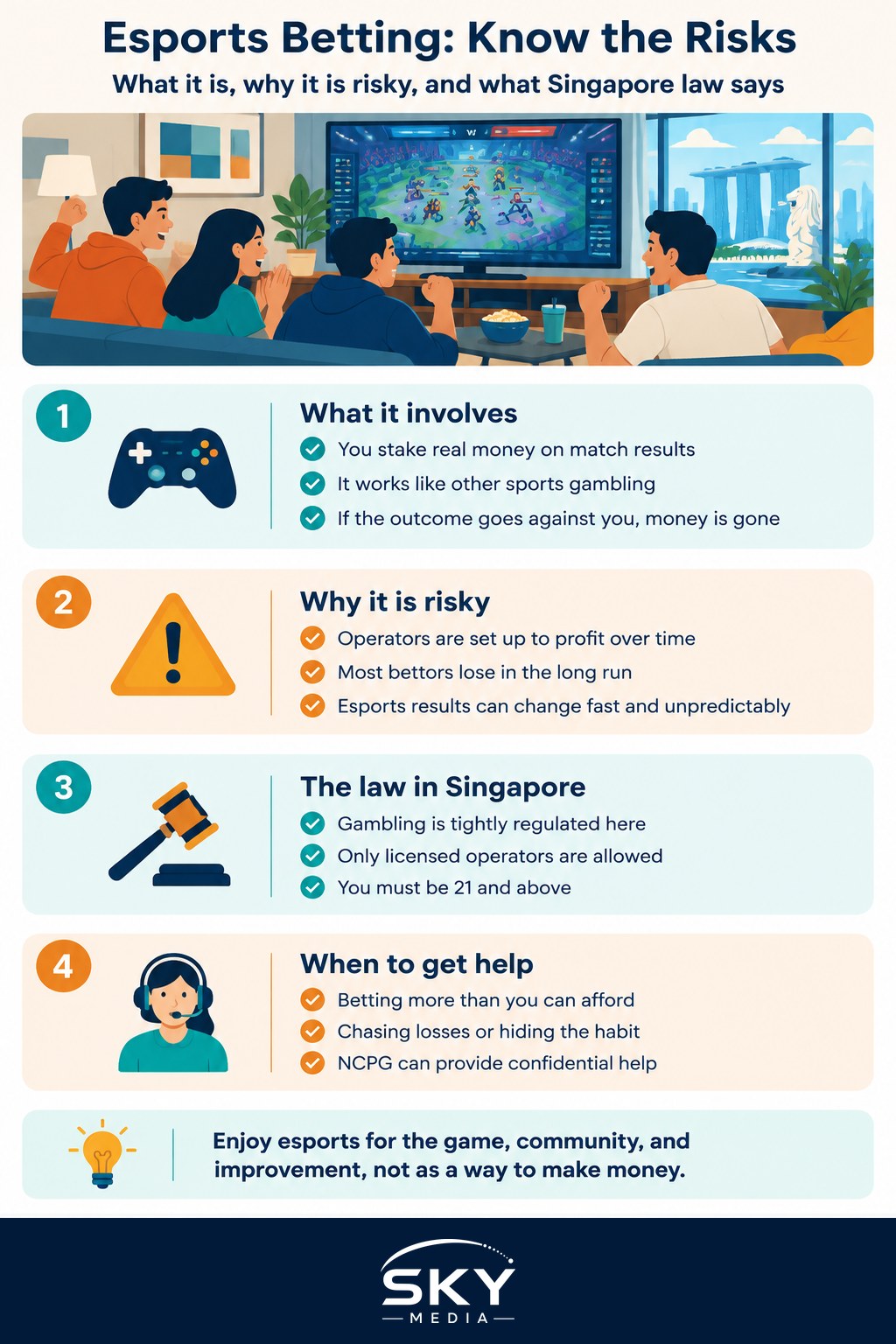
Esports betting means staking real money on the result of a competitive match or event, in the hope of winning more money back. It works like any other form of sports gambling. The site sets terms, you place a wager, and if the outcome does not go your way, your money is gone.
The single most important thing to understand is that the house is designed to profit over time. Betting operators are businesses, and the terms are always arranged so that, across all customers, they come out ahead. That means the typical bettor loses money in the long run. Any wins you see or hear about are the exception that gets talked about, not the everyday reality. Treating betting as income or a side hustle is a serious mistake.
Esports adds its own layer of unpredictability. Results can swing on a single teamfight, a patch that changes the game, a roster substitution, or a player having an off day. No amount of following the scene guarantees anything. Believing you can outsmart the outcome is exactly the kind of thinking that leads people to bet more than they intended.
Beyond the money itself, betting can be genuinely addictive. The rush of a potential win, the sting of a loss, and the urge to win it back can pull people into a cycle that is hard to break. That cycle can damage finances, relationships, studies, and mental health.
The law in Singapore, and unlicensed sites
Gambling in Singapore is tightly regulated. Betting is only legal when it is offered through operators licensed by the authorities, and you must be of legal age, which is 21 and above. Anything outside that framework is not permitted.
This matters because a large share of esports betting online is run by unlicensed or overseas sites that are not legal to use here. These carry extra dangers on top of the gambling itself. There is often no meaningful protection if the operator refuses to pay out, changes the terms, or simply disappears with your money. Your personal and payment details may be at risk. And using them can put you on the wrong side of the law.
A related trap is skin betting, where in-game cosmetic items are used as a form of currency to gamble on matches or games of chance. It is often marketed to younger players and made to feel casual or harmless, but it is still gambling, it is unregulated, and it is risky and not legal to engage in here. Treat any offer to wager skins or items with the same caution as cash gambling. Our guide on avoiding scams and in-game spending covers the wider dangers of unofficial money and item schemes.
Enjoy the scene without gambling
The good news is that you lose nothing by skipping betting entirely. The best parts of esports are free and open to everyone. You can follow your favourite teams, learn the games, watch big events, and join the local community without ever placing a wager.
If you love the competitive side, put that energy somewhere rewarding. Watching matches thoughtfully, as our guide on how to watch esports explains, deepens your appreciation for the skill on display. Learning how the local scene works through our overview of the esports scene in Singapore connects you with events and people. Even better, improving at a game yourself is far more satisfying, and far cheaper, than gambling on others.
If betting is causing harm
Gambling problems can affect anyone, and they are nothing to be ashamed of. Warning signs include betting more than you can afford, chasing losses, hiding it from family or friends, borrowing to keep going, or feeling anxious and unable to stop.
If any of this sounds like you or someone you care about, please reach out for support. In Singapore, the National Council on Problem Gambling offers help and runs a confidential helpline, and you can find its contact details and resources through official channels. Speaking to a trusted family member, friend, or a professional is a strong and sensible first step, not a weakness.
The practical takeaway
Esports betting is gambling with real financial risk, it tends to lose money over time, and it can be addictive. In Singapore it is legal only through licensed operators for those aged 21 and above, while unlicensed sites, overseas platforms, and skin betting are risky and not legal to use. It is not a path to income and never worth treating as one. Enjoy competitive gaming for the sport, the community, and your own improvement, and if betting is ever causing harm, reach out for help early.
Further reading: Is Esports Prize Money Taxable in Singapore?