

You placed in a local tournament, or your team took home a cash prize from a regional qualifier. Now comes the less exciting question: do you owe tax on it? The answer to the esports prize money tax question in Singapore depends largely on whether your gaming is a hobby or something closer to a job or business.
This guide explains the general principles the Inland Revenue Authority of Singapore (IRAS) uses to decide whether income is taxable, and how they may apply to casual players, semi-pros and full-time professionals. It is general information, not tax advice. Tax treatment depends on your specific facts, so check with IRAS or a qualified tax professional for your situation.
How Singapore Taxes Income in General
Singapore taxes income that is earned in or derived from Singapore, and certain income received here. Not every receipt of money counts as income, though. Singapore does not have a capital gains tax, and some windfalls are generally not treated as taxable income.
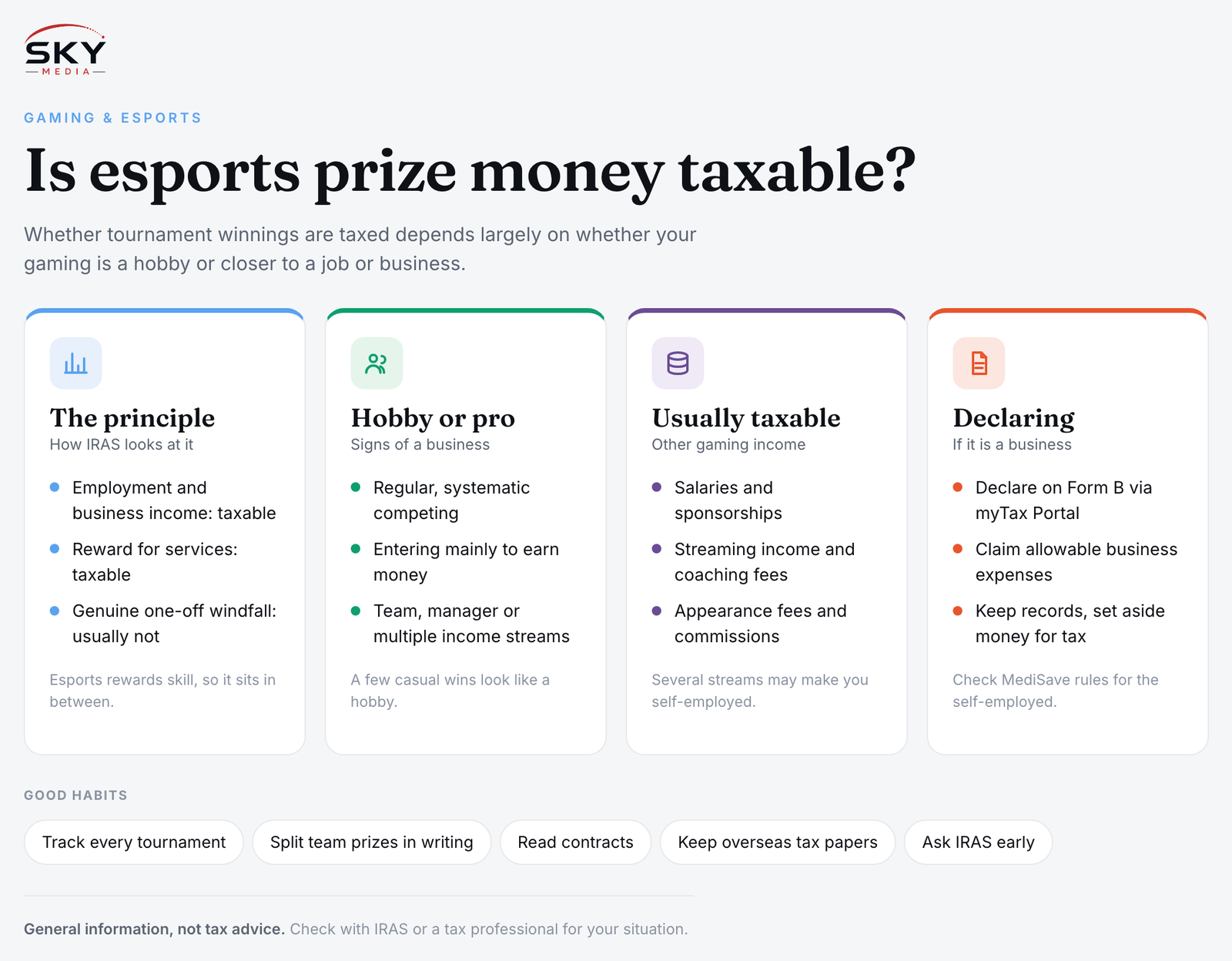
IRAS commonly looks at the nature of the payment. Broadly, money tends to be taxable when it:
- Comes from employment, such as a salary paid by an esports organisation.
- Comes from carrying on a trade, business, profession or vocation.
- Is a reward for services you provided.
Money tends not to be taxable when it is a genuine windfall, such as a one-off lucky draw prize, that is not connected to any trade, business or employment. That is why lottery wins are generally not taxed, a point covered in our guide to claiming Toto and 4D prizes.
Esports prize money sits somewhere in between, because tournaments reward skill and effort, not pure luck. So the key question becomes: are you competing as a hobby, or as part of a business or profession?
Hobbyist vs Professional: The Key Distinction
Tax authorities generally look at the overall picture rather than a single factor. Things that may point towards gaming being a business or vocation include:
- Regularity. You compete frequently and systematically, not occasionally.
- Intention to earn. You enter tournaments mainly to make money and treat winnings as a source of income.
- Organisation. You have a team structure, a manager, coaching, training schedules or a registered business.
- Multiple revenue streams. Prize money combines with sponsorships, salaries, streaming income, merchandise or appearance fees.
- Reliance on the income. Gaming income forms a meaningful part of how you support yourself.
On the other hand, a student who joins a few community tournaments a year for fun and occasionally wins a modest prize looks much more like a hobbyist.
| Situation | Likely treatment | What to do |
|---|---|---|
| Occasional casual tournament win, no other gaming income | Often treated as non-taxable | Keep records; ask IRAS if unsure |
| Regular competing with sponsorships and streaming income | Likely taxable as business or self-employed income | Declare in your annual tax return |
| Salaried player for an esports organisation | Salary taxable as employment income; prize shares may be too | Check your contract and Form IR8A |
| Gaming run through a registered company | Taxed at corporate level | Speak to an accountant |
These are general patterns, not rulings. If you are unsure which side you fall on, IRAS can provide guidance, and keeping clear records will help either way.
Other Gaming Income That Is Usually Taxable
Even if your prize money might be treated as a windfall, many other forms of esports income are more clearly taxable because they are payment for services or part of a business:
- Salaries and allowances from an esports team or organisation.
- Sponsorship payments, whether in cash or sometimes in kind, such as products given in exchange for promotion.
- Streaming income from platforms, including subscriptions, ad revenue and viewer tips or donations.
- Coaching fees for teaching other players. Our article on esports coaching explains how this side of the scene works.
- Content creation fees, appearance fees and brand collaborations.
- Commissions from affiliate links or merchandise sales.
If you earn from several of these, you are likely to be considered self-employed for tax purposes, and prize money may then be seen as part of that business too.
What If You Win Overseas?
Many tournaments are held online or abroad, with organisers based in other countries. A few points are worth knowing:
- Foreign withholding tax. Some countries deduct tax from prize money before paying non-resident winners. Keep the paperwork showing any tax withheld.
- Foreign-sourced income. Singapore’s rules on foreign-sourced income received by individuals differ from those for local income, and they depend on how the income is received. Check IRAS guidance on foreign-sourced income for the current position.
- Currency and payment platforms. Record the amount, date and currency of each payment, and how it reached you.
Cross-border tax is complex. If you are receiving significant overseas winnings or sponsorships, it is worth getting professional advice.
Declaring and Paying Tax as a Self-Employed Gamer
If your esports activity counts as a business, you generally need to:
- Declare your income in your annual Form B (for self-employed individuals) through IRAS’s myTax Portal by the filing deadline. Check the IRAS website for the current filing period.
- Claim allowable business expenses, which may include expenses wholly and exclusively incurred in earning that income, such as gaming equipment used for the business, tournament entry fees, travel for competitions or coaching costs. IRAS has rules on what qualifies, so check before claiming.
- Keep records of income and expenses for the period IRAS requires. Screenshots of prize announcements, bank statements, invoices and receipts all help.
- Consider MediSave contributions. Self-employed persons earning above a certain net trade income threshold must contribute to MediSave. The CPF Board sets the current rules.
- Set aside money for tax throughout the year. Our guide to setting aside money for tax as a freelancer has practical budgeting tips.
If you are both employed and gaming on the side, your employment income is reported by your employer, while your gaming business income must be declared separately by you.
Practical Tips for Young Players
- Keep a simple spreadsheet of every tournament, the amount won, your share if it was a team prize, and any related costs.
- Clarify team prize splits in writing, so everyone knows how much they actually received.
- Read contracts carefully before signing with a team or sponsor, including who pays what and whether you are an employee or contractor.
- Ask questions early. IRAS publishes guidance on its website and can be contacted directly.
- Avoid betting-related income. Gambling on esports outside licensed channels carries legal and financial risks; see our article on esports betting and its risks.
The Bottom Line
A one-off win from a casual tournament may not be taxable, but once gaming becomes regular, organised and income-driven, prize money and related earnings are likely to be treated as taxable income. Keep good records, understand which category you fall into, and when in doubt, confirm with IRAS or a tax professional. Treating your gaming income responsibly from the start makes it far easier to grow from hobbyist to pro without unpleasant surprises at tax time.
Further reading: Esports at the SEA Games: How Singapore Competes