

If your child has dyslexia, ADHD, autism, a physical condition or a sensory impairment, you may wonder whether they can get extra time or other support in national examinations. In Singapore, this support is called access arrangements, and the Singapore Examinations and Assessment Board (SEAB), which runs the PSLE, N-Level, O-Level and A-Level papers, sets the rules. This guide focuses on access arrangements SEAB offers, how applications usually work, and what parents can do to prepare well ahead of the exam year.
This is general information. Requirements, deadlines and the list of arrangements can change, so always confirm the current details with your child’s school and the SEAB website.
What Access Arrangements Are, and What They Are Not
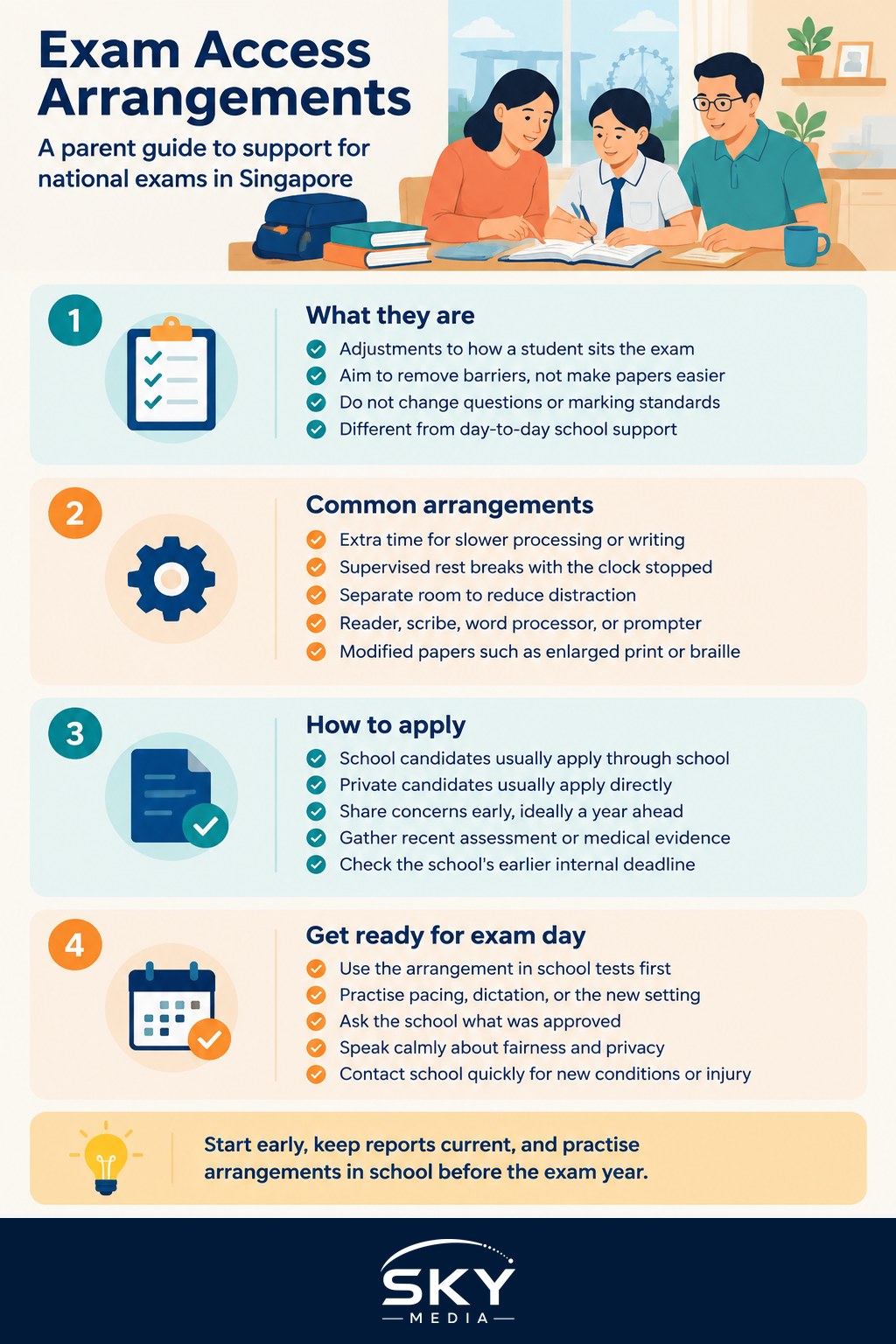
Access arrangements are adjustments to how a candidate sits a national exam, designed to remove barriers caused by a special educational need or condition. The aim is a fair chance to show what the student knows. They do not make the exam easier, change the content of questions, or lower the standard of marking.
This makes them different from day-to-day special educational needs (SEN) support in school, such as learning support programmes, allied educators or classroom accommodations. A student may receive plenty of help in class but still need a separate, formal application for national exams. For the broader picture of school-based help, see our guide to special educational needs support in Singapore.
Types of Access Arrangements Parents Commonly Ask About
The exact arrangements depend on the student’s needs and on what SEAB approves. Commonly seen types include:
- Extra time. Additional time on top of the standard paper duration, often for students whose processing, reading or writing speed is affected.
- Supervised rest breaks. Short pauses, with the clock stopped, for students who struggle with fatigue, attention or pain.
- Separate room. Sitting the paper away from the main hall to reduce distraction or to accommodate other arrangements.
- Reader. A person who reads questions aloud, typically for students with significant reading difficulties.
- Scribe. A person who writes answers as the student dictates, for students who cannot write effectively.
- Word processor. Typing answers on a computer with restricted functions instead of handwriting.
- Modified papers. Enlarged print or braille papers for students with visual impairment.
- Prompter. Someone who discreetly redirects a student’s attention back to the task.
Some arrangements can be combined. Others have practical implications, for example a reader or scribe usually means a separate room. Equipment rules still apply; our guide to SEAB-approved calculators covers one such area.
How the Application Process Usually Works
For school candidates, the school generally submits the application to SEAB on the student’s behalf. Parents play a key supporting role. Private candidates usually apply directly, so check SEAB’s instructions for private candidates if this applies to you.
| Step | Who is usually involved | What parents can do |
|---|---|---|
| Identify the need | Teachers, SEN officer, parents | Share concerns early, ideally a year or more before the exam |
| Gather evidence | Psychologist, doctor, school | Arrange or update professional assessment reports |
| Show normal way of working | School and teachers | Ask whether the arrangement is already used in school tests |
| School submits application | School exam secretary | Check the school’s internal deadline, which is earlier than SEAB’s |
| SEAB decision | SEAB | Ask the school to share the outcome and approved arrangements |
Evidence matters
Applications are generally supported by documents such as a psychological or educational assessment, a medical report, or a specialist’s letter. These typically need to show the diagnosis or condition and explain how it affects the student’s exam performance. SEAB may expect reports to be reasonably recent, so ask the school what currency is required rather than assuming an old report is enough.
Normal way of working
A recurring principle is that access arrangements should reflect how the student already works. If a child will need a scribe or extra time in the national exam, it helps a great deal if the school has been providing that arrangement in internal tests and records how it is used. Arrangements introduced suddenly in the exam year may be harder to justify, and the student will also be less comfortable using them.
Timeline: When Parents Should Start
Deadlines for applications are set by SEAB and schools, and they fall well before the exam itself. Rather than relying on specific dates, which can change, use this rough planning approach:
- Two years ahead. If you suspect an undiagnosed learning need, raise it with the school and consider assessment. Waiting lists for assessments can be long.
- About a year ahead. Confirm with the school’s SEN officer or exam secretary which arrangements they plan to request, and what evidence they need.
- The year of the exam. Make sure the arrangement is used consistently in school tests and preliminary examinations.
- After the decision. Ask the school to explain exactly what was approved, so your child knows what to expect on the day.
If your child develops a condition or injury close to the exam, such as a broken writing arm, there may be a route for late or special consideration. Contact the school immediately, as these cases are handled separately.
Helping Your Child Use Their Arrangements Well
Approval is only half the job. Students do best when the arrangement feels familiar.
- Practise with it. A student with extra time needs to learn how to pace the extra minutes. A student with a scribe needs to practise dictating clearly, including punctuation.
- Rehearse the setting. If they will be in a separate room, ask whether the school can simulate that during preliminary exams.
- Talk it through calmly. Some teens worry about being seen as different. Explain that arrangements are about fairness, and that other candidates are not told who receives them.
- Look after wellbeing. Exam pressure can be heavier for students who have struggled with learning. If your child seems very anxious, a school counsellor can help. Our guide to managing exam day nerves has practical ideas.
Common Questions From Parents
Will access arrangements appear on my child’s certificate?
Policies on this can differ, so ask SEAB or the school directly rather than relying on hearsay.
Can we apply ourselves if the school disagrees?
For school candidates, applications normally go through the school. If you disagree with the school’s view, ask for a meeting with the SEN officer or exam secretary, bring your reports, and ask what further evidence would help.
Do arrangements carry over from PSLE to O-Levels?
Do not assume so. Each national exam typically requires its own application and current evidence.
Is my child too mildly affected to qualify?
Eligibility depends on the evidence of how the condition affects exam performance, not just on a diagnosis. The school’s SEN team is best placed to advise.
Where to Check Current Rules
The SEAB website publishes the official information on access arrangements for each national exam, including guidance for private candidates. The Ministry of Education (MOE) has information on SEN support in mainstream and special education schools. Your child’s school, especially the SEN officer and exam secretary, is the practical link between you and SEAB. Because procedures and deadlines may be updated, check the latest guidance each year rather than relying on what an older sibling or friend experienced.
Starting early, keeping reports current and practising the arrangement in school are the three things that make the biggest difference.
Official sources: SEAB
Further reading: Support for Hearing-Impaired Students in Singapore Schools