

Weekday routines often settle down after a separation. It is the holidays that bring friction: who gets the first week of the June break, where the children spend the reunion dinner on Chinese New Year’s Eve, whose turn it is to host the birthday party. A clear holiday access arrangement for separated parents can take much of the tension out of these moments, for both adults and children.
This guide focuses on practical ways to share school holidays, festivals and special days. It is general information, not legal advice. If you have a court order, the order sets out what must happen, and changes generally need either the other parent’s agreement or the court’s involvement. For your specific situation, speak to a family lawyer, or check resources from the Family Justice Courts and the Ministry of Social and Family Development (MSF).
Start With What Is Already in Place
Before planning schedules, check what already governs your arrangement.
- Court orders. If your divorce or separation involved a court order on custody, care and control, and access, read the access terms carefully. Many orders include holiday and festive provisions.
- Written parenting plans. If you agreed a plan through mediation or with lawyers, it may already address holidays.
- Informal arrangements. Some separated parents agree everything between themselves. That can work well, but writing it down helps avoid misunderstandings later.
If the terms used are unfamiliar, our guide to custody, care and control, and access explains what each one means. In short, the parent with care and control is the one the child mainly lives with, and access refers to the time the child spends with the other parent.
Common Ways to Split School Holidays
Singapore’s school calendar has a few holiday periods: shorter breaks between terms and the long year-end holidays. Exact dates are published by the Ministry of Education (MOE) each year, so check school holidays and term dates when planning ahead.
There are several common approaches. None is “correct”; the best one fits your children’s ages, your work schedules and the distance between homes.
| Approach | How it works | Works well when | Watch out for |
|---|---|---|---|
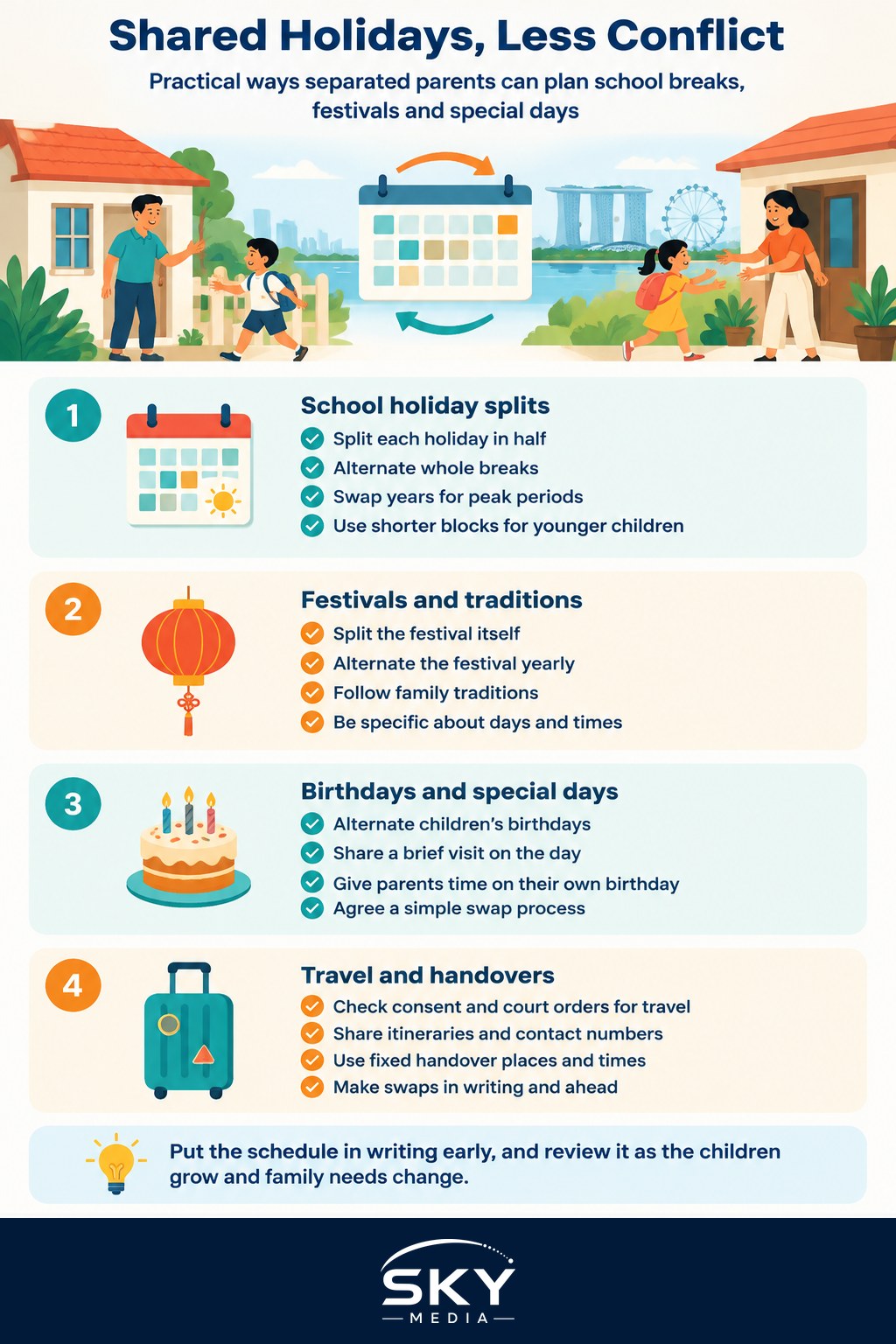
| Split each holiday in half | Each parent gets one half of every break | Parents live close, children are comfortable with both homes | Frequent handovers in short breaks |
| Alternate whole breaks | One parent has the March break, the other has the June break, and so on | Parents want longer stretches, or travel is involved | Long gaps from one parent for young children |
| Alternate years | Parent A has the first half of year-end holidays in odd years, Parent B in even years | Both parents want a fair share of peak periods over time | Need a clear record of whose year it is |
| Weekly rotation | Holidays split into alternating weeks | Long year-end break, older children | Can feel unsettled for very young children |
Younger children often do better with shorter, more frequent time with each parent, because long separations from either parent can feel unsettling. Older children and teens may prefer longer blocks, especially if one home is nearer friends, tuition or CCA commitments, and their views deserve a respectful hearing.
Think about childcare too. If both parents work, a holiday period may need camps or relatives to fill weekdays. Coordinating this jointly avoids double bookings and gaps. Our guide on holiday childcare options for working parents covers the usual choices.
Sharing Chinese New Year, Hari Raya, Deepavali and Christmas
Festivals carry emotional weight, and both sides of the family often have their own traditions. Some practical options:
- Split the festival itself. For Chinese New Year, one parent has the reunion dinner on the eve, and the other has the first day of visiting. The next year, swap.
- Alternate the festival yearly. One parent has the whole festive period this year and the other has it next year.
- Follow family traditions. If one parent’s extended family holds a big gathering on a particular day, the children might attend that each year, balanced by time elsewhere.
- Match festivals to families. In mixed-heritage families, children may spend Hari Raya Puasa or Deepavali with the parent whose family celebrates it, and Christmas or Chinese New Year with the other.
Whatever you choose, be specific. “Chinese New Year with Mum” can mean many things. Write down which days, what time the children are collected, and where they are returned.
Birthdays and Other Special Days
Birthdays are another common friction point. Options parents often use:
- Children’s birthdays. Alternate who has the actual day each year, or let the child see both parents briefly on the day. Parties can be held separately, or jointly if relations are cordial.
- Parents’ birthdays. Many arrangements give each parent a few hours with the children on their own birthday.
- Mother’s Day and Father’s Day. These are often simply allocated to the relevant parent, regardless of the regular schedule.
- Grandparents’ milestones and family events. Weddings, funerals and big birthdays come up unexpectedly. Agree on a simple way to request swaps for these.
The most important principle is that children should not feel they must choose sides. Speak positively about the time they will spend with the other parent, even if it is hard.
Travel, Handovers and Swaps
Overseas travel needs particular care. Holidays are when families travel, but taking a child abroad may need the other parent’s consent, and some court orders include specific conditions about travel or passports. Check your order and, if in doubt, get legal advice before booking. Share itineraries, flight details and contact numbers with the other parent as a matter of courtesy and safety.
Handovers are smoother when they are predictable. Agree on fixed times and places, such as a void deck, a school gate or a neutral public spot if tension is high. Keep handovers brief and calm.
Swaps will happen. A work trip, a family emergency or a school event can upend the plan. A simple rule helps: requests are made in writing, a reasonable time in advance, and lost time is made up within a set period. Use a shared calendar app so both homes can see the schedule.
Keeping Children at the Centre
- Plan early. Agree on the year-end holiday schedule well before term ends, so children know what to expect.
- Keep consistent rules where you can, such as bedtimes and screen time, across both homes.
- Let children pack their favourite things and travel with familiar items between homes.
- Listen to older children’s preferences, without making them responsible for the decision.
- Seek help if conflict persists. Family Service Centres and the support services listed by MSF offer counselling and co-parenting programmes. If you need to vary a court order, a family lawyer or the Family Justice Courts can explain the process.
No schedule is perfect, and what works for a toddler will need revisiting by the time they are a teen. Review your holiday arrangements every year or two, and keep the focus where it belongs: helping your children enjoy their holidays and festivals with the people who love them.