

When you decide to sell or rent out a property in Singapore, one of the first choices you face is how to engage an agent. The exclusive vs open listing question sounds technical, but it shapes how your property is marketed, how much attention it gets, and who is accountable for the result. This guide explains the two arrangements in plain terms, weighs the pros and cons, and covers the commission point that trips up many owners. It is general information, not legal or financial advice, so read your agreement carefully and check any agent against the official register.
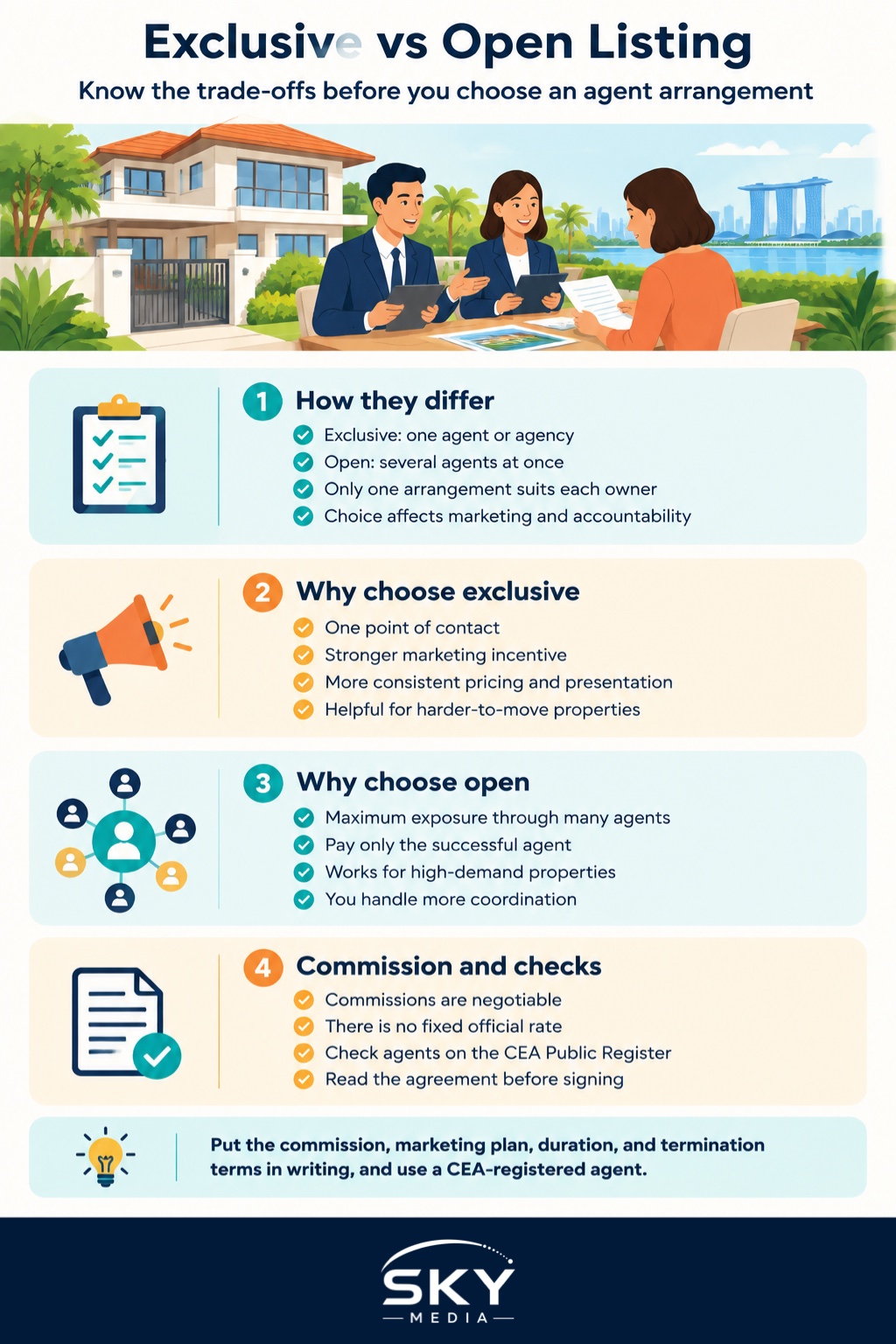
The Two Arrangements in Plain Terms
Both options involve appointing a CEA-registered agent, but they differ in how many agents you engage and who is responsible.
- Exclusive listing (sole agency). You appoint one agent (or one agency) to market your property for a defined period. That agent has the exclusive right to represent you, and typically earns the commission when the property is sold or let, often regardless of who introduces the buyer during the exclusive term.
- Open listing. You allow multiple agents to market the property at the same time, without an exclusive commitment. Whichever agent brings the successful buyer or tenant earns the commission, and the others get nothing.
Neither is inherently right or wrong. The better fit depends on your property, your timeline, how much marketing effort the property needs, and how involved you want to be. It is worth understanding the trade-offs before you sign anything.
Why Owners Choose an Exclusive Listing
At first glance, giving one agent exclusivity can feel like reducing your options. In practice, many owners and agents find the opposite. Because a sole agent knows they will earn the commission if the property sells within the term, they have a clear incentive to invest properly in marketing: professional photos, floor plans, portal advertising, viewings, and follow-up.
An exclusive arrangement also gives you a single accountable point of contact. One agent coordinates viewings, filters enquiries, and reports back, which reduces the noise of dealing with several people who may share information inconsistently. For higher-value or harder-to-move properties, that focused effort and single line of accountability can be an advantage.
The trade-off is commitment. You are tied to one agent for the agreed period, so choosing the right agent matters a great deal. If the agent underperforms, you may have to wait out the term or negotiate an exit. Read the exclusivity period, the scope, and any termination terms carefully before signing.
Why Some Owners Prefer an Open Listing
An open listing appeals to owners who want maximum exposure across many agents without committing to one. In theory, more agents mean more channels and more potential buyers, and you only pay the agent who actually delivers.
In reality, the incentive can cut the other way. When several agents are competing and none is guaranteed the commission, some may be reluctant to spend heavily on marketing a listing they might lose. You can also end up with inconsistent pricing or presentation across different portals, which can confuse buyers and make the property look like it has been sitting on the market. Coordination falls more on you, since you are the common point across all the agents.
Open listings can work well for properties in high demand or in situations where you are comfortable managing multiple relationships. For many owners, though, the lack of a single accountable agent is the main drawback.
A Side-by-Side Comparison
The table below summarises the practical differences. Use it as a starting point for a conversation with agents, not as a verdict, since the right choice is specific to your property and goals.
| Factor | Exclusive listing | Open listing |
|---|---|---|
| Number of agents | One appointed agent or agency | Multiple agents at once |
| Marketing incentive | Strong, as commission is secured within term | Can be weaker, as commission is uncertain |
| Accountability | Single point of contact | Spread across many agents |
| Pricing and presentation | Consistent, controlled by one agent | Can vary across listings |
| Your involvement | Lower, agent coordinates | Higher, you coordinate |
The Commission Point You Must Not Miss
Whichever route you choose, understand that estate agent commissions in Singapore are negotiable and are not fixed by any authority. There is no official rate that you are obliged to pay, so treat the number as part of the negotiation. Agree the commission, the marketing plan, the duration, and the termination terms in writing before you commit.
Only work with a CEA-registered agent, and verify them on the CEA Public Register first. The written estate agency agreement should set out exactly what you are agreeing to; if a clause is unclear, ask for it to be explained or amended before signing. Be cautious of anyone who pressures you to sign quickly, asks for money through informal channels, or cannot be verified on the register. When in doubt, slow down and confirm through the proper channels.
Making the Decision
Start with your objective. If you want focused effort, consistent presentation, and one accountable person, an exclusive listing often suits. If you prioritise broad exposure and are willing to coordinate several agents yourself, an open listing may fit. For many sellers of a typical home, the accountability of a sole agency is the deciding factor, but there is no single correct answer for everyone.
Whatever you decide in the exclusive vs open listing choice, put the terms in writing, keep the commission negotiable, and use a registered agent. For questions about the transaction itself, such as stamp duties or the legal process, defer to IRAS and a conveyancing lawyer rather than relying on an agent’s summary. A clear agreement at the start protects you throughout the sale.
Explore more
Once you have a listing strategy, the next step is fielding offers; see our guide to negotiating a property offer in Singapore for the OTP mechanics. Sellers financing an onward purchase can read understanding SORA and your home loan rate, and those handling an estate should see selling an inherited property in Singapore.
Frequently Asked Questions
Can I switch agents if my exclusive agent is not performing? Only on the terms in your agreement. An exclusive listing binds you for the agreed period, so check the termination clause before signing. If you want out early, discuss it with the agent or agency and keep any change in writing.
How long should an exclusive listing last? There is no single correct length, as it is negotiated in the agreement. Choose a period that gives the agent time to market properly without locking you in for too long. Read the exclusivity and termination clauses carefully.
Do I pay commission if I find the buyer myself? It depends on the wording. With an exclusive agreement, the agent may be entitled to commission even when the buyer is introduced by someone else. With open listings, only the agent who delivers is paid. Confirm the clause before signing.
Is an exclusive listing better for a hard-to-sell property? Often, because a sole agent has an incentive to invest in photos, advertising and follow-up. It is not guaranteed, so judge the agent’s marketing plan and track record rather than the label.
How do I check that an agent is allowed to represent me? Look the agent up on the CEA Public Register before engaging them, and make sure the estate agency agreement is in writing. Be cautious of anyone who cannot be verified or asks for money through informal channels.
Official sources: Council for Estate Agencies
Further reading: How to Take Better Condo and HDB Listing Photos