

Most deposit disputes between tenants and landlords in Singapore come down to one question: what condition was the place in when you moved in? The document that answers it is the inventory list. If you are new to renting here, the rental inventory list Singapore landlords and agents attach to the tenancy agreement can look like a dull formality. It is actually the most useful piece of paper you will sign for protecting your security deposit.
This guide explains how to read an inventory list, what to check on handover day, and how to use it at move-out. It is general information, not legal advice. For a specific dispute, refer to your tenancy agreement and seek proper advice.
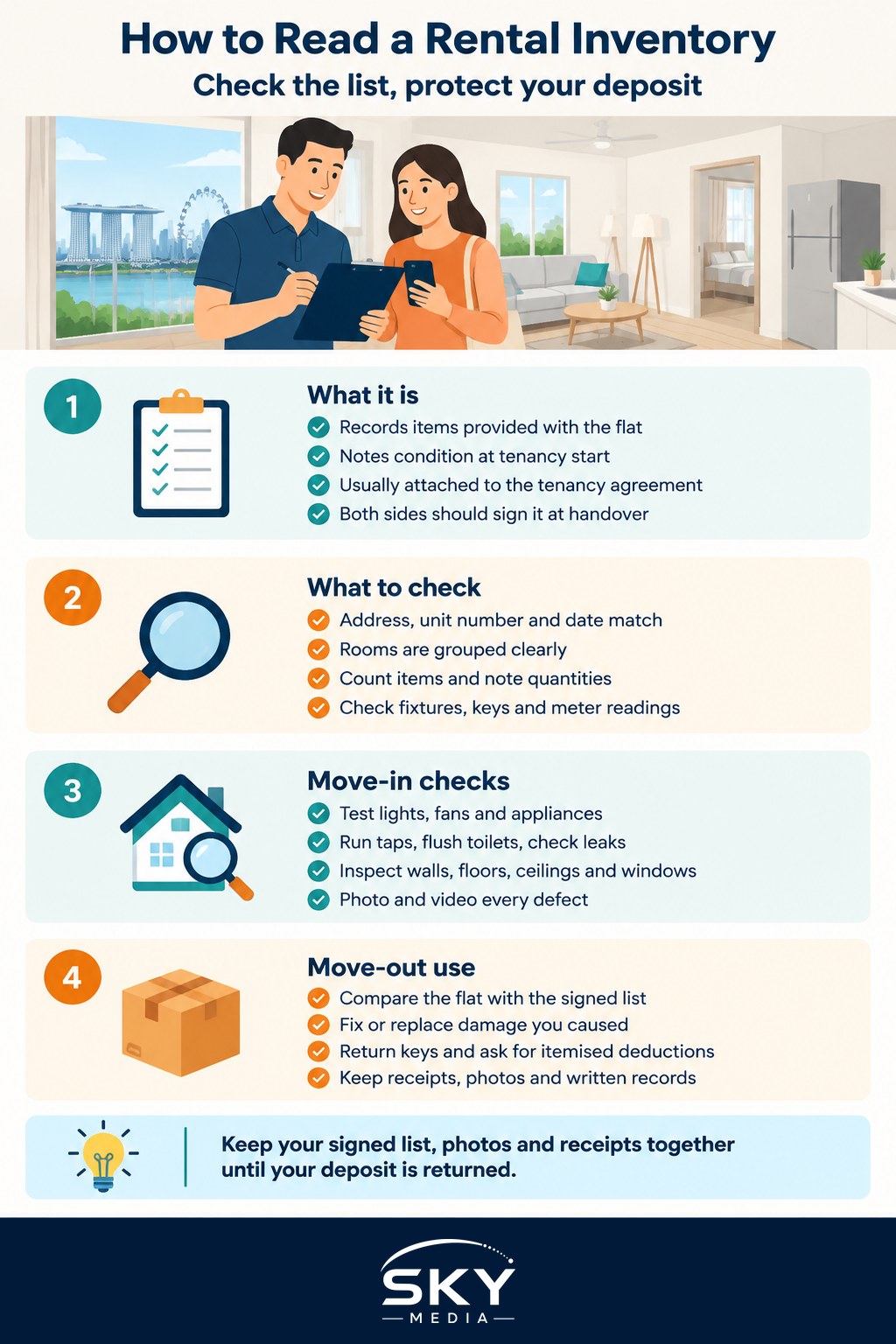
What a Rental Inventory List Is and Why It Matters
An inventory list is a record of everything the landlord provides with the property, and the condition of each item, at the start of the tenancy. It usually sits as a schedule or annex to the tenancy agreement, and both parties, or their agents, sign it at handover.
It matters because:
- It sets the baseline. At move-out, the landlord compares the flat against this record. Anything missing or damaged beyond normal use may be deducted from your deposit.
- It protects you from blame for old damage. A stain, crack or faulty appliance that was already there should be on the list. If it is not, you may struggle to prove it was not your doing.
- It reduces arguments. A clear, signed list with photos leaves less room for “he said, she said” months or years later.
In Singapore, the security deposit is commonly a sum tied to the monthly rent and the lease length, and it is held by the landlord until the tenancy ends. The exact amount, deduction terms and refund timeline are set by your tenancy agreement, so read those clauses alongside the inventory.
How to Read Each Section of the List
Inventory lists come in many formats, from a short typed table to a detailed room-by-room report with photos. Whatever the format, look for these elements.
- Property details and date. The address, unit number and handover date should match your tenancy agreement.
- Room-by-room grouping. Living room, kitchen, each bedroom, bathrooms, service yard and balcony. This makes checking easier and avoids items falling through the gaps.
- Item names and quantities. “Dining chairs x 6” is far better than “dining set”. Count everything.
- Condition notes. Each item should have a short description such as “good”, “scratched on left side”, or “door hinge loose”. Vague words like “OK” are a warning sign.
- Fixtures as well as furniture. Lights, curtains, blinds, ceiling fans, aircon units, water heater, kitchen hob and hood, built-in wardrobes, and window grilles should all be listed.
- Keys and access cards. Number of main door keys, gate keys, mailbox keys, window grille keys, and access cards or remote controls.
- Meter readings. Some lists record the electricity and water meter readings, which helps when utility accounts are transferred.
- Signatures and photos. Both sides should sign and date every page, with photos either embedded or referenced.
If you rent through an agent, the agent is usually registered with the Council for Estate Agencies (CEA), the regulator for property agents. You can ask them to walk the list with you, but the responsibility to check it is still yours.
What to Check on Move-In Day
Block out at least an hour for handover, more for a larger unit. Bring your phone fully charged and go through the flat methodically.
- Test everything that switches on. Lights, fans, aircon in every room, water heater, hob, oven, washing machine, fridge and doorbell.
- Run every tap and flush every toilet. Look under sinks for leaks and check that drains flow well.
- Inspect walls, floors and ceilings. Note stains, cracks, scuffs, chipped tiles and signs of water seepage, especially below bathrooms and near windows.
- Open every door, drawer and window. Check locks, hinges, sliding tracks and window grilles.
- Check soft furnishings. Mattresses, sofas and curtains can hide stains and tears.
- Photograph and video. Take wide shots of each room, then close-ups of every defect. Keep the originals with their timestamps, and back them up to cloud storage.
Anything you find that is not already on the list should be added before you sign, or emailed to the landlord or agent the same day with photos so there is a dated record. Some tenancy agreements give a short window after move-in to report defects, so check the clause and act within it.
The same documentation habits you would use for a home inventory for insurance apply here: photos, dates, serial numbers for appliances where relevant, and copies kept somewhere safe.
Common Wording and What It Means for Your Deposit
The table shows typical entries and how they tend to play out at move-out.
| What the list says | What it usually means | What to do |
|---|---|---|
| “Good condition” with no photo | The landlord may assume it was perfect | Add a photo and note any small marks before signing |
| “Minor scratches on tabletop” | Existing damage is recorded and shared | Photograph the scratches so the extent is clear |
| Item missing from the list | You may have no proof it was provided or its state | Ask for it to be added, or confirm in writing it was not provided |
| “Aircon x 3, working” | Aircon was working at handover | Test each unit and check your servicing obligations in the agreement |
| “Keys x 2” | You must return two keys at the end | Count them, and record any access cards separately |
Two concepts come up in almost every Singapore tenancy agreement:
- Fair wear and tear. Normal deterioration from everyday living, such as light fading or minor scuffs, is generally not charged to the tenant. Damage from misuse or neglect usually is. Where the line falls can be disputed, which is exactly why detailed move-in notes help.
- Minor repair and servicing clauses. Many agreements make the tenant responsible for small repairs up to a stated amount and for regular aircon servicing. The amounts and frequency vary by agreement, so read yours and keep service receipts.
Using the List at Move-Out
Treat move-out as the mirror image of move-in.
- Re-read the list a few weeks early. Fix or replace anything you damaged, and keep receipts.
- Clean thoroughly. Some agreements require professional cleaning or curtain washing at the end. Check the wording.
- Arrange a joint inspection. Walk through the flat with the landlord or agent, using the original signed list and your move-in photos.
- Take fresh photos and video. Capture each room in the same angles as your move-in record.
- Return keys and cards. Get written acknowledgement of what you handed back.
- Ask for itemised deductions. If anything is deducted from your deposit, ask for a breakdown and the reason for each item.
If There Is a Dispute
Start with a calm, written conversation. Share your move-in photos and point to the signed list. Many disagreements end there once both sides see the evidence.
If you still cannot agree, options in Singapore include mediation services and, for claims within its limits, the Small Claims Tribunals under the State Courts. Check current procedures, claim limits and fees on the official State Courts and Judiciary websites, as these can change. Whatever route you take, a clear, signed rental inventory list with dated photos will be your strongest evidence.
A careful hour at handover can save weeks of argument at the end of the lease. Read the list properly, add what is missing, and keep your records safe until your deposit is back in your account.
Explore more: Understanding Your Tenancy Agreement and Rental Deposits and Disputes for Newcomers.
Frequently Asked Questions
Can I add defects to the inventory list after I have already signed it? You can try, but it is much weaker than adding them before signing. Email the landlord or agent the same day with dated photos so there is a record, and check whether your tenancy agreement gives a short window after move-in to report defects. Act within that period.
Who pays if the aircon breaks during my tenancy? It depends entirely on your tenancy agreement. Many agreements make the tenant responsible for regular servicing and for minor repairs up to a stated amount, while the landlord handles larger faults. Read those clauses before signing and keep your service receipts.
Is photographing the flat on move-in day enough, or do I need a formal report? Dated photos and video are valuable, but they work best alongside a signed inventory list that refers to them. A formal report is not required in every tenancy. Keep the original files with timestamps and back them up so you can produce them at move-out.
What counts as fair wear and tear when I move out? Fair wear and tear is the normal ageing from everyday living, such as light fading or minor scuffs, which a tenant is generally not charged for. Damage from misuse or neglect usually is. Where the line falls can be argued, so detailed move-in notes help.
Where can I go if my landlord will not return my deposit? Start with a calm written request that includes your signed list and photos. If that fails, options in Singapore include mediation and, for claims within its limits, the Small Claims Tribunals. Check current procedures, limits and fees on the State Courts website, and consider legal advice.
Further reading: Letter of Intent and Good Faith Deposit for Rentals in Singapore · Furnished vs Unfurnished Rentals