

You may have spent years building a strong career in another country, only to find that your CV gets little response in Singapore. Often the problem is not your experience. It is that hiring managers here cannot easily judge it. A company that is a household name in your home market may be unknown locally, a job title may mean something different, and a result described in a foreign currency or system can be hard to compare.
This guide shows you how to present the overseas experience Singapore employers will understand and value. The goal is translation, not exaggeration: helping a busy recruiter see quickly what you did, at what scale and with what results.
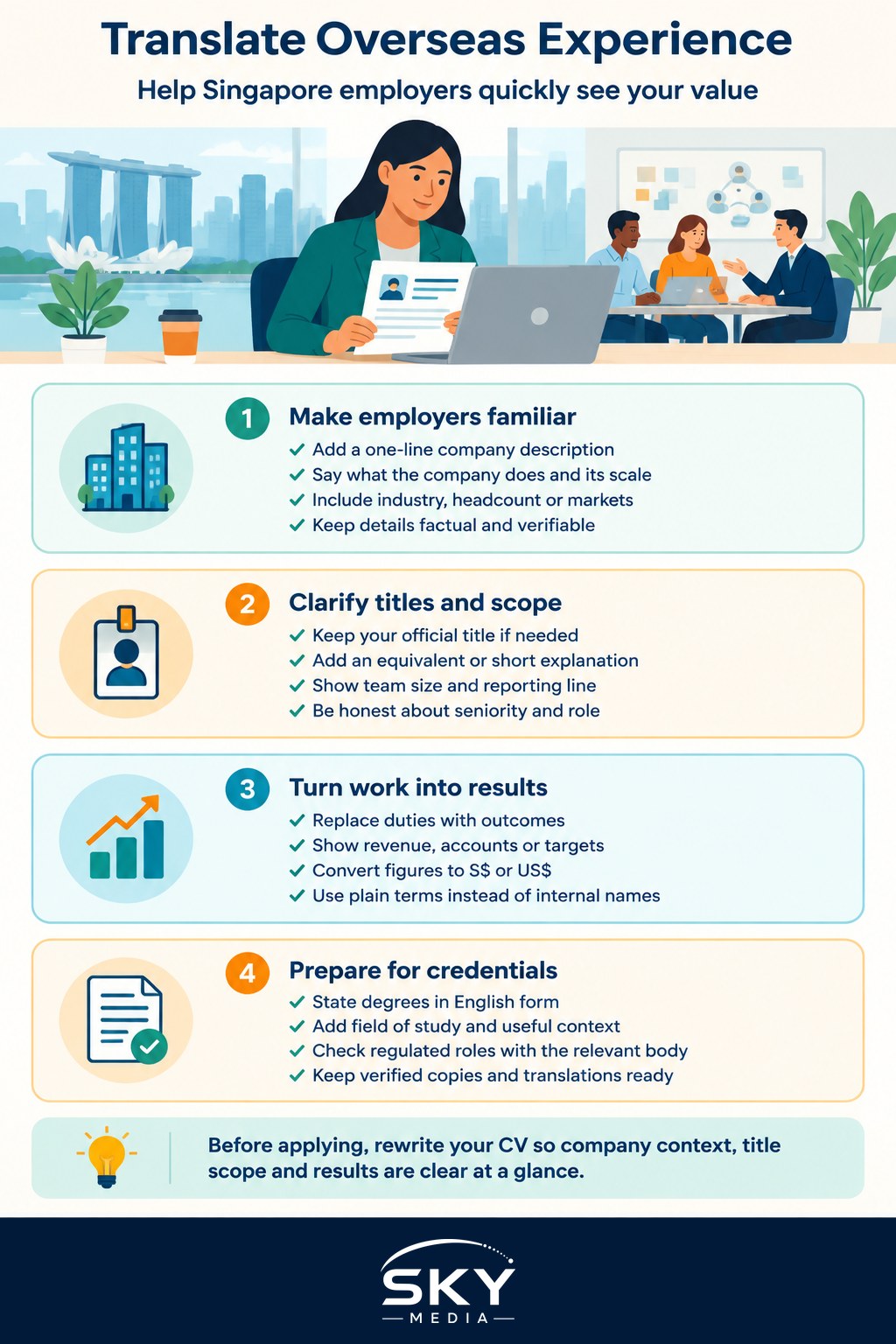
Why Overseas Experience Gets Lost in Translation
Recruiters in Singapore often screen many CVs quickly. They look for signals they recognise: familiar company names, standard job titles, local or regional market experience and clear achievements. When your background does not fit those patterns, they may move on, not because you are weak, but because they are unsure.
Common gaps include:
- Unfamiliar employers. A large company in your home country may be unknown here, so its size and reputation do not register.
- Different title systems. Seniority labels vary widely between countries and industries.
- Local jargon. Internal system names, government schemes or industry terms from your home market mean nothing to a local reader.
- Unclear scale. Numbers in another currency, or without context, are hard to interpret.
- Qualification differences. Degrees, professional certifications and education systems are structured differently across countries.
Your job is to close each of these gaps on paper and in person.
Translate Your Employers and Job Titles
Start with the two things a recruiter reads first.
Add a one-line company description. Under each employer name, include a short line explaining what the company does and its scale, for example its industry, approximate number of employees, the markets it serves or whether it is listed. Keep it factual and verifiable.
Clarify your title. If your official title would mislead a local reader, keep it, but add a clear equivalent or explanation. For instance, if your title was “Manager” but you led a team of 20 across several functions, show the scope in your first bullet point. If your title was senior-sounding but you were an individual contributor, be honest about that too. Honesty matters, because reference checks and background checks may reveal any mismatch.
Explain reporting lines. A line such as “reported to the regional head, managed four direct reports” tells the reader where you sat in the organisation better than any title.
Convert Achievements Into Clear, Comparable Results
Singapore employers tend to respond well to concrete, measurable results. Turn duties into outcomes.
- Replace “responsible for sales in the eastern region” with what you achieved: revenue growth, number of accounts, market share or a target you exceeded.
- Convert large monetary figures into Singapore dollars or US dollars, or give both, so the scale is easy to grasp. Note that the conversion is approximate.
- Replace internal system or platform names with the general category, such as “the company’s in-house customer management system” instead of an acronym only insiders know.
- Highlight anything regional or international, such as cross-border projects, work with multinational clients or teams in several countries. These often translate well to Singapore’s role as a regional hub.
How Common Overseas Details Translate
| What you have | How a local reader may see it | How to present it |
|---|---|---|
| Large employer unknown in Singapore | No sense of size or reputation | Add one line on industry, headcount and markets |
| Job title that differs from local norms | Confusion about your seniority | Keep the title, show team size and scope in the first bullet |
| Results in another currency | Hard to judge the scale | Give an approximate S$ or US$ figure alongside |
| Home market jargon or system names | Meaningless acronyms | Describe the function in plain words |
| Degree from a university unfamiliar here | Uncertainty about its standing | State the field, level and any recognised ranking or accreditation |
| Professional licence from another country | Unclear if it is valid here | Check with the Singapore regulator for that profession and say so |
Qualifications, Licences and Work Passes
Education and professional credentials need a little extra care.
- Degrees. Write the degree in its English form, add the field of study and, where useful, a brief note on the institution. Avoid overstating, and keep certified copies and translations ready.
- Regulated professions. Fields such as medicine, nursing, law, engineering and accountancy have their own Singapore regulators or professional bodies. Your overseas licence may not automatically allow you to practise here. Check with the relevant body before you describe yourself as licensed in Singapore.
- Verification for work passes. For some work pass applications, the Ministry of Manpower (MOM) may require proof that your qualifications have been verified. If you need a work pass, check the current requirements on the MOM website early, since obtaining verification can take time.
This is general information, not immigration or legal advice. Requirements can change, so always confirm with MOM and the relevant professional body.
Talking About Overseas Experience in Interviews
The interview is your chance to bring your story to life. Prepare a few examples using a simple structure: the situation, the task, what you did and the result. This is often called the STAR method, and many local interviewers expect answers in roughly this shape.
Some practical tips:
- Lead with relevance. Connect each example to the role you are applying for. Explain how a challenge you solved overseas is similar to one the company faces here.
- Show adaptability. Employers may wonder whether you will adjust to a new workplace. Share examples of working across cultures, learning new systems quickly or collaborating with colleagues from different backgrounds.
- Acknowledge what is new. If you lack local market knowledge, say so briefly and show how you are learning, through courses, networking or industry events.
- Avoid comparisons that sound dismissive. Saying “we did it better back home” rarely lands well. Frame differences as perspectives you can add.
- Explain any breaks clearly. If your move created a career gap, address it calmly. Our guide to explaining employment gaps to employers has useful phrasing.
Build Local Credibility Alongside Your CV
Your CV and interview are stronger when supported by local signals.
- Update your LinkedIn profile with the same translated titles and company descriptions, and connect with people in your industry in Singapore.
- Prepare referees who can speak English or arrange for them to provide a written reference with a translation.
- Join professional associations or industry meetups, where people can get to know your work directly.
- Consider a short local course or certification in your field to show commitment and fill knowledge gaps.
- Use public job portals such as MyCareersFuture and career services from the Skills and Workforce Development Agency (SWDA, formed in 2026 from Workforce Singapore and SkillsFuture Singapore) to understand the language local employers use in job descriptions.
It also helps to understand the hiring process from the other side. Our guide for employers on hiring employees in Singapore shows what local companies need to consider, which can help you anticipate their questions.
A Quick Checklist Before You Apply
- Every employer has a one-line description
- Titles are clarified with scope and team size
- Results are numbers, with currency converted
- Jargon is replaced with plain descriptions
- Qualifications are stated accurately, with documents ready
- Interview stories are prepared and linked to the role
Your overseas career is an asset. With careful translation, the overseas experience Singapore employers might overlook becomes a clear advantage on your CV and in the interview room.
Frequently Asked Questions
Do Singapore employers prefer candidates with local experience? Some do, mainly because local market knowledge and networks are easier to judge. But many companies value regional or international experience, especially multinationals serving Asia. Show how your background relates to the role and what you are doing to learn the local market.
Should I put a photo or my age on a Singapore CV? It is not required, and many applicants leave them out so the CV focuses on skills and results. Employers are expected to hire on merit, and MOM publishes guidance on fair employment. Include only what helps the recruiter judge your fit for the role.
How do I answer why I want to work in Singapore? Give a specific reason linked to the job, such as the industry, the regional role or your skills, rather than general praise. Show you understand the market and have thought about staying. Employers want to know you are committed, not just exploring options.
How should I state my salary expectations when my last pay was overseas? Research pay for similar roles in Singapore on job portals and with recruiters, rather than converting your old salary. Cost of living, taxes and benefits differ. Give a range that reflects the local market and your experience, and ask about the full package.
Is it better to apply for Singapore jobs from overseas or after I arrive? Both are possible. Applying from abroad lets you start early, but some employers prefer candidates who are already in Singapore because of work pass timing. Be clear about your availability, and check current work pass requirements with MOM before making plans.
Further reading: What to Do When Employers Say You Are Overqualified · What to Know About Relocating for Work