

You apply for a role you know you can do well, and the reply comes back polite but firm: “You are overqualified for this position.” It can sting, especially if you chose the role on purpose for better balance, a new industry or less stress. Being told you are overqualified for job openings is common among mid-career professionals, returning parents, people relocating to Singapore and those who have just been retrenched.
The good news is that “overqualified” is rarely a judgement on your ability. It is usually a set of worries the employer has not said out loud. Once you understand those worries, you can address them directly in your CV, cover letter and interview.
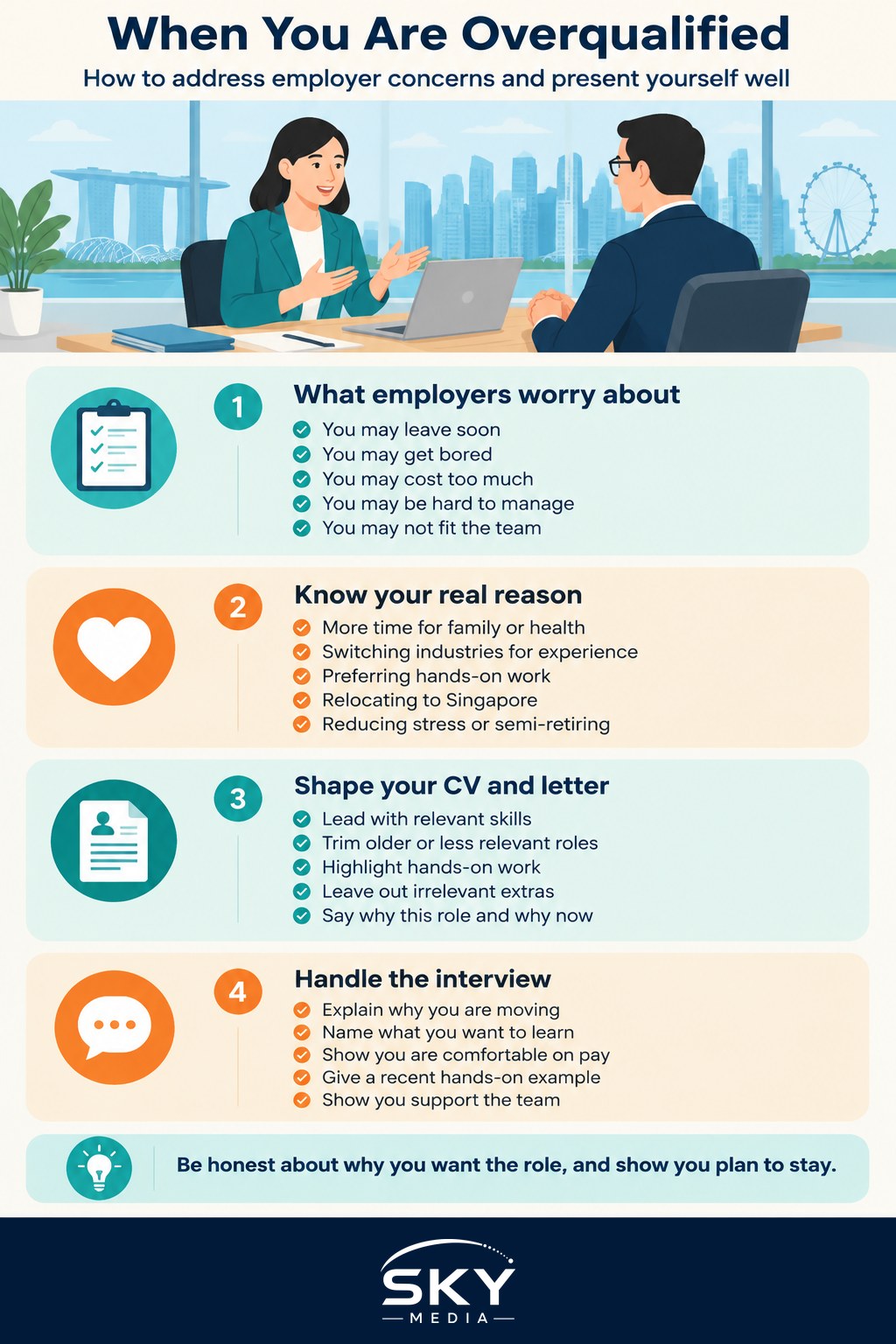
What Employers Really Mean by Overqualified
When a hiring manager says you are overqualified, they are often thinking one or more of these:
- You will leave soon. They fear you will treat the job as a stopgap and quit when something better appears, wasting their hiring and training effort.
- You will be bored. They worry the work will not challenge you and your performance or attitude will slip.
- You will cost too much. They assume you expect a salary near your previous level.
- You will be hard to manage. A manager who is younger or less experienced than you may worry you will question decisions or want their job.
- You will not fit the team. They may worry you will not want to do hands-on or junior tasks.
Some of these are fair concerns. Some are assumptions. Your job is to replace assumptions with evidence.
Decide Why You Want This Role First
Before you fix your CV, get clear on your own reasons. Employers can sense a vague answer. Strong, honest reasons include:
- Wanting more time for family, caregiving or health.
- Switching industries and accepting a step down to gain relevant experience.
- Preferring hands-on work over people management.
- Relocating to Singapore and building local experience.
- Reducing stress after years in a demanding role.
- Semi-retirement or a planned wind-down.
If your honest reason is “I need any job right now”, that is understandable, but think about whether the role is one you could stay in for a reasonable period. If not, the employer’s flight-risk worry may be valid, and your energy may be better spent on roles closer to your level.
Tailor Your CV So You Look Right for the Role
A CV for a more senior role is built to impress. A CV for a deliberate step down should be built to fit. That does not mean hiding the truth or lying about qualifications. It means choosing what to emphasise.
- Lead with relevant skills, not your most senior title. A short profile at the top should explain the kind of role you want and why.
- Trim, do not delete. You can summarise early or less relevant roles in a line each, and focus detail on experience that matches the job.
- Describe hands-on work. If you managed a team but also did the technical work, highlight the doing, not only the leading.
- Leave out irrelevant extras. A long list of certifications unrelated to the job can reinforce the overqualified label.
- Keep it honest. Never remove degrees or roles in a way that misrepresents your history, especially if a background check or reference will reveal it.
Use the cover letter to name the elephant in the room in one or two calm sentences: why this role, why now, and why you intend to stay.
Answering Concerns in the Interview
The table below sets out common concerns and practical ways to respond. Adapt the wording so it sounds like you.
| Employer’s worry | What to say or show | What to avoid |
|---|---|---|
| You will leave quickly | Explain your reason for the move and what you want from the next few years; mention past roles you stayed in for a long time | Saying “I just need something for now” |
| You will be bored | Name specific parts of the job you enjoy and want to get better at | Implying the work is easy or beneath you |
| You expect a high salary | Say you have researched the range and are comfortable with it if the role is right | Naming your old salary as your benchmark |
| You will undermine your manager | Talk about supporting a team lead and sharing experience only when asked | Telling stories that show you overriding bosses |
| You will not do junior tasks | Give a recent example of happily doing hands-on work | Calling tasks “admin” or “basic” |
Some extra techniques help:
- Address it before they ask. If you sense hesitation, say: “You may be wondering why someone with my background is applying. Here is why.”
- Offer value without threat. Frame your experience as a bonus for the team, such as being able to train newer staff or handle tricky clients, while being clear you want the role as described.
- Ask about growth honestly. If you hope to grow later, say so, but do not suggest you are aiming for your interviewer’s position.
Downshifting Deliberately, Not Accidentally
A planned downshift is very different from a panicked one. If you are choosing to step back, a little preparation makes it sustainable:
- Check your finances. Work out a lower salary budget and how long your savings can bridge any gap. If you are leaving a job, review gaps in employer group insurance so you are not left without coverage.
- Talk to people in the role. Short conversations with people already doing the work tell you what it is really like. Our guide on informational interviews explains how to ask.
- Use public support. The Skills and Workforce Development Agency (SWDA, formed in 2026 from Workforce Singapore and SkillsFuture Singapore) and the career centres under it offer career coaching and job matching, and MyCareersFuture lists vacancies. Check their sites for current programmes, including those for mid-career switchers.
- Consider adjacent roles. Contract, part-time, project-based or specialist individual contributor roles can offer the balance you want without such a sharp step down.
- Leave well. If you are moving from a current role, handle your exit professionally. Our tips on exit interviews help you leave on good terms, which matters for references.
When to Look Elsewhere
Sometimes an employer will not move past the label no matter how well you explain. That is their decision, and it may reflect a team that would not have suited you. Signs it is time to redirect your search include repeated rejections for the same kind of role, interviewers who visibly do not engage with your explanation, or roles where the salary truly does not meet your needs.
In that case, aim for organisations that value experience: smaller firms that need someone who can do many things, companies building new teams, or sectors facing skill shortages. A well-chosen role where your experience is welcome is far better than one where you constantly have to prove you will not leave.
Being called overqualified is frustrating, but it is also a sign you bring a lot to the table. With a focused CV and a clear, confident story, you can turn that worry into a reason to hire you.
Frequently Asked Questions
Should I remove my degree from my CV if I am told I’m overqualified? No. Leaving out degrees or roles in a way that misrepresents your history can backfire at background checks or reference calls. Instead, trim and reorder: lead with relevant skills, summarise older roles briefly, and keep every qualification you list accurate and honest.
Is it better to take a step down or keep searching at my level? It depends on your finances and your reasons. A deliberate step down suits people wanting balance or a career switch, while someone who needs a similar salary may do better aiming at roles near their level. Work out a lower budget and how long your savings can last first.
Can I negotiate salary after being called overqualified? Yes, but show you have researched the range and are comfortable with it, rather than quoting your old salary as the benchmark. Employers worry you will want more than the role pays. Saying you understand the pay band and still want the job eases that fear.
Where can mid-career jobseekers in Singapore get free career help? SWDA and the career centres under it offer career coaching and job matching, and MyCareersFuture lists vacancies. Check their websites for current programmes for mid-career switchers, since schemes and eligibility change. Short chats with people already in the role also help.
What if I am overqualified because I was just retrenched? It is a common situation, and employers will usually want to know why you are taking a lower-level role and whether you will stay. Be clear about your reasons and what you want over the next few years. Avoid saying you just need something for now.
Further reading: Rejoining a Former Employer: How to Ask and What to Watch For