

Behind every product a company sells and every service it runs sits a chain of suppliers, contracts, and purchasing decisions. Procurement is the function that manages all of that, and it is a field that quietly shapes cost, quality, and resilience across almost every industry. If you are considering a procurement career in Singapore, you may be surprised by how strategic and people-focused the work has become. This guide walks through the typical roles, the skills that matter, and realistic pathways in, so you can judge whether it fits the way you like to work.
What procurement involves
At its simplest, procurement is about getting the right goods and services, at the right quality and price, at the right time, from suppliers you can rely on. But the modern version of the job goes well beyond placing orders.
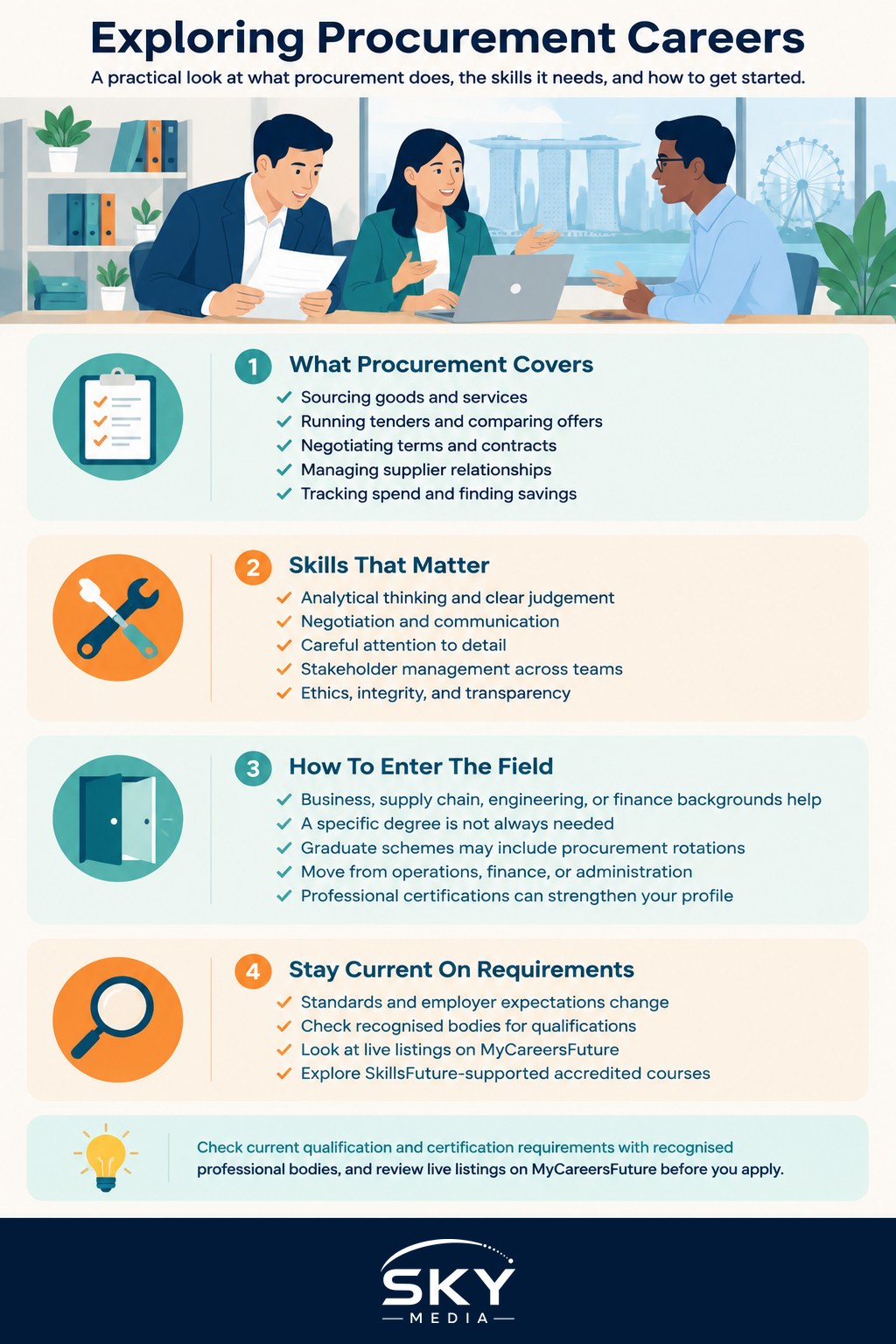
- Sourcing and buying: identifying suppliers, running tenders, and comparing offers on more than just price.
- Negotiation and contracting: agreeing terms, managing risk, and setting up clear agreements.
- Supplier relationship management: keeping key suppliers performing well and resolving issues.
- Category management: taking ownership of a spend area, such as IT or logistics, and developing a strategy for it.
- Procurement operations and analytics: managing purchasing systems, tracking spend, and finding savings.
There are also related roles in supply chain, logistics, and vendor management that overlap with procurement, so the boundaries can be fluid. In practice, the work blends analysis with relationship building. You spend part of your time in spreadsheets and systems, and part of it talking to internal stakeholders and suppliers, often balancing competing priorities. If you enjoy solving problems that touch the whole business, this can be a satisfying place to sit. It also connects naturally to broader skills, and our guide on handling difficult conversations at work is genuinely useful given how much of the job involves negotiation.
Skills that make a good procurement professional
The strongest procurement people combine commercial sharpness with the ability to work well across many teams.
- Analytical thinking: reading data, comparing options, and building a clear case for a decision.
- Negotiation and communication: getting to fair outcomes while keeping relationships intact.
- Attention to detail: contracts and terms reward carefulness.
- Stakeholder management: influencing colleagues who do not report to you, so they buy into procurement decisions.
- Ethics and integrity: procurement handles significant spend and supplier relationships, so fairness and transparency are non-negotiable.
Increasingly, procurement also values digital fluency, since much of the work runs through e-procurement platforms and data tools, and an awareness of sustainability and supply chain risk. Being able to influence without formal authority is a real asset here, and you can strengthen it further by reading about emotional intelligence at work, which underpins much of the day to day.
Pathways in and checking current requirements
There is no single entry route into procurement, which makes it accessible from several starting points.
- Many people enter through business, supply chain, engineering, or finance backgrounds, but a specific degree is not always essential.
- Graduate schemes and management trainee programmes sometimes include procurement rotations, which are a good way to try it.
- Others move across from adjacent roles in operations, finance, or administration once they have shown commercial aptitude. If that describes you, transitioning to a new industry offers a practical framework.
- Professional certifications in procurement and supply exist and are valued by many employers, and they can strengthen your profile as you progress.
Because professional standards, recognised certifications, and employer expectations evolve, treat the details as a moving target. Check current qualification and certification requirements with recognised professional bodies in procurement and supply, and confirm what specific employers ask for by looking at live listings on MyCareersFuture. SkillsFuture may support relevant accredited courses, so it is worth exploring what applies to you.
Procurement rewards people who are curious about how businesses really work and who can be both firm and fair with the people around them. Start by building solid commercial and analytical foundations, get exposure to how buying decisions are made, and grow your influence steadily over time. If you like the idea of a role that touches the whole organisation and directly affects its bottom line, a career in procurement is well worth exploring. Take one practical step this month, and let your experience build from there.
Frequently Asked Questions
What is the difference between procurement and purchasing? Purchasing is mainly placing orders, while procurement is broader and covers sourcing, negotiation, contracts, supplier relationships and strategy. Titles vary a lot between companies and the two words are sometimes used interchangeably, so read job descriptions closely.
Are procurement certifications worth getting? Many employers value recognised procurement and supply certifications, and they can strengthen your profile as you progress. They do not replace experience, so check live listings on MyCareersFuture for what employers want before paying.
How does procurement differ from supply chain management? Procurement focuses on sourcing goods and services and managing suppliers, while supply chain management covers the wider flow from suppliers through production and delivery. The two overlap, so boundaries are fluid.
What does a category manager do? A category manager owns a spending area, such as IT or logistics, and builds a strategy for it. The role mixes data analysis, supplier negotiation and working with internal teams.
Can I move into procurement from admin or finance? Yes. Admin and finance staff often cross over after showing commercial aptitude, since contracts, budgets and attention to detail transfer well. Ask to join purchasing projects and consider a graduate scheme or rotation.
Further reading: Exploring a Career in Veterinary Science in Singapore