

A psychology career in Singapore appeals to people who want to understand how minds work and to help others through hard moments. It can be deeply meaningful work. It can also be quietly demanding, because you carry other people’s difficulties as part of the job. If you are patient, a good listener, and comfortable sitting with strong emotions without rushing to fix everything, this field is worth exploring seriously.
This guide covers what psychology and counselling roles look like locally, the training and standards involved, and the honest realities of the path. Both are professional fields with recognised standards and registration frameworks, so we will point you to the right bodies to confirm current requirements before you commit.
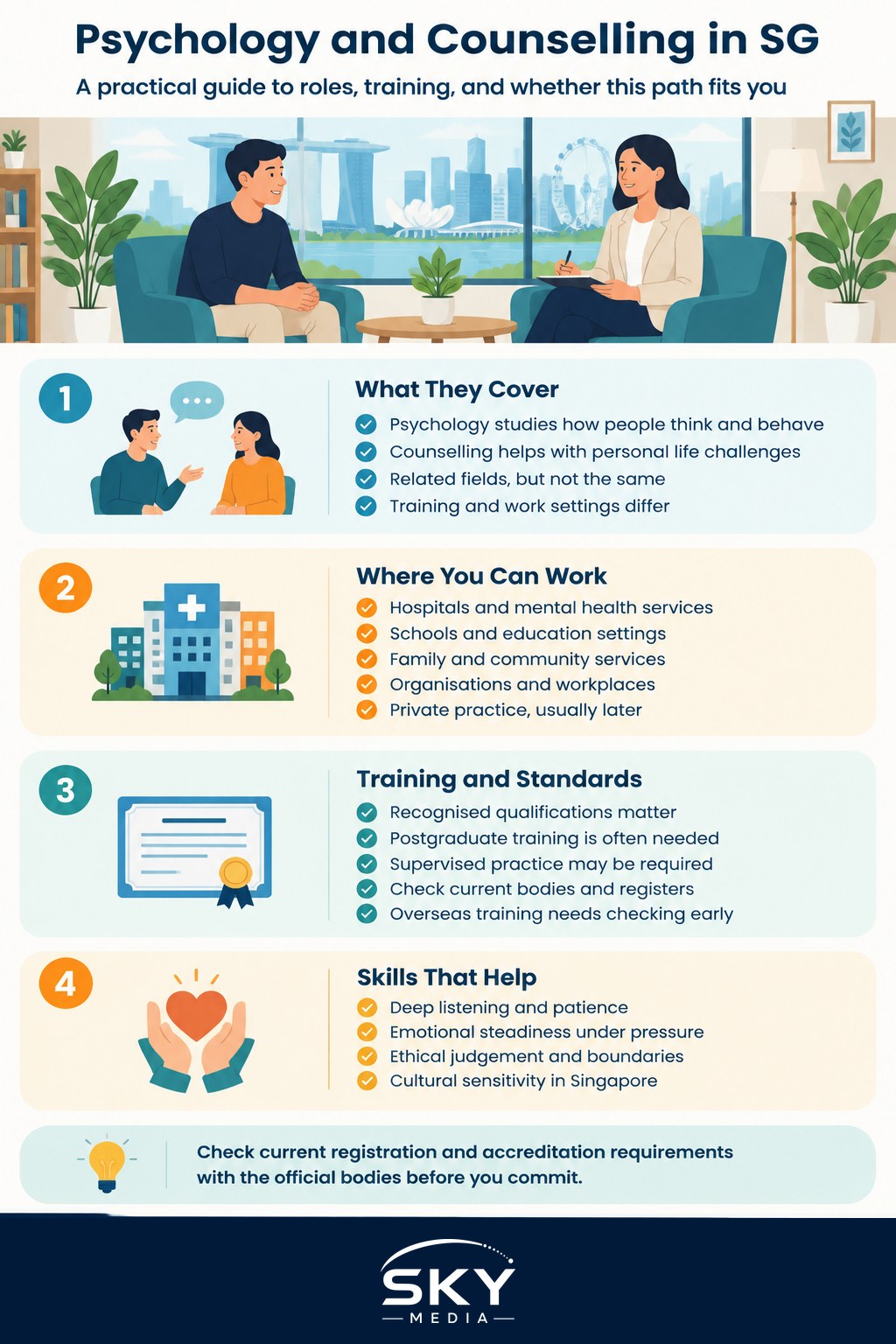
Psychology and counselling are related but not identical
People often use the words interchangeably, but they describe overlapping paths with different emphases.
- Psychology is the broader study of how people think, feel, and behave. Within it are specialised branches such as clinical psychology, which focuses on assessing and treating mental health conditions, as well as educational, organisational, and forensic psychology.
- Counselling focuses on helping people work through personal, relationship, and life challenges through talking and structured support. Counsellors work in schools, family service settings, workplaces, and community organisations.
Both draw on similar skills, but the training routes, the depth of clinical work, and the settings differ. It helps to learn what each actually involves before deciding which fits you.
Where the work happens
In Singapore, psychology and counselling professionals work across a range of settings:
- Healthcare, including hospitals and mental health services, where clinical work is more intensive.
- Schools and education, supporting students with learning, behaviour, and wellbeing.
- Family and community services, helping individuals and families through crises and long-term challenges.
- Organisations, where organisational psychologists support hiring, wellbeing, and team performance.
- Private practice, which usually comes later, after significant supervised experience.
There is growing attention to mental health locally, which has raised interest in these fields. That is encouraging, but it does not guarantee an easy path, and roles can be competitive.
Qualifications, registration, and standards
This is the part to take seriously. Psychology and counselling in Singapore are professional fields with recognised qualifications and registration or accreditation frameworks. To practise, especially in clinical or counselling roles, you generally need relevant postgraduate training, supervised practice, and registration or accreditation with the appropriate professional body.
Because the specific requirements, recognised programmes, and titles can change, do not assume. Check the current standards directly with the relevant professional bodies and registers for psychology and for counselling in Singapore. If you trained overseas, confirm early how your qualifications are viewed here and what additional steps apply. Treat this article as an overview, not the official rulebook, and let the accrediting bodies give you the exact picture.
If you are early in your thinking, our guide on choosing your first career path can help you weigh a long training commitment before you begin.
Skills and temperament that matter
Beyond the academic route, certain qualities make this work sustainable.
- Deep listening. The ability to hear what someone means, not just what they say.
- Emotional steadiness. You need to stay grounded when others are distressed, and to look after your own wellbeing too.
- Ethical judgement. Confidentiality, boundaries, and doing no harm are central.
- Cultural sensitivity. Singapore is multicultural, and good practitioners adapt to different backgrounds and beliefs.
These strengths overlap with other people-centred fields. Strong emotional intelligence at work is useful here and in many related roles, and some people find their fit in the wider social services sector instead.
Is it the right fit for you?
Be honest about the demands. The training is long, entry into clinical roles is competitive, and the emotional load is real. Burnout is a genuine risk in helping professions, so self-care and supervision are not optional extras. The reward is work that can genuinely change lives, including your own understanding of people.
A smart early step is to talk to practitioners about their actual week. Use the approach in our guide on how informational interviews work to ask honest questions about the highs and the strains.
Getting started
If this path still calls to you, move deliberately. Build a strong foundation in psychology, confirm the current registration and accreditation requirements with the official bodies, and seek supervised or volunteer experience to test whether the day-to-day suits you. Outcomes vary and the road is long, so go in with realistic expectations and steady, ethical effort. Approached this way, a psychology career in Singapore can be one of the most quietly rewarding paths you could choose.