
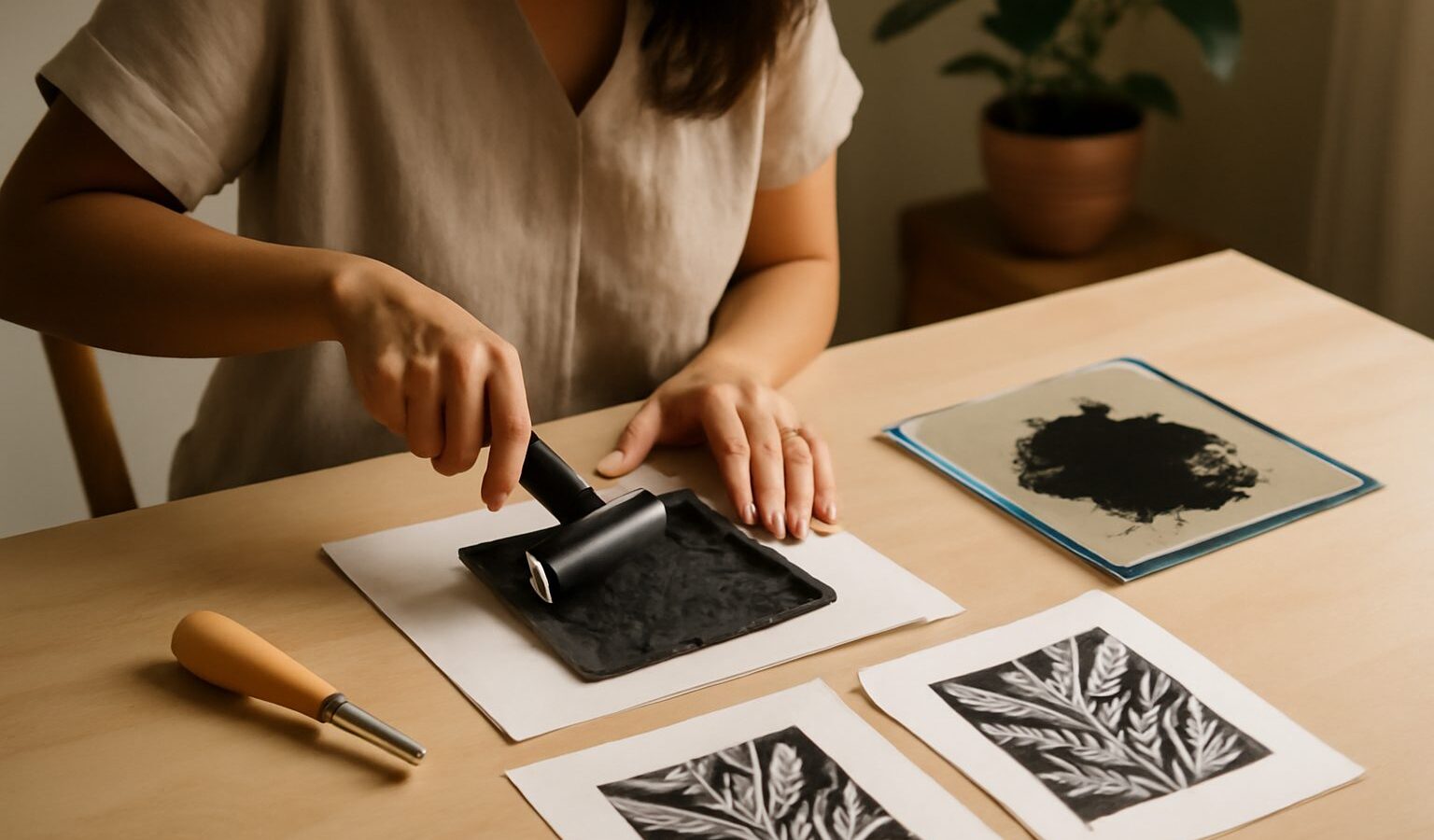
There is a small thrill in printmaking that few other art forms give you: the moment you peel a fresh print away from a block or screen and see your design appear, clean and complete. Printmaking is the craft of making art you can reproduce, transferring an image from a prepared surface onto paper or fabric, often many times over. It sits at a happy meeting point of drawing, design and hands on making, which is why so many beginners fall for it. This guide is a warm, jargon free introduction for anyone in Singapore who is curious to try.
You do not need a studio full of heavy presses to begin. Some of the most rewarding methods start with a rubber block, a simple tool and a spoon. Others, like screen printing, open up once you join a shared studio. Let us look at the main families of printmaking, what each feels like to do, and where you can get your hands inky nearby.
What Printmaking Actually Is
At its heart, printmaking means creating a design on one surface, the matrix, then inking it and pressing it onto paper or cloth to make an impression. Because the matrix can be reused, you can pull a whole series of prints, called an edition, that are all closely related but each subtly unique. That reproducible quality is what separates it from painting or drawing, where every piece is one of a kind.
The appeal for beginners is threefold. First, it is process led, so you are guided by clear steps rather than a blank page and the pressure to be spontaneous. Second, it is forgiving in its own way, because you can test proofs and adjust before committing to a final run. Third, the results look polished and confident even when your skills are still young, thanks to the crisp graphic quality the medium naturally produces. Many people who feel they “cannot draw” discover they can absolutely design a strong print.
The Main Methods to Know
Printmaking is really a family of related techniques. Understanding the broad categories helps you pick a friendly starting point rather than feeling lost among unfamiliar terms.
- Relief printing: you cut away the parts you do not want to print, so the raised surface carries the ink. Lino printing and woodcut belong here. This is the classic beginner entry, cheap and satisfying.
- Screen printing: ink is pushed through a fine mesh screen with a squeegee, with a stencil blocking out the areas that stay blank. This is how many posters and printed tees are made.
- Intaglio: the image is cut or etched into a metal plate, ink sits in the grooves, and a press forces paper into them. Etching and drypoint live here and usually need studio equipment.
- Monotype and monoprint: you paint or roll ink onto a smooth plate and print it, making a single, painterly impression. It is a lovely, loose bridge between painting and printing.
You do not need to learn all of these. Most people start with lino or a simple stamp based method, enjoy it, and only later explore screen printing or the press based techniques once a studio is within reach.
Getting Started Without a Big Studio
The good news for anyone in a compact Singapore flat is that relief printing needs very little. A soft cutting block, a set of basic cutting tools, a small tube of water based block printing ink, a roller called a brayer, and a smooth surface to roll ink on are enough. You transfer the ink by pressing paper onto the block and rubbing the back with the bowl of a spoon, so you can make real prints with no press at all.
A safe, sensible first project looks like this.
- Sketch a simple design with bold shapes. Fine detail is hard at first, so keep it graphic and clear.
- Transfer or draw it onto the block, remembering that your image will print in reverse, which matters most for any lettering.
- Carve away everything you want to stay white, always cutting away from your hand holding the block for safety.
- Roll a thin, even layer of ink across the raised surface with your brayer.
- Lay paper on top, rub firmly with a spoon, then peel back slowly to reveal your print.
Work in a ventilated spot, choose water based inks for easy clean up with soap and water, and protect your table with newspaper or an old mat. Keep every proof, because the “mistakes” often teach you the most about how much ink and pressure your block likes.
Lino, Screen or Monotype: Choosing Your First Path
If you are unsure which method to try first, this comparison lays out how the three most beginner friendly approaches differ in cost, space and feel. There is no wrong choice; pick the one whose vibe appeals to you.
| Aspect | Lino / Relief | Screen Printing | Monotype |
|---|---|---|---|
| Kit cost to start | Low | Medium to high | Low |
| Space needed | A tabletop at home | A shared studio is ideal | A tabletop at home |
| Best for | Bold graphic images, cards | Posters, tote bags, tees | Loose, painterly one offs |
| Editions | Many prints from one block | Many prints from one screen | Usually just one impression |
| Beginner feel | Tactile and methodical | Punchy and design led | Free and experimental |
A practical route many locals take is to begin with lino at home to learn how ink and paper behave, then book a screen printing taster at a studio when they want to print onto fabric or make bolder multicolour posters. Each method teaches something that carries over to the others.
Where to Learn and Print in Singapore
Once you are hooked, Singapore has welcoming ways to go deeper. Independent print studios run beginner workshops and offer members access to presses and screen printing equipment you would not keep at home. Community clubs and arts schools hold short introductory courses, and public institutions such as the National Gallery and the National Library sometimes programme hands on printmaking sessions or exhibitions that show the craft in context. Craft markets and open studio events are a friendly place to meet local printmakers, see their process and pick up tips.
Because schedules, class fees and studio membership terms change from season to season, always check directly with the studio, club or venue for current details before you plan a visit. When you buy tools and inks, a specialist art supply shop can point you to beginner friendly, water based materials, which keep clean up simple and your home practice fume free.
Most of all, give yourself permission to make rough early prints. Printmaking is a craft you learn in your hands, one pull at a time, and that steady, tactile progress is exactly the pleasure of it. Start small, print often, and enjoy the quiet magic of lifting each fresh sheet.
Explore more
Keen to keep making? If you would like a painting companion to your prints, try our guide to watercolour painting for beginners in Singapore. You might also enjoy learning to draw as an adult to strengthen the designs you carve, or visit artist studios and open studios in Singapore to see printmakers at work.