

You have picked out a new fridge or laptop in the sale, and at the counter comes the question: “Would you like two more years of warranty?” But is an extended warranty worth it in Singapore, or are you paying for cover you already have, or will never use?
This guide is a decision tool for that moment. It does not re-explain your basic consumer rights or how to make a claim. Instead, it helps you weigh a store’s extended plan against the free cover you may already get from your credit card, and decide item by item.
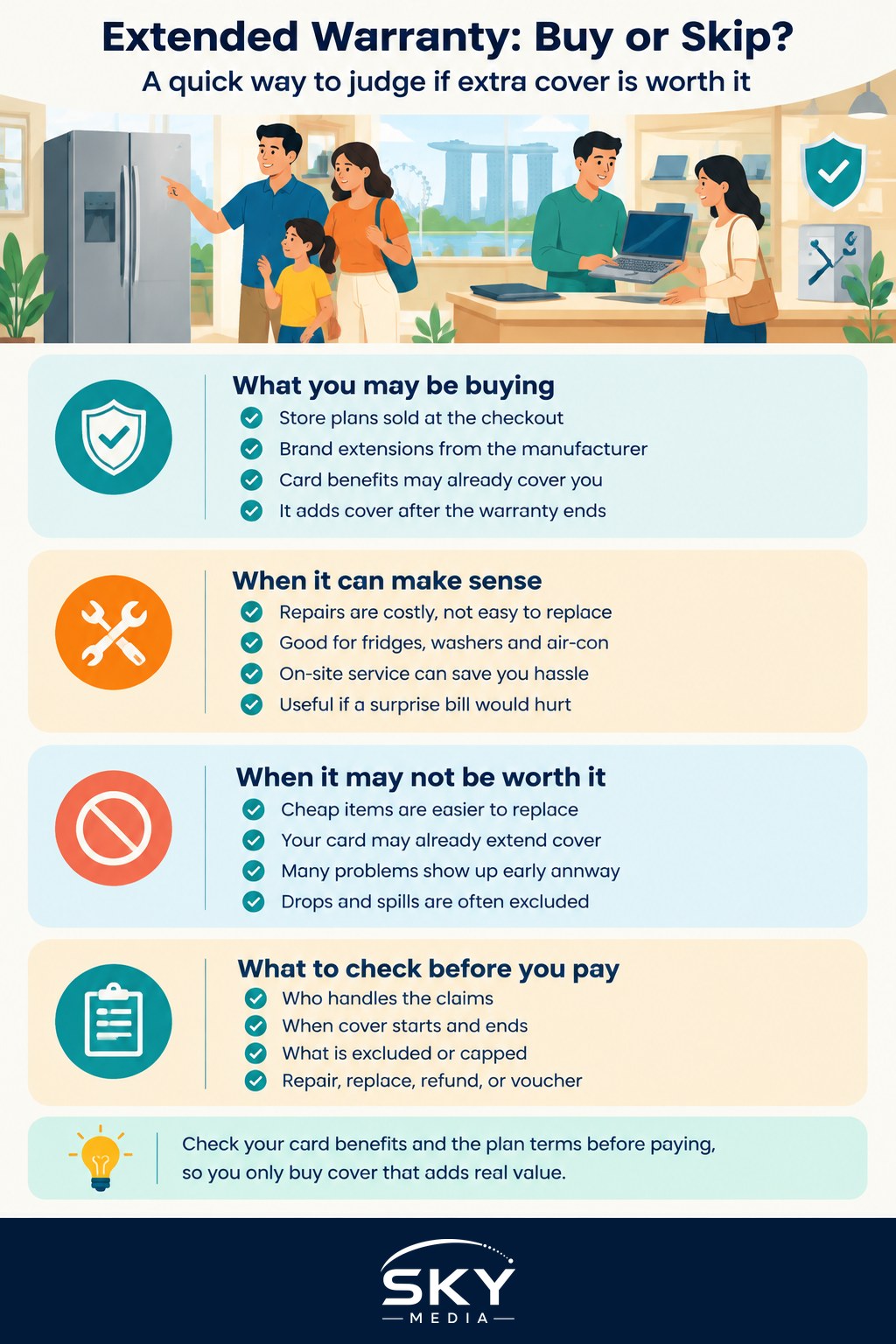
What You Are Actually Being Sold
An extended warranty is a service contract that continues repair cover after the manufacturer’s warranty ends. In Singapore you will usually meet three types:
- Store or retailer plans. Offered at the till by electronics and appliance chains. They are often run by a third-party provider or insurer, not the store itself.
- Manufacturer extensions. Some brands sell their own extended cover, typically through their website or authorised service centres, and sometimes bundled during promotions.
- Credit-card purchase cover. Some credit cards include extended warranty or purchase protection as a card benefit when you pay with that card. Coverage, caps and eligibility differ widely between cards and can change, so the card’s benefit terms are what count.
Remember that you already have some protection by default. The manufacturer’s warranty covers defects for its stated period. Separately, Singapore’s lemon law under the Consumer Protection (Fair Trading) Act gives you remedies when goods are defective at the time of purchase, including a presumption for defects that show up within the first six months. Our explainer on warranty and consumer rights for electronics covers those rights in detail. An extended warranty only adds value beyond what these already provide.
Store Plan vs Credit-Card Cover vs Going Without
| Option | What you pay | Typical strengths | Watch out for |
|---|---|---|---|
| Store extended plan | Upfront fee at purchase | Clear process, often includes pick-up or on-site repair for large appliances | Exclusions, claim caps, provider not being the store |
| Manufacturer extension | Upfront fee, sometimes promotional | Repairs by authorised service centres with genuine parts | May need registration within a set window |
| Credit-card cover | Nothing extra if you pay with the card | Automatic once conditions are met | Card terms, claim paperwork, caps per item or per year |
| No extra cover (self-insure) | Nothing | Keep the money for repair or replacement later | You absorb the full cost of a late failure |
None of these is automatically best. The right choice depends on what you are buying, how much a repair would cost, and how much a surprise bill would hurt.
When an Extended Warranty Tends to Make Sense
Extended cover is most worth considering when several of these are true at once:
- The item is expensive to repair, not just to replace. Large appliances such as washing machines, fridges and air-conditioners can need costly parts like compressors, motors or control boards. A single out-of-warranty repair can be a meaningful share of the purchase price.
- The product has many moving or electronic parts. Devices with motors, pumps or complex boards have more that can go wrong than, say, a simple fan.
- On-site service matters to you. For a fridge or washer, a plan that sends a technician to your HDB flat or condo can save you the hassle of arranging transport.
- A sudden repair bill would strain your budget. If an unexpected few hundred dollars would cause real stress, a fixed fee now buys predictability. That is a fair reason, even if it is not the cheapest option on average.
When It Usually Is Not Worth It
On the other side, the extra cost is often hard to justify when:
- The item is cheap or replaced often. Small kitchen appliances, accessories and budget gadgets rarely cost much to replace. Before buying cover on smaller add-ons, see our take on tech accessories that are worth buying and simply buy well.
- Your credit card already extends the warranty. Paying twice for overlapping cover is a common waste. Check your card benefits before you reach the counter.
- Most failures happen early. Many defects appear in the first months, when the manufacturer’s warranty and lemon law already apply.
- The plan excludes the likely problem. Phones, laptops and tablets more often suffer drops, spills and cracked screens than internal faults. Standard extended warranties usually exclude accidental damage unless you buy a separate accidental damage plan.
- You will upgrade soon. If you swap phones every two years, cover that starts in year two may barely be used.
Read These Terms Before You Pay
Ask to see the plan terms, or look them up on your phone at the counter. The questions below cover most of the fine print:
- Who is the provider? Note the company that handles claims and how to reach them. If the store closes or changes partners, you need to know who honours the plan.
- When does cover start and end? Some plans run from the purchase date and overlap the manufacturer’s warranty, so a “three-year plan” may only add one or two extra years.
- What is excluded? Look for accidental damage, wear and tear, consumable parts such as batteries and filters, cosmetic damage, and faults from power surges or pests.
- Is there a claim cap? Many plans limit total payouts to the purchase price, and some end after one replacement.
- Repair, replace or refund? Check whether they repair first, replace with an equivalent model, or offer a voucher instead of cash.
- Is there an excess or call-out fee? Some plans charge per claim or visit.
Making Credit-Card Cover Work for You
If your card offers extended warranty or purchase protection, a few habits make claims smoother later:
- Pay the full amount with that card. Some benefits apply only if the whole purchase, not just a deposit, is charged to the eligible card.
- Register the product if the card or brand requires it. Some benefits have a registration step within a certain time after purchase.
- Keep every document. Itemised receipt, card statement, the manufacturer’s warranty card and serial number. Our guide on how to digitise receipts and warranties shows simple ways to keep them findable years later.
- Check the current benefit terms. Card benefits are updated from time to time. Read the latest terms on the bank’s website or call the bank before relying on them.
Deciding at the Counter
If your card already extends the warranty, or you could comfortably absorb a repair bill, you can usually decline politely. If the item is a costly appliance with expensive parts, you will keep it for years, and the terms are clear, a plan can be a reasonable buy. Sale-season pricing sometimes discounts plans too, but a discount on cover you do not need is still money spent.
Cars and EVs work differently, with their own warranty structures. If that is your big purchase, see car warranties explained.
Where to Get Help if Things Go Wrong
If a provider refuses a claim you believe is valid, first ask for the refusal in writing and check it against the plan terms. If you cannot resolve it, the Consumers Association of Singapore (CASE) assists consumers with disputes against businesses, and the Small Claims Tribunals hear many consumer claims under a set value limit. Procedures and limits can change, so check the current details on the official CASE and Small Claims Tribunals websites.
This guide is general information, not financial advice. Plan terms, card benefits and consumer rules vary and change, so confirm details with the retailer, the plan provider or your bank before you buy.
Official sources: CASE (Consumers Association of Singapore)