

Mid-year exams are over and the June holidays are a natural time to think about what comes next. If you love clothes, sketch outfits in the margins of your notebooks or already alter your own pieces, a fashion design course in Singapore could be the next step. The tricky part is that there is no single route. You can take a diploma, go straight for a degree, or start with short courses to test the waters. This guide compares those routes so you can pick the one that fits your stage, budget and goals.
Course names, entry requirements and fees change from year to year, so treat this as a starting map and confirm details on each institution’s official website before applying.
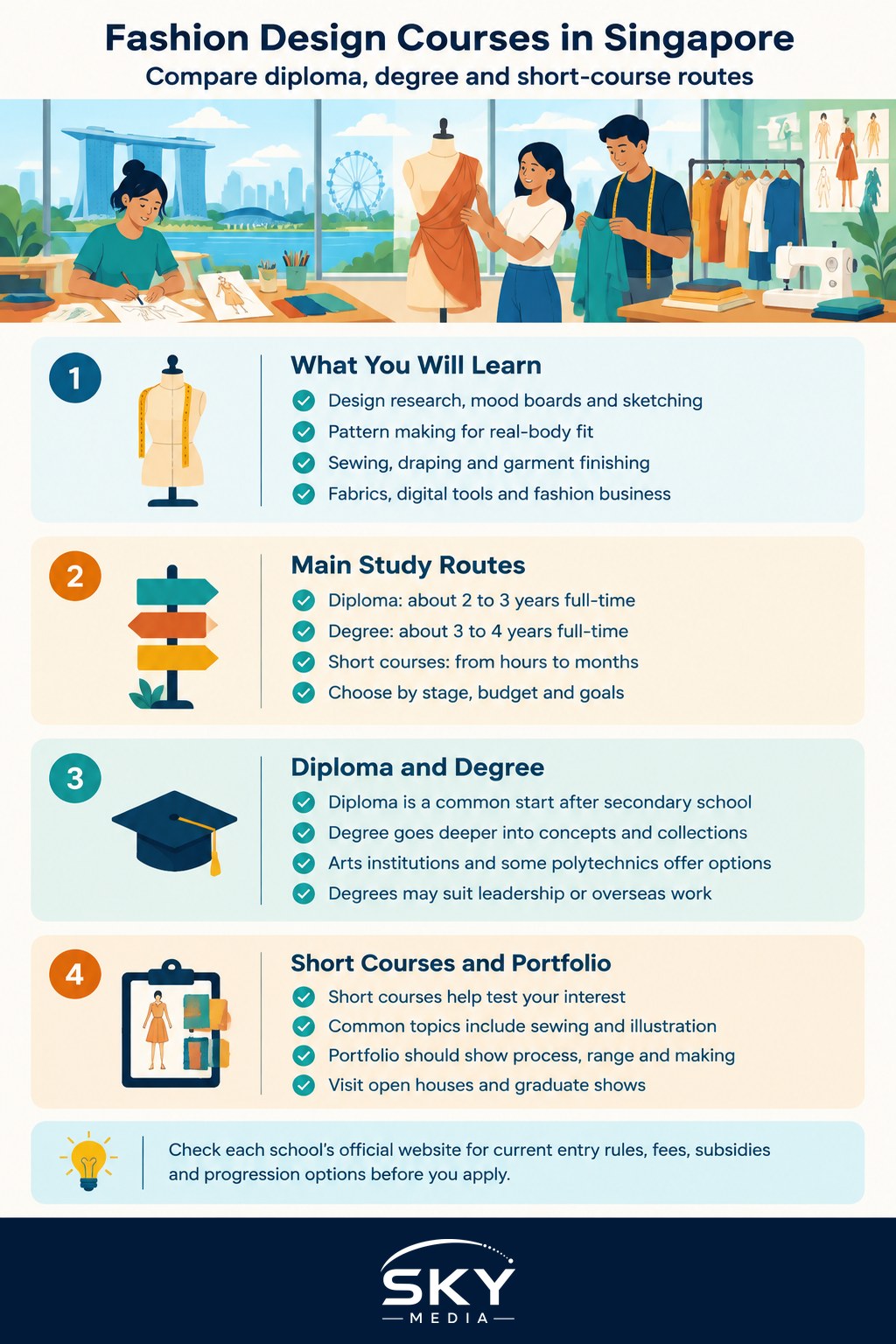
What Fashion Design Study Actually Involves
Fashion design is much more than drawing pretty dresses. Most serious programmes combine creative and technical work, and it helps to know what you are signing up for.
- Design and illustration: research, mood boards, sketching and developing a collection around a concept.
- Pattern making: turning a 2D design into flat pattern pieces that fit a real body.
- Garment construction: sewing, draping on a dress form, finishing and fitting.
- Textiles and materials: how fabrics behave, dyeing, printing and sourcing.
- Digital tools: design software, digital pattern making and, increasingly, 3D garment simulation.
- Business and context: fashion history, branding, merchandising, marketing and, more and more, sustainability.
Expect long studio hours, a lot of hands-on making and regular critiques where lecturers and classmates comment on your work. If you enjoy that kind of feedback and iteration, you will likely thrive.
The Three Main Routes Compared
Here is a side-by-side look at the main pathways into fashion design.
| Route | Typical length | Entry focus | Good for |
|---|---|---|---|
| Diploma (arts institution or polytechnic) | Around 2 to 3 years full-time | O-Level or equivalent results, plus portfolio or interview for many | Students after secondary school who want hands-on, industry-ready skills |
| Degree (bachelor’s) | Around 3 to 4 years full-time | A-Level, diploma or equivalent, plus portfolio and interview | Those aiming for design leadership, further study or overseas work |
| Short courses and certificates | A few hours to several months, part-time | Usually open entry | Testing your interest, building a portfolio, adults switching careers |
Lengths are general guides only. Some degree programmes give credit to diploma holders, so a diploma can sometimes shorten the path to a degree. Check each programme’s own entry and progression rules.
The Diploma Route
A diploma is the most common starting point for students leaving secondary school. In Singapore, fashion-focused diplomas have traditionally been offered by the arts institutions, which now come together under the University of the Arts Singapore (UAS), alongside its member colleges LASALLE College of the Arts and the Nanyang Academy of Fine Arts (NAFA). Some polytechnics have also offered design diplomas with fashion, apparel or related tracks over the years, so look carefully at current course lists.
Why choose a diploma:
- Practical from day one. You will sew, cut patterns and make garments early.
- Industry links. Many programmes include internships, live projects with brands and a graduation show.
- A strong portfolio. By the end, you should have a body of work to apply for jobs or a degree.
Things to check: whether you need a portfolio or interview, whether the course is eligible for government subsidies for your citizenship status, what tuition grants apply, and what equipment and materials you will need to buy yourself. If you are weighing several polytechnic or diploma options, our guide to choosing a polytechnic course offers a useful framework.
The Degree Route
A bachelor’s degree in fashion design goes deeper into concept, research and collection development. In Singapore, degree options have been available through the arts institutions as well as private education institutions, some in partnership with overseas universities. Many Singaporeans also study fashion abroad.
Why choose a degree:
- Deeper creative development. More time to find your own design voice and build a final collection.
- Wider career options. Useful for roles in design direction, brand development, education or curating, and for postgraduate study.
- International recognition. Helpful if you plan to work overseas.
Questions to ask:
- Is the degree awarded by the institution itself or by a partner university?
- If it is a private institution, is it registered with the Committee for Private Education (CPE), which falls under the Skills and Workforce Development Agency (SWDA, formed in 2026 from Workforce Singapore and SkillsFuture Singapore)? Check the official CPE register.
- What is the total cost, including materials, fabric for collections and any overseas trips, not just tuition?
- What do recent graduates go on to do? Ask to see graduate show work.
Short Courses and Part-Time Options
You do not have to commit to years of study straight away. Short courses are a smart way to test your interest during the school holidays or alongside work.
Common short course types include:
- Basic sewing and machine skills
- Pattern making and garment construction
- Fashion illustration and sketching
- Upcycling and alterations, which tie in well with sustainable fashion
- Digital fashion design software
- Fashion business, styling and merchandising
You will find these at arts institutions’ continuing education arms, private design schools, community centres and independent studios. Adults may find some courses are eligible for SkillsFuture Credit or are run as WSQ (Workforce Skills Qualifications) courses. Our guide to WSQ courses explains how these work. Always confirm eligibility on the official SkillsFuture website before you sign up.
When choosing a short course, check class size, how much hands-on time you get, whether materials are included, and the cancellation and refund terms.
Building a Portfolio Before You Apply
Many diploma and degree programmes ask for a portfolio. It does not need to be professional, but it should show your thinking and potential.
- Show your process. Include rough sketches, mood boards and notes, not only finished drawings.
- Show range. Mix fashion sketches with other art, photography or textile experiments.
- Show making. Photos of garments you have sewn or altered, even simple ones, help a lot.
- Show your interests. A small project inspired by local culture, such as a modern take on the kebaya or cheongsam, can stand out.
- Keep it focused. Quality matters more than quantity. Follow each school’s portfolio guidelines exactly.
Visiting graduate shows and open houses is one of the best ways to see what each school values and to ask current students honest questions.
Where Fashion Study Can Lead
A fashion qualification opens more doors than becoming a designer with your own label. Graduates commonly work as assistant designers, pattern makers, textile designers, product developers, merchandisers, buyers, stylists, costume designers for theatre and film, fashion marketers and content creators. Some start small labels or online stores after gaining industry experience.
The industry is competitive, so internships, networking and a strong portfolio matter as much as the certificate. Think about which part of fashion excites you most, then choose the route that builds those skills. Whichever path you pick, a fashion design course in Singapore is a real investment of time and money, so research carefully, talk to students and graduates, and choose with your eyes open.