

Signing up for a course is easy. Undoing a poor choice two years later is not. Whether you are picking a polytechnic diploma, a university degree, a part-time certificate or a short skills course, the key to choose the right course is to ask sharper questions before you enrol. Glossy brochures and open house booths tell you what a course offers. They rarely tell you whether it suits you, where it really leads or what you are giving up to take it.
This guide is not about study techniques. It is about avoiding bad course decisions by questioning outcomes, fit and trade-offs properly. For a broader look at matching interests and careers, see our guide on choosing a course and career fit.
Why Most Course Decisions Go Wrong
Common reasons students end up in the wrong course include:
- Choosing based on a friend’s choice, a parent’s wish or a single exciting module.
- Assuming a course title tells you the job you will get.
- Focusing on admission scores rather than daily content.
- Not asking what the work is actually like once you graduate.
- Underestimating the time, money and energy a course demands.
Each of these can be prevented with the right questions, asked early.
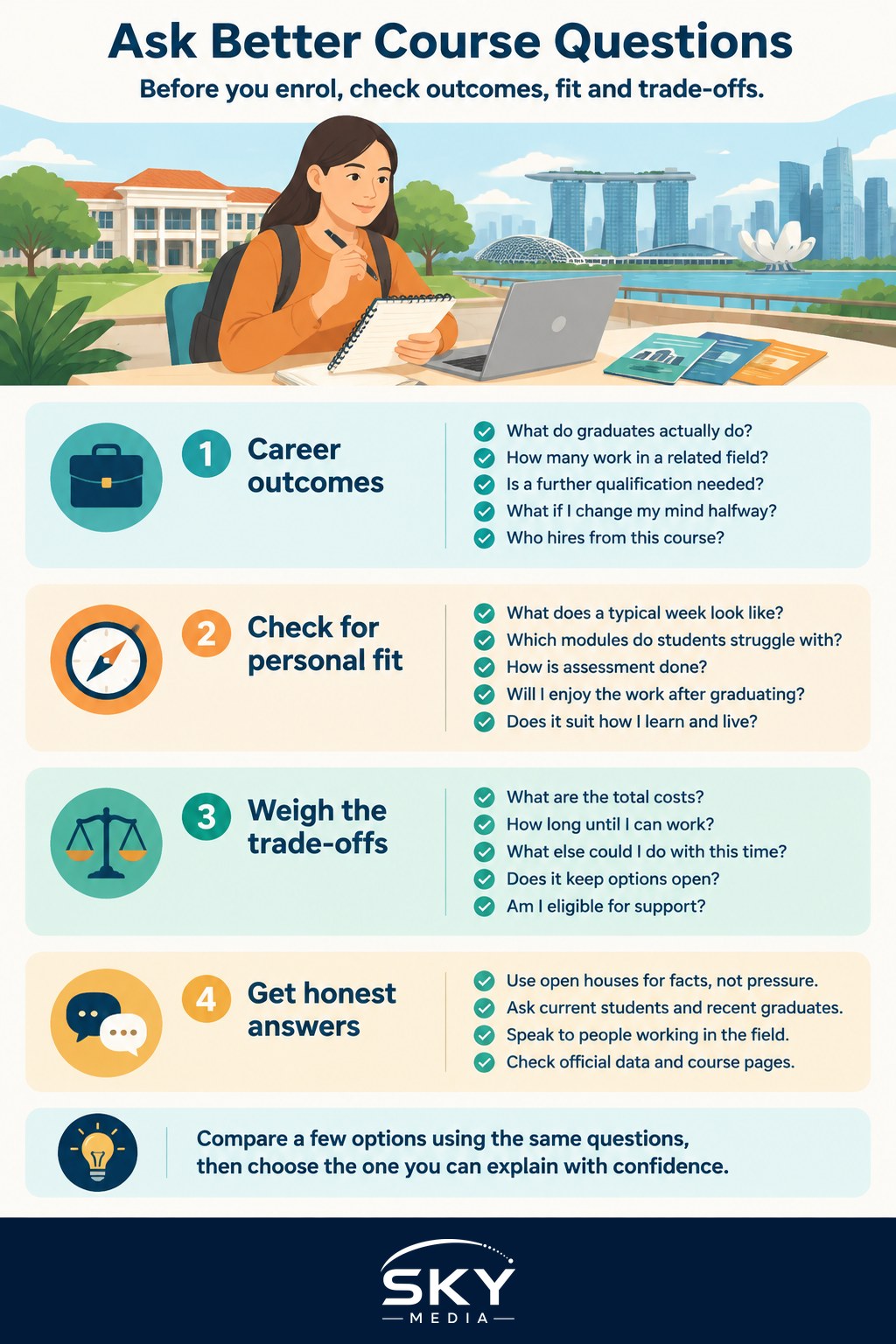
Questions About Career Outcomes
These help you test whether a course really leads where you think it does.
“What do graduates of this course actually do?” Ask for typical job roles and industries, not just success stories. A course with broad outcomes may suit you if you are still exploring; a narrow one suits you if you are certain.
“How many graduates work in a related field?” Institutions here often publish graduate employment information, and the Ministry of Education (MOE) releases graduate employment survey results for the autonomous universities and polytechnics. Read these with care: they show averages, not guarantees, and figures vary by year.
“Is a further qualification normally needed?” Some careers expect a degree, professional exam or licence after the course. Know the full path, not just the first step.
“What would I do if I changed my mind halfway?” Ask whether credits transfer, whether you can switch courses and how others have used the qualification in different fields.
“Who hires from this course?” Employers who regularly recruit from a course, offer internships or sit on industry panels give useful clues about its real-world value.
Questions About Fit
Outcomes only matter if you can thrive along the way.
- “What does a typical week look like?” Lab work, group projects, essays, coding, fieldwork and presentations each suit different people. Ask current students, not just staff.
- “Which modules do students struggle with most?” If the hardest part is something you dislike, think carefully.
- “How is assessment done?” Exam-heavy and project-heavy courses reward different strengths.
- “Will I enjoy the work after graduating, not just the course?” A fun course can lead to a job you find dull, and the reverse can also be true.
- “Does it match how I learn and live?” Consider class times, travel, workload and whether you need to work part-time.
A good test is to try the work before you commit: a short online module, a related project, a holiday job or a conversation with someone in the field. Our guide on how to ask better questions has tips for getting honest answers from these conversations.
Questions About Trade-offs and Cost
Every course costs something beyond fees.
| Trade-off | Question to ask | Why it matters |
|---|---|---|
| Money | What are the total costs, including materials and living expenses? | Fees are only part of the picture; check current figures with the institution |
| Time | How many years until I can work in this field? | Longer paths delay income and experience |
| Opportunity | What else could I do with this time? | Work experience or a different course may get you further |
| Flexibility | Does this keep options open or narrow them? | Broad courses help undecided students; specialist ones suit clear goals |
| Funding | Am I eligible for subsidies, bursaries or SkillsFuture support? | Eligibility rules change, so confirm directly with the official source |
SkillsFuture is Singapore’s national programme supporting lifelong learning, including credits and subsidies for eligible courses. Eligibility and amounts depend on your age, citizenship and the course, so check the current rules on the official SkillsFuture website and with the course provider before relying on them. If you are considering a part-time or short course, our guides to short courses and microcredentials and WSQ courses explain those options in more detail.
Where and How to Get Honest Answers
Different sources give different kinds of truth. Combine several.
- Open houses and course talks. Useful for facts, but remember the institution wants to attract you. Prepare specific questions in advance.
- Current students and recent graduates. Ask what surprised them, what they would change and whether they would choose it again.
- People working in the field. A short chat with someone a few years into the career often reveals more than any brochure.
- School counsellors and education and career guidance (ECG) counsellors. Secondary schools, junior colleges and polytechnics have ECG support to help students explore options. Use it.
- Official data. Read published employment surveys and course pages directly rather than relying on forum rumours.
Keep notes in one place so you can compare courses fairly rather than relying on whichever talk you heard last.
Red Flags to Watch For
Pause and dig deeper if you notice:
- Vague answers about where graduates end up.
- Pressure to sign up quickly or pay deposits on the spot.
- Promises of guaranteed jobs or salaries.
- Unclear accreditation or recognition, especially for private providers. Check that the provider and qualification are recognised by the relevant authority, such as the Committee for Private Education (CPE) for private education institutions.
- A gap between how the course is marketed and what current students describe.
Turning Answers Into a Decision
Once you have your answers, rank your top options against three things: likely outcomes, personal fit and total trade-offs. Ask yourself which choice you could explain confidently to someone you respect in five years’ time.
It is fine if your answer is “not yet”. Taking time to work, try a short course or gather more information is often wiser than rushing into a long commitment. The most useful habit you can build is not picking perfectly, but asking good questions every time a big learning decision comes up. That habit will serve you well beyond this course, from internships to the questions you ask at job interviews.
Frequently Asked Questions
Is it too late to change course after I have started? Not necessarily. Many institutions allow transfers or course changes within a window, and some credits may count toward another programme. Rules differ, so speak to the school’s advisers early, find out about fees and timelines, and compare it with finishing and pivoting later.
How can I check that a private course provider is properly registered? Look up the institution on the Committee for Private Education’s register, and ask whether the qualification is awarded by the school or by an external partner. Be wary of providers who cannot show recognition, and ask for the answer in writing.
Should I follow my passion or the field that pays best? Neither alone is a safe guide. Test your interest through trial work, check realistic job paths and consider how long you could stay motivated. A field that fits your strengths and still offers decent options is often better than a pure passion or a pure paycheque.
What if my parents want a different course from the one I prefer? Listen to their concerns, then bring evidence: graduate outcomes, course content and job roles you have researched. Invite them to an open house or a chat with someone working in the field. A calm, informed conversation usually goes further than a debate.
Can I study part-time while working full-time? Many people do, through evening, weekend or online part-time programmes, but the workload can be heavy. Ask about class schedules, the number of hours outside class and whether your employer offers study leave or support. Check SkillsFuture for any funding you may qualify for.
Further reading: Training Bonds and Course Fee Clawbacks: What Employees Should Know