

At many Singapore wedding banquets, there is a moment after the march-in and before the yam seng when a parent stands up, holds the microphone a little too tightly and speaks to a room of several hundred guests. Often it is the bride’s father. A good father of the bride speech does not need to be eloquent or funny. It needs to be warm, short, clear and heard by everyone, including the grandparents who are more comfortable in Mandarin, Malay, Tamil or a dialect than in English.
This guide covers how to structure the speech, how long to make it, and how to handle more than one language without losing the room. The same advice works well if the speech is given by a mother, a guardian, or both parents together.
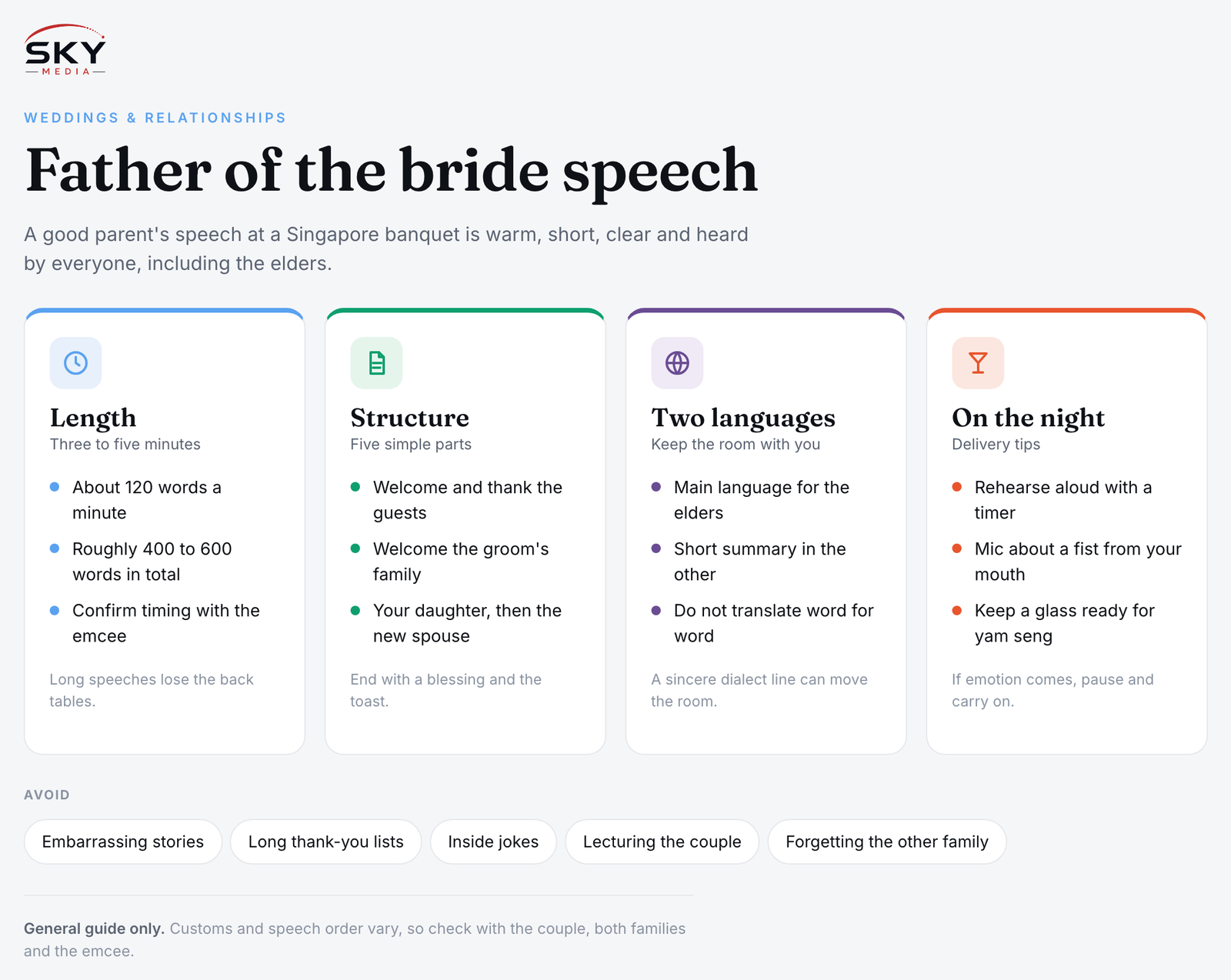
What a Parent’s Speech Is For
Speeches by the best man and maid of honour tend to be about friendship and stories from the couple’s younger days. If you want help with those, see our guide to writing a best man or maid of honour speech. A parent’s speech has a different job. It usually:
- Welcomes and thanks guests on behalf of the family, especially relatives who travelled or elders who are honoured guests.
- Acknowledges the other family, formally welcoming the groom’s parents and relatives.
- Shares a little about the bride from a parent’s point of view.
- Welcomes the new spouse into the family.
- Offers a blessing or wish for the couple’s future.
- Often leads into a toast, which at many Chinese banquets means calling for the yam seng.
Because it speaks for the family, the tone is warmer and more formal than a friend’s speech. Gentle humour is welcome, but embarrassing stories are not.
How Long Should It Be
Aim for about three to five minutes. At a typical banquet, guests are seated at round tables, the food courses are timed, and the emcee has a schedule. A speech that runs past five minutes makes the kitchen and the emcee nervous and loses the back tables.
As a rough guide, a calm speaking pace is around 120 words a minute. That puts a good speech at roughly 400 to 600 words in total, across all languages. If you are speaking in two languages, each one gets less time, so keep both versions tight.
Talk to the couple and the emcee beforehand to confirm:
- When the speech happens (often after the second march-in or before the toast)
- Whether the groom’s parent is also speaking, and in what order
- Whether you will lead the yam seng or hand back to the emcee
- Whether the couple want photos or a slideshow shown during the speech
A Simple Structure That Works
| Part | Roughly how long | What to say |
|---|---|---|
| Welcome and thanks | 30 to 45 seconds | Greet guests, thank elders and those who travelled |
| Welcome the other family | 20 to 30 seconds | Name and thank the groom’s parents |
| About your daughter | 1 to 1.5 minutes | One or two short stories or qualities |
| Welcome the new spouse | 30 to 45 seconds | What you appreciate about them |
| Blessing and toast | 30 to 45 seconds | A wish for the couple, then the toast |
Opening. Keep it simple: “Good evening, honoured elders, family and friends. On behalf of my wife and myself, thank you all for coming tonight.” Mention any special guests by name or title, such as grandparents or relatives from overseas.
The other family. “We are especially happy to welcome Mr and Mrs Tan and the whole Tan family. Tonight our two families become one.” This small gesture means a great deal to the other side.
Your daughter. Pick one or two moments, not her whole life story. A specific image works best: how she insisted on carrying her own school bag on her first day of Primary One, or how she phoned home every night during her first job overseas. Link the story to a quality, such as determination or kindness.
Your new son-in-law (or daughter-in-law). Say something real. Perhaps he fixed your phone without making you feel old, or he always walks the grandparents to the car. Then welcome him: “From today, you are not a guest in our home. You are family.”
Blessing and toast. Offer a wish, such as patience, laughter and good health, and invite everyone to raise their glasses. If you are leading the yam seng, explain it briefly for any guests who have not done it before, then lead with energy.
Speaking in Two or More Languages
Many Singapore families are multilingual, and banquets often have guests across generations and backgrounds. Some tips:
- Choose a main language based on who most needs to understand you, often the elders. Use the other language for a shorter summary.
- Do not translate word for word. Repeating every line doubles the length and tires the room. Instead, give the full speech in one language and a short version of the key points, the thanks and the blessing, in the other.
- Alternate by section if both languages matter equally: welcome in English, then Mandarin; the story in English; the blessing in both.
- Use simple sentences in your weaker language. A short, sincere line in your mother’s dialect can move the room more than a polished paragraph.
- Consider subtitles. If the couple are showing photos on screen, slides with short bilingual captions can carry part of the message.
- Watch traditional phrases. Four-character Chinese blessings, Malay pantun or Tamil verses can be beautiful. Check pronunciation and meaning with a relative who knows them well.
For cross-border families, such as a Singapore groom and a bride from mainland China, a few words in the other family’s preferred language or dialect is a thoughtful touch. Customs, expectations and even the order of speeches vary by family and culture, so ask rather than assume.
Delivery Tips for the Big Night
Even confident speakers get nervous in front of a full ballroom.
- Write it out, then speak from cue cards with large print, or from your phone with the screen brightness up and notifications off.
- Rehearse aloud several times, ideally with a timer and in front of one trusted person.
- Hold the microphone close, about a fist’s distance from your mouth. Banquet rooms are noisy, and soft voices disappear.
- Pause for laughter or applause rather than talking over it.
- Look up at different parts of the room, including the far tables.
- Keep a glass ready for the toast so you are not searching for one at the end.
- Go easy on drinks before you speak.
- Let emotion happen. If your voice cracks when you talk about your daughter, pause, breathe and carry on. Guests will be with you.
Common Mistakes to Avoid
- Telling stories about past relationships or embarrassing childhood moments
- Long lists of thank-yous that read like credits at the end of a film
- Inside jokes only three people understand
- Lecturing the couple on marriage
- Making the speech about yourself
- Forgetting to mention the other family
If you want to coordinate the look as well as the words, our guide on what parents of the couple wear to a Singapore wedding is a helpful companion, and couples writing their own words may enjoy writing your own wedding vows.
In the end, the best father of the bride speech is honest, short and full of love. Guests will not remember every word, but they will remember how proud and happy you looked as you raised your glass.