
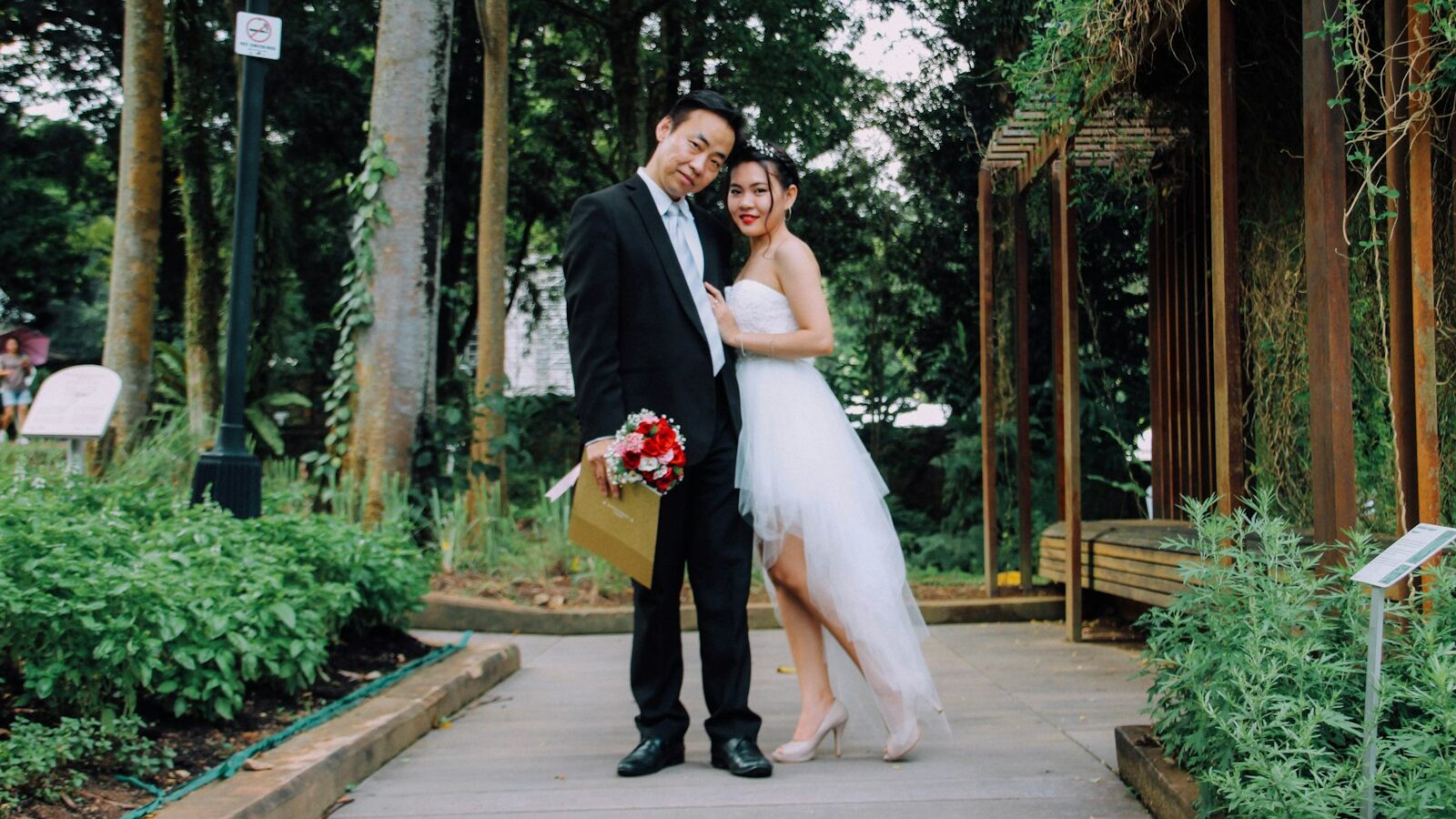
Guests can usually blend into the crowd at a wedding, but parents of the couple cannot. You stand in the family photos, greet every table, walk in during the march-in and often take part in ceremonies such as the tea ceremony or the solemnisation. That makes choosing a mother of the bride outfit in Singapore, or a suit for the father of the groom, a slightly different job from dressing as a guest.
This guide focuses on the parents. It covers what is commonly worn at Chinese, Malay, Indian and Western-style weddings here, how to coordinate with the couple, and how to stay comfortable through a long day in tropical heat. Customs vary widely by family, dialect group and religion, so treat these as commonly seen practices rather than fixed rules, and always ask the couple first.
Start With a Conversation With the Couple
Before you shop, ask the couple a few simple questions. Many already have a colour theme in mind for their parents.
- Is there a colour palette? Some couples ask both sets of parents to wear complementary tones so the family photos look cohesive.
- How many events are there? A Chinese wedding can include a morning gate-crash and tea ceremony, a solemnisation and an evening banquet. A Malay wedding may have an akad nikah (the solemnisation) and a separate bersanding (sitting-in-state) reception. You may need more than one outfit.
- Will you be on stage? If you are part of the march-in, a toast or a cake-cutting moment, choose something that photographs well from a distance.
- Are the families matching? Some families like both mothers in a similar style, such as both in cheongsam or both in kebaya. Others prefer each family to wear its own tradition.
A quick group chat between both sets of parents can avoid two mothers turning up in the same shade.
Chinese Weddings: Cheongsam, Qun Kua and Suits
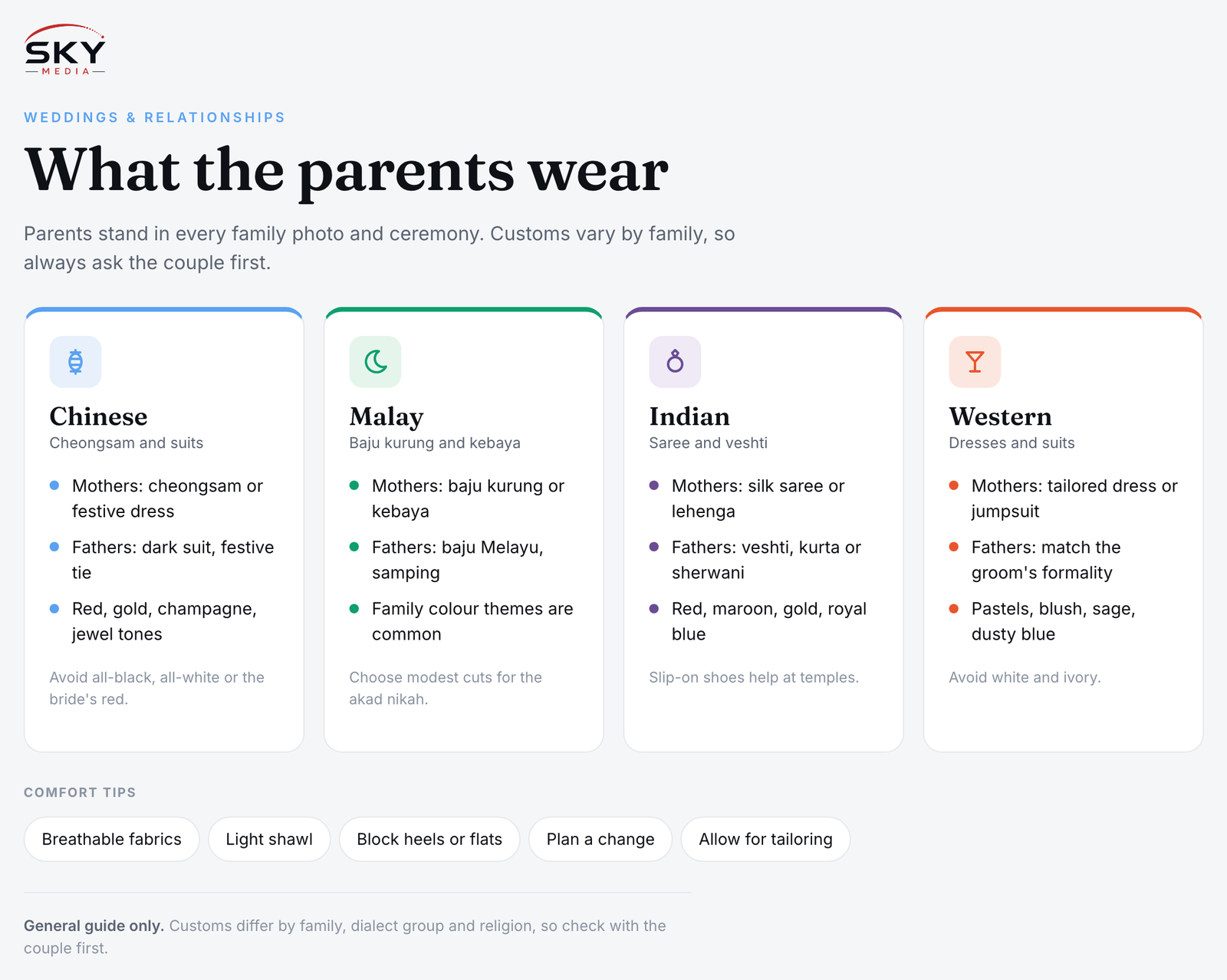
At Chinese weddings in Singapore, the mother of the bride and mother of the groom commonly wear a cheongsam (also called qipao), a modern dress in a festive colour, or a smart blouse and skirt or trouser set. For the tea ceremony, some families choose a qun kua (a traditional embroidered two-piece) for the bride, and mothers may pick a cheongsam in a coordinating tone.
Colours that are commonly favoured include red, pink, gold, champagne, burgundy and jewel tones, which are associated with joy and good fortune. Many families avoid all-black and all-white outfits, as these colours are linked with mourning in Chinese tradition. Some mothers also avoid wearing the exact red of the bride’s tea ceremony outfit so the bride stands out, so check with her.
Fathers typically wear a dark lounge suit with a tie in a festive colour, or a coordinated shirt and tie for the tea ceremony. For the evening banquet, a well-fitted suit in navy, charcoal or a dark tone is the usual choice. Our guide on what to wear for Chinese New Year touches on similar auspicious colour thinking.
Malay Weddings: Baju Kurung, Kebaya and Baju Melayu
At Malay weddings, parents usually wear traditional attire. Mothers commonly choose a baju kurung (a loose, knee-length tunic over a long skirt) or a kebaya (a fitted blouse, often embroidered, worn with a sarong or long skirt), together with a tudung (headscarf) for those who wear one. Fathers often wear a baju Melayu (a long-sleeved tunic with matching trousers) with a samping (a short sarong wrapped around the waist) and a songkok (a black cap).
Families frequently coordinate colours. It is common for the bride’s family to wear one theme colour and the groom’s family to wear another, so guests can easily tell the two sides apart in photos. Ask the couple whether there is a family colour assigned to you.
Modesty matters at Malay weddings, particularly at the akad nikah, which often takes place at a mosque or in a formal setting. Choose long sleeves, loose cuts and ankle-length hemlines, and avoid sheer fabrics.
Indian Weddings: Saree, Lehenga and Kurta
At Indian weddings in Singapore, mothers of the couple often wear a silk saree, sometimes a heavier Kanchipuram-style silk for the main ceremony, or a lehenga (a long skirt with a fitted blouse and drape) or salwar kameez for related functions. Fathers commonly wear a veshti (a white or cream wrap with a decorative border) and shirt for South Indian ceremonies, or a kurta, sherwani or bandhgala jacket for North Indian events.
Bright colours such as red, maroon, gold, orange, green and royal blue are widely worn. Many families avoid black and plain white at auspicious events, although customs differ between communities. Indian weddings may stretch across several functions, such as a mehendi, sangeet or reception, and each may have its own dress expectation, so ask for the schedule early.
If the ceremony is held at a temple, shoes are removed before entering, so pick footwear that slips on and off easily and keep shoulders covered.
Western and Church Weddings: Dresses and Suits
For church weddings, hotel solemnisations and garden weddings with a Western style, the mother of the bride usually wears a tailored dress, a dress with a jacket or a smart jumpsuit, in a colour that complements the wedding palette. Pastels, blush, dusty blue, sage and soft metallics are common. The long-standing convention is to avoid white, ivory and anything that could be mistaken for a bridal gown.
Fathers typically wear a suit that matches the formality of the groom’s outfit. If the groom and groomsmen are in tuxedos, the fathers may also wear dinner suits; if it is a day wedding, a lounge suit is usually right. For dress code terms, see our guide on what to wear to a wedding in Singapore, which covers guest attire but uses the same vocabulary.
Quick Comparison of Parent Outfits by Wedding Style
| Wedding style | Mothers commonly wear | Fathers commonly wear | Points to check |
|---|---|---|---|
| Chinese | Cheongsam, festive dress or smart set | Dark suit with a festive tie | Avoid all-black or all-white; do not clash with the bride’s red |
| Malay | Baju kurung or kebaya, with tudung if worn | Baju Melayu with samping and songkok | Family colour theme; modest cuts for the akad nikah |
| Indian | Silk saree, lehenga or salwar kameez | Veshti, kurta, sherwani or bandhgala | Multiple functions; slip-on shoes for temples |
| Western or church | Tailored dress, dress with jacket or jumpsuit | Suit or dinner suit to match the groom | Avoid white and ivory; match the event’s formality |
Dressing for Heat, Long Hours and Mixed Families
Singapore weddings often mix air-conditioned ballrooms with outdoor moments, and parents are on their feet for hours.
- Choose breathable fabrics. Silk, cotton blends and lined crepe tend to be more comfortable than heavy polyester. Bring a light shawl or wrap for cold banquet halls.
- Prioritise footwear. Block heels, wedges or elegant flats are far easier for walking table to table. Break new shoes in at home first.
- Plan for a change. If you have a morning ceremony and an evening banquet, it is common to change outfits. Arrange a room or space with the couple.
- Think about tailoring. Traditional garments, especially kebaya and cheongsam, often need fitting. Allow a few weeks for alterations, and ask the tailor about current timelines.
- Coordinate across cultures. At mixed weddings, such as a Chinese and Malay couple, parents sometimes each wear their own tradition, or both families wear one tradition for a particular ceremony. Either can look lovely when colours are coordinated.
Parents travelling from China may wish to wear a qipao or Tang-style jacket; sharing photos of past local weddings helps them know what to expect. Families working through other cross-border customs may also find our piece on bride price expectations for China-Singapore couples useful.
Accessories, Hair and Final Details
A corsage or boutonniere matching the bridal flowers is a common way to mark parents at a Western-style wedding. Gold jewellery is often worn at Indian and Chinese weddings; keep it comfortable for a long day.
If you book hair and makeup with the bridal party, confirm timing so you are ready before the first photos. Fathers should get a haircut a few days before and check shoes and ties or samping are ready.
Finally, remember that your outfit is part of the couple’s memory of the day. When in doubt, choose something that lets you move, hug, bow and smile without fuss.
Further reading: Writing a Father of the Bride Speech for a Singapore Wedding · How to Seat Divorced Parents at a Wedding in Singapore · Morning Wedding Ideas for Singapore Couples