

You paid for a renovation that was never finished, a gym that closed overnight, or a phone that broke within weeks and the shop refuses to help. When talking to the business gets you nowhere, the Consumers Association of Singapore (CASE) is often the next stop. Knowing how a CASE complaint Singapore consumers file actually works, and what to prepare, makes it far more likely you will get a result.
This guide walks through the process step by step: what CASE can and cannot do, how to lodge a complaint, how mediation works, and where to go if the matter is not resolved. It is general information, not legal advice. CASE updates its processes and any fees from time to time, so check the details on the official CASE website before you file.
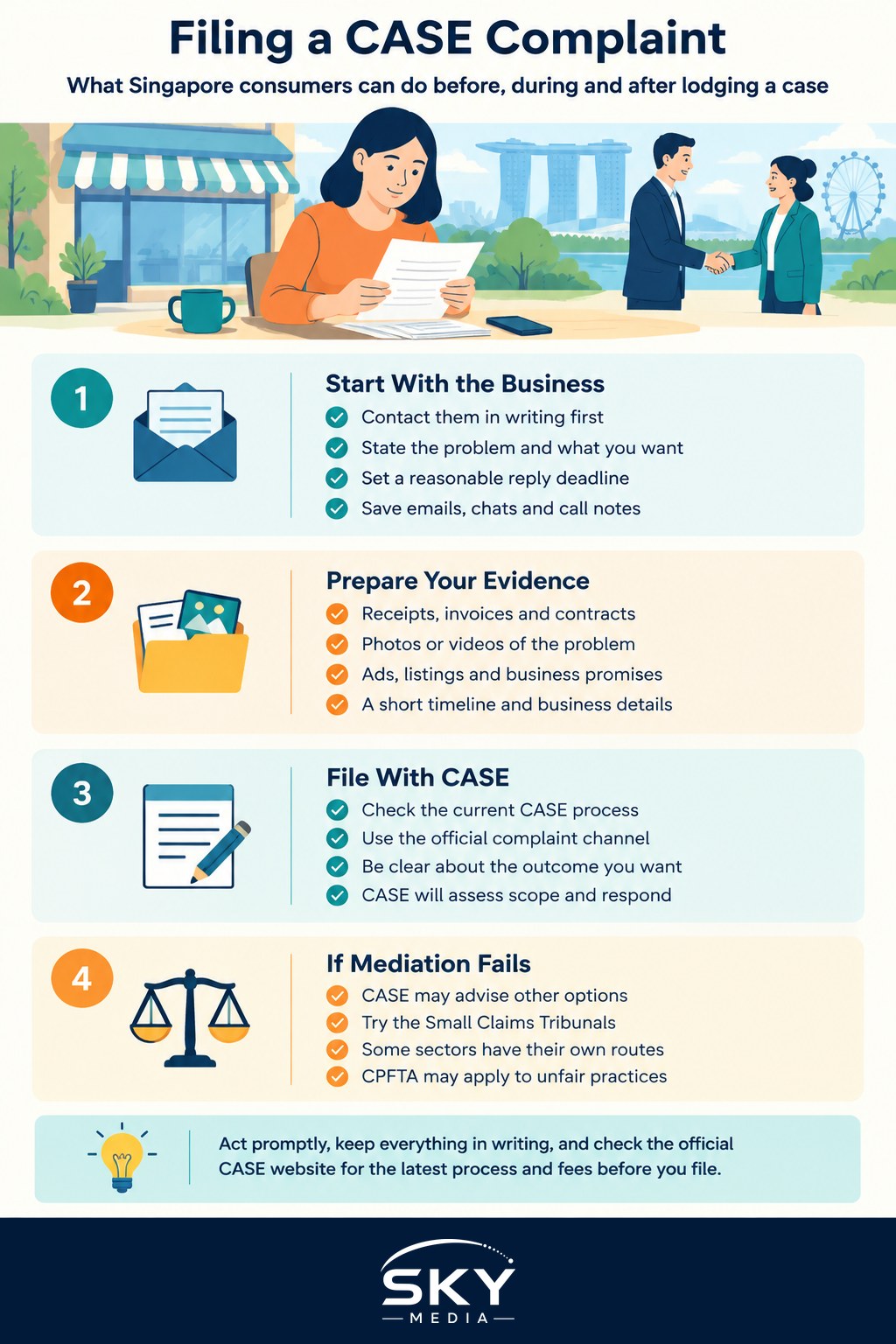
What CASE Does and Where It Fits
CASE is a non-profit organisation that helps consumers with disputes against businesses. It provides advice, handles complaints and can mediate between you and the business to reach a settlement. It also works with the Competition and Consumer Commission of Singapore (CCCS), which administers the Consumer Protection (Fair Trading) Act (CPFTA), the main law against unfair practices.
It helps to understand CASE’s limits:
- CASE is not a court. It cannot force a business to refund you or pay compensation. Mediation depends on both sides agreeing to a settlement.
- It handles consumer disputes with businesses. Disputes between private individuals, such as a sale between two people online, usually fall outside its scope.
- Some sectors have their own channels. For example, issues with banks and insurers may go to the Financial Industry Disputes Resolution Centre, and some regulated services have their own complaint routes. CASE can point you in the right direction.
Before You File: Try the Business First
CASE generally expects you to have tried to resolve the matter with the business directly. This step also creates the evidence you will need later.
- Contact the business in writing. Email or use their official channel so there is a record. State what you bought, when, what went wrong and what you want, such as a repair, replacement or refund.
- Give a reasonable deadline. For example, ask for a reply within a set number of working days.
- Keep calm and factual. A clear, polite message is more persuasive than an angry one. Our guide to writing a formal complaint or appeal letter has templates and tips.
- Save everything. Replies, screenshots of chats, and notes of phone calls with dates and names.
Step by Step: Lodging Your CASE Complaint
Step 1: Gather your evidence
Prepare these before you start the online form:
- Receipts, invoices, contracts or order confirmations
- Photos or videos of the defective product or unfinished work
- Advertisements, product listings or promises the business made
- Your written messages to the business and their replies
- A short timeline of what happened
- The business’s full name and, ideally, its Unique Entity Number (UEN), which you can find on receipts or by searching ACRA’s Bizfile, the official business registry
Step 2: Check CASE’s website for the current process
CASE accepts complaints through its official channels, typically an online form. Read the current instructions, including any membership requirements or administrative fees for mediation services, since these can change.
Step 3: Fill in the complaint form
Describe the problem clearly and briefly. State exactly what outcome you want. Vague requests such as “compensation” are harder to mediate than “a full refund of the deposit” or “completion of the remaining works by a set date”.
Step 4: Wait for CASE to assess and respond
CASE reviews whether your complaint is within its scope. It may give you advice on your rights, suggest steps to take yourself, or proceed to contact the business.
Step 5: Mediation or negotiation with the business
If CASE takes up the case, it will usually contact the business and try to facilitate a settlement. You may be asked for further documents or to attend a mediation session.
Step 6: Settlement or next steps
If you reach an agreement, make sure the terms are written down, including what the business will do and by when. If the business refuses to engage or no agreement is reached, CASE can advise on your other options.
What You Can Expect at Each Stage
| Stage | What happens | What you should do |
|---|---|---|
| Direct contact with business | You raise the problem and request a remedy | Put it in writing and keep copies |
| Filing with CASE | You submit the complaint with evidence | Be specific about the outcome you want |
| CASE assessment | CASE checks scope and may give advice | Respond quickly to requests for information |
| Mediation | CASE helps both sides negotiate | Be realistic and open to fair compromise |
| No settlement | CASE advises on other routes | Consider the Small Claims Tribunals or other bodies |
If Mediation Does Not Work
Mediation fails sometimes, usually because the business will not engage or the two sides are too far apart. You still have options.
- Small Claims Tribunals (SCT). Part of the State Courts, the SCT hears many consumer claims, including claims arising from contracts for goods and services, up to a set monetary limit. Claims are filed online through the Community Justice and Tribunals System. You generally do not need a lawyer, and there are filing fees and time limits. Check the current limits and fees on the judiciary’s website.
- Lemon law remedies. Under the CPFTA, if a product does not conform to the contract at the time of delivery, typically within a set period after purchase, you may be entitled to ask for a repair or replacement, and in some cases a price reduction or refund. CASE and CCCS publish guidance on how this works.
- Sector regulators. Some industries, such as telecommunications, travel agents and financial services, have regulators or dispute bodies with their own processes.
- Reporting unfair practices. If a business is persistently misleading consumers, CASE and CCCS can take action under the CPFTA against errant traders, even if it does not resolve your individual case.
Tips for a Stronger Complaint
- Act promptly. Evidence fades and time limits apply, especially for lemon law claims and the SCT.
- Stick to the facts. Dates, amounts, what was promised and what was delivered.
- Know what you want. A clear, reasonable remedy is easier to negotiate.
- Avoid public flame wars. Posting angry reviews before resolving the dispute can make the business less willing to settle, and you should be careful not to post anything untrue.
- Check before paying deposits in future. Look for written contracts, clear refund terms and a registered business. Prepaid packages carry extra risk if a business closes.
Most consumer disputes settle once both sides see the facts laid out clearly. Start with a written approach to the business, prepare your evidence carefully, file with CASE through its official channels, and keep the Small Claims Tribunals in mind if mediation does not resolve it.
Explore more: How to File a Pet Welfare Complaint in Singapore
Official sources: CASE (Consumers Association of Singapore)
Further reading: Cancelling a Door-to-Door Sale: The Five-Day Cooling-Off Period