

If your hairline is creeping back or your crown is thinning, finasteride is one of the first names you will hear. It is a daily pill, it is backed by a long record of clinical use, and it works on the hormone that drives most male balding. It is also a prescription medicine with side effects that deserve a calm, honest look before you start.
This guide explains how finasteride hair loss treatment works, what results are realistic, which side effects men commonly ask about, and how to get it through a doctor in Singapore. It is general information, not medical advice. Your doctor is the right person to decide whether it suits you.
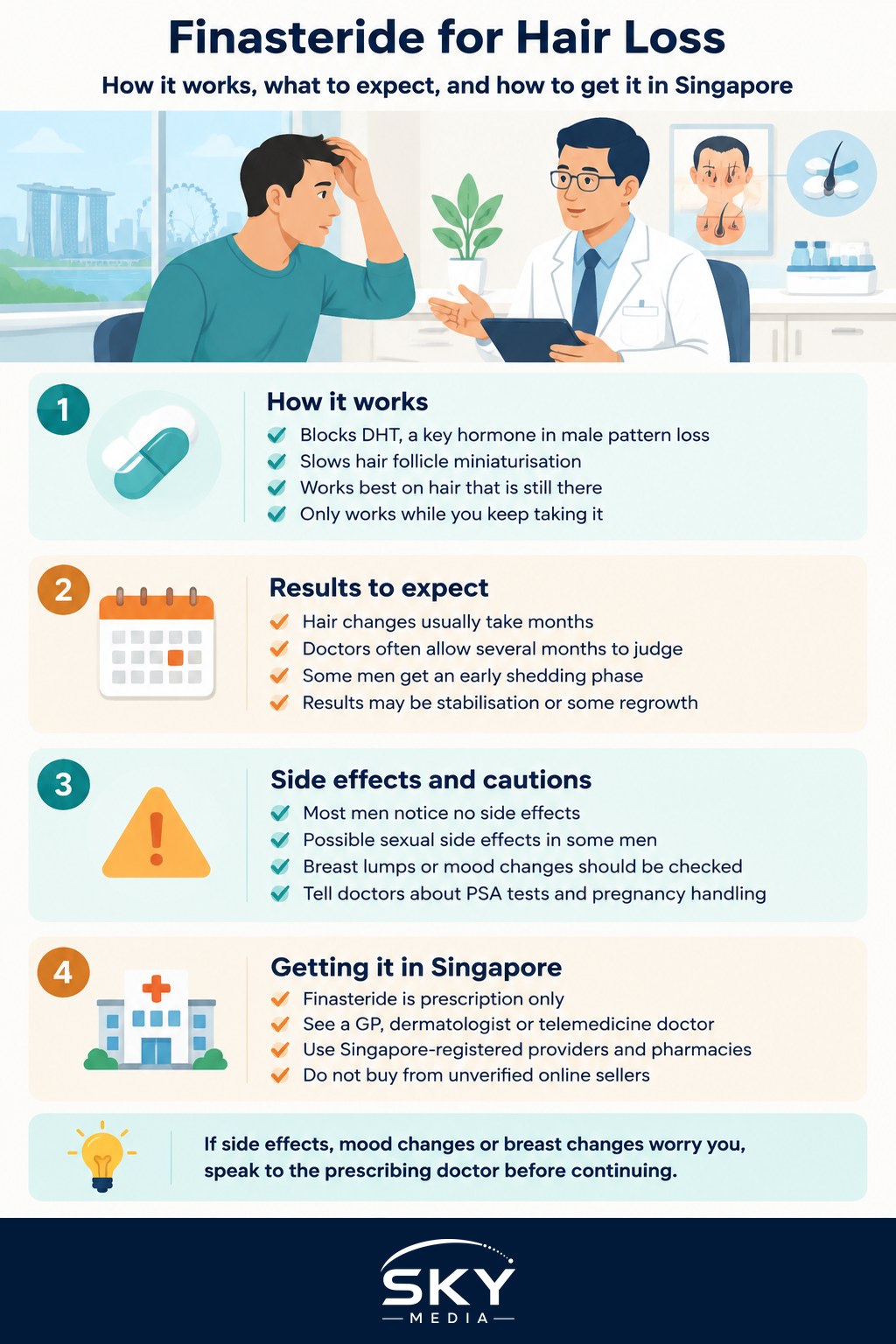
How Finasteride Works on Male Pattern Baldness
Most hair loss in men is androgenetic alopecia, usually called male pattern baldness. It tends to run in families and shows up as a receding hairline, thinning at the crown, or both.
The main culprit is dihydrotestosterone, or DHT. Your body makes DHT from testosterone using an enzyme called 5-alpha reductase. In men who are genetically sensitive, DHT gradually shrinks hair follicles on the top and front of the scalp. Each growth cycle produces a finer, shorter hair, until some follicles stop producing visible hair at all. This process is called miniaturisation.
Finasteride blocks one form of that enzyme, so less testosterone is converted into DHT. With lower DHT levels in the scalp, the shrinking process slows down. For many men it stops further loss, and for some it allows partly shrunken follicles to grow thicker hair again.
A few points follow from this:
- It treats a cause, not a symptom. That is why it is often described as a “DHT blocker”.
- It works best on hair that is still there. Follicles that have been inactive for years are unlikely to come back, so earlier treatment usually gives better results.
- It only works while you take it. If you stop, DHT levels return to where they were and the balding process resumes over the following months.
- It is for male pattern loss. Hair loss from stress, thyroid problems, iron deficiency or patchy alopecia areata needs a different approach, which is why a proper diagnosis matters first. Our overview of hair loss and thinning in Singapore covers the other common causes.
What Results to Expect, and When
Finasteride is slow. Hair grows in cycles, so any change takes months to show up in the mirror. Doctors usually ask patients to give it a fair trial of several months before judging whether it is working, and the full effect can take a year or longer.
Some men notice a short phase of extra shedding early on, as weaker hairs make way for new growth. It is commonly reported and often settles; mention it to your doctor if it worries you.
Realistic outcomes fall into roughly three groups:
- Stabilisation. Loss stops or slows a lot. For many men this is the main goal and counts as success.
- Some regrowth. Hair at the crown and mid-scalp often becomes fuller. The hairline at the temples tends to respond less.
- Little or no response. A minority of men see limited benefit. Your doctor can discuss other options.
Monthly photos in the same lighting are the easiest way to track progress.
Side Effects Men Should Know About
Most men who take finasteride report no noticeable side effects, but some do, and it is better to know about them up front. The ones most often discussed are:
- Sexual side effects. Reduced libido, difficulty getting or keeping an erection, and changes in ejaculation, such as lower volume. These affect a small proportion of users and often resolve when the medicine is stopped.
- Breast changes. Tenderness or enlargement of breast tissue. Any lump should be checked by a doctor promptly.
- Mood changes. Low mood and, rarely, depression have been reported. Tell your doctor and the people close to you if your mood shifts after starting.
- Persistent symptoms. A small number of men report sexual, mental or physical symptoms that continue after stopping, sometimes called post-finasteride syndrome. It is debated and still being studied, but it is a reason to discuss your concerns openly before starting.
There are also some practical points that are easy to overlook:
- PSA tests. Finasteride lowers the level of prostate-specific antigen (PSA) in the blood. If you have prostate screening, tell the doctor you are taking it so your result is read correctly. Our guide to men’s health checks by age explains when such screening tends to come up.
- Pregnancy and handling tablets. Finasteride can affect the development of a male baby. Women who are or may be pregnant are generally advised not to handle crushed or broken tablets. Keep the pack stored safely at home.
- Blood donation. Donors on certain medicines, including finasteride, may need to wait before giving blood. Check the current eligibility rules with the Health Sciences Authority (HSA) before you donate.
If any side effect bothers you, do not just push through in silence. Speak to the prescribing doctor, who can review your options.
Finasteride vs Minoxidil vs Doing Nothing
Finasteride is often compared with minoxidil, the topical treatment. They work in different ways and are sometimes used together. Our separate guide on minoxidil for hair loss covers the topical option in detail; here is a quick side-by-side.
| Factor | Finasteride | Minoxidil | No treatment |
|---|---|---|---|
| How it works | Lowers DHT, the hormone behind pattern loss | Stimulates follicles and prolongs the growth phase | Loss continues at its natural pace |
| Form | Daily pill | Liquid or foam on the scalp | Not applicable |
| How to get it in Singapore | Prescription from a doctor | Generally available from pharmacies; ask the pharmacist | Not applicable |
| Main concerns | Sexual and mood side effects in some men | Scalp irritation, early shedding | Gradual, often permanent thinning |
| If you stop | Gains are lost over months | Gains are lost over months | Not applicable |
Choosing to do nothing is a valid decision too. Some men are comfortable with a shorter haircut or a shaved look, and that choice carries no side effects at all.
Getting a Prescription in Singapore
In Singapore, finasteride for hair loss is a prescription medicine, so you will need to see a doctor rather than buy it off the shelf. The usual routes are:
- A general practitioner (GP). Many GP clinics can assess straightforward male pattern baldness and prescribe treatment. If you have a CHAS card (the Community Health Assist Scheme, which subsidises care at participating clinics), ask the clinic how it applies to your visit.
- A dermatologist. Worth seeing if the pattern is unusual, the loss is sudden or patchy, or the scalp is itchy, scaly or painful. Polyclinics can refer you to a public hospital dermatology clinic, which may be more affordable but can involve a wait.
- Telemedicine services. Several licensed online providers offer video consultations for hair loss, with medication delivered to your home. Choose a provider that uses Singapore-registered doctors and pharmacies, and expect to answer questions about your health history.
At the appointment, expect questions about family history, how fast the loss has progressed, other medicines you take and any health conditions. The doctor may examine your scalp and, in some cases, order blood tests to rule out other causes.
A few cautions:
- Avoid unverified online sellers. Medicines sold through overseas websites or marketplaces may be fake, mislabelled or contaminated. HSA regularly warns the public about such products.
- Do not split or share tablets unless your doctor or pharmacist has told you how to.
- Ask about cost upfront. Prices vary between clinics and between generic and branded versions.
Questions to Ask Your Doctor Before Starting
Going in prepared helps. Ask whether your loss is definitely male pattern baldness, what results are realistic for you, which side effects should make you call the clinic, and when you will review progress together.
Hair loss can affect confidence more than people admit. Finasteride is one well-studied option, but the right choice is the one you make with good information and a doctor you trust. For a wider look at looking after yourself, see our guide to men’s health essentials in Singapore.
Frequently Asked Questions
Can women take finasteride for hair loss? It is mainly prescribed for men. Women who are or may become pregnant should not take it or handle broken tablets, because it can affect a male baby’s development. For women with thinning hair, a doctor will look for the cause and suggest suitable options.
Is finasteride safe to take for many years? Many men use it long term under a doctor’s supervision, but it should be reviewed periodically. Ask your doctor how often to follow up and what to watch for. Because it only works while you take it, it is usually a long-term commitment if you want to keep the benefit.
Does finasteride affect fertility if we are planning a baby? Some men report effects on semen, so raise it with your doctor if you and your partner are trying for a baby. They can explain what is known and whether pausing makes sense. Do not stop or change treatment without medical advice.
What should I do if I miss a dose of finasteride? Follow the instructions on your prescription label or ask your doctor or pharmacist. In general, do not double up to make up for a missed tablet. Taking it at the same time each day, such as with breakfast, makes it easier to remember.
Do I still need finasteride after a hair transplant? Many doctors suggest continuing medical treatment, because transplanted hair is usually resistant to balding but the surrounding natural hair can keep thinning. Whether you need it depends on your pattern of loss and your doctor’s advice. Discuss a long-term plan before surgery.
Further reading: Alopecia Areata: Patchy Hair Loss Explained · Hair Supplements and Biotin