

Food and Consumer Education (FCE) is the secondary school subject that teaches you how food, health and money decisions fit together. In lower secondary it is part of the general curriculum for many students, and some go on to take it as an examinable subject at upper secondary. Because it mixes cooking, nutrition science and consumer skills, students often find it harder to “study” than a purely written subject. You cannot just memorise your way to a good grade.
This guide breaks Food and Consumer Education (FCE) into its three working parts, coursework tasks, practical cooking and the written paper, and gives you a study approach for each. Exact assessment formats, weightings and requirements are set by SEAB (the Singapore Examinations and Assessment Board) and MOE and can change, so always check the current syllabus document and your teacher’s instructions.
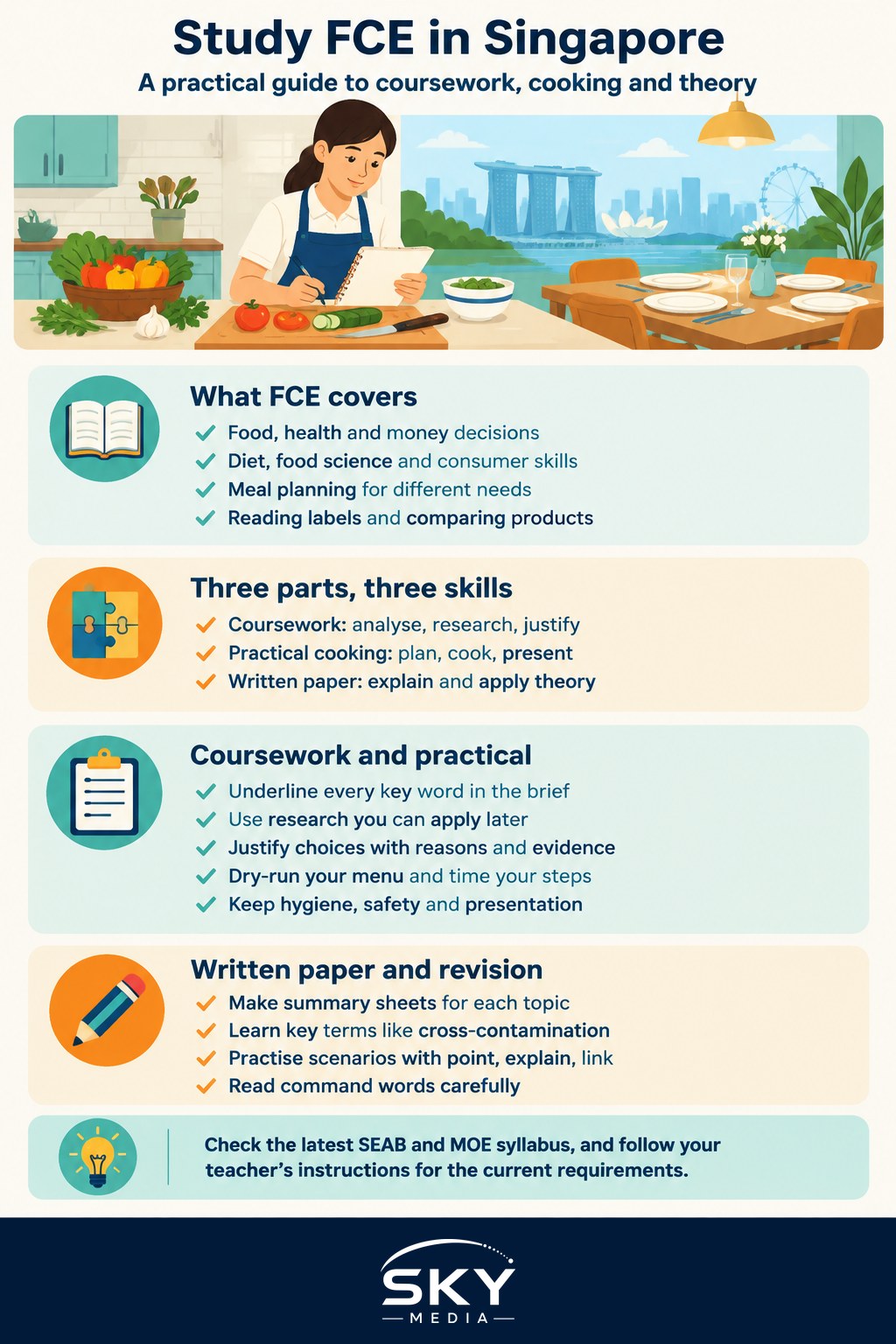
What FCE Covers
FCE is built around a simple idea: everyday choices about food and spending affect your health, your wallet and the people around you. Topics usually fall into a few broad areas:
- Diet and health: nutrients and their functions, dietary needs at different life stages, and diet-related health issues.
- Food science and preparation: how heat, mixing and other methods change ingredients, food safety and hygiene, and choosing suitable cooking methods.
- Meal planning: planning balanced meals for specific people, such as a teenager, an elderly person or a family on a budget.
- Consumer education: reading food labels, comparing products, budgeting, advertising and your rights as a consumer.
If you are new to Singapore’s school system and want to understand where FCE sits among other subjects, our explainer on the Singapore education system is a helpful starting point.
How the Three Parts Compare
Each part of FCE tests different skills. Knowing what each one rewards stops you from studying the wrong way.
| Component | What you do | Skills being assessed | How to prepare |
|---|---|---|---|
| Coursework task | Investigate a given brief, research, plan and justify choices in a written or portfolio format | Analysis, research, decision-making, evaluation | Practise breaking down briefs, keep organised notes, link every choice to the task |
| Practical cooking | Prepare and present dishes you planned, under time limits | Planning, food skills, hygiene, time management | Do full dry runs at home, write a timed work plan, practise core techniques |
| Written paper | Answer structured and longer questions on theory | Knowledge, application, explanation | Learn key concepts, practise past-style questions, use clear structure |
Coursework Tasks: Think Like an Investigator
Coursework is where many students lose marks without realising it. The task usually gives you a scenario, such as planning meals for someone with a particular need or comparing products for a family on a budget. Markers are looking for a clear thought process, not just a nice final dish.
Analyse the brief properly
- Underline every key word: who the meal is for, their needs, any constraints such as cost, time or culture.
- Turn the brief into a list of specific considerations. For example, “a family on a tight budget” becomes cost per serving, filling ingredients, minimal waste and use of seasonal or affordable produce.
Research with purpose
- Use reliable sources. HPB (the Health Promotion Board) and HealthHub publish guidance such as the “My Healthy Plate” approach to balanced meals, which is a good reference for Singapore-based tasks.
- Only include research you actually use later. Pages of copied nutrition facts that never shape your decisions do not earn marks.
- Where the task involves consumer choices, compare at least a few options on clear criteria such as price per unit, nutrition label and suitability.
Justify every decision
- For each dish, explain why it meets the brief. Mention specific nutrients, cooking methods or costs.
- Show that you considered alternatives and why you rejected them.
Evaluate honestly
- After the practical, assess what worked and what did not, using evidence such as taste feedback, appearance, cost or time.
- Suggest realistic improvements. “I would add more vegetables” is weak; “I would add spinach to the soup to increase iron and fibre without changing cooking time” is strong.
Practical Cooking: Plan the Session Before You Cook
In the practical, you are judged on more than whether the food tastes good. Organisation, hygiene, technique and presentation all matter.
Write a timed work plan
- List every step in order, with start times and how long each takes.
- Dovetail tasks. While rice cooks, prepare the vegetables; while a dish bakes, wash up.
- Build in buffer time for plating and cleaning.
Do at least one full dry run at home
- Cook the whole menu once, timing yourself, using similar equipment if possible.
- Note where you ran late and adjust the plan.
Practise core skills
- Knife skills, such as dicing and slicing evenly.
- Basic methods like stir-frying, steaming, boiling and baking.
- Making a simple sauce, dough or batter if your menu requires one.
Hygiene and safety are marks too
- Tie back hair, wash hands, use separate boards for raw and cooked food, and keep your station clean as you go.
- Check that meat and poultry are cooked through, and handle hot equipment carefully.
Presentation
- Plate neatly with suitable portions and a simple garnish. Wipe drips off the plate edge.
- Serve at the right temperature and on time.
Written Paper: Turn Knowledge Into Clear Answers
The written paper tests whether you understand theory and can apply it to situations.
Build a strong core of knowledge
- Make summary sheets for each topic: nutrients, their functions, sources and effects of too much or too little.
- Learn key terms precisely, such as cross-contamination, nutrient density and unit price.
Practise application
- Many questions give a scenario and ask you to recommend or explain. Always link back to the person or situation in the question.
- Use the “point, explain, link” structure: state the point, explain why, and link it to the scenario.
Read command words carefully
- “State” or “list” needs short answers.
- “Explain” needs reasons.
- “Discuss” or “evaluate” needs more than one side and a conclusion.
Consumer topics need real-world thinking
- Know how to read a nutrition information panel and compare products per 100g.
- Understand basic consumer rights such as refunds, warranties and what to do if a product is faulty. Our guide to knowing your consumer rights in Singapore gives useful real-life examples you can adapt for answers.
A Simple Weekly Study Routine
FCE rewards steady work more than last-minute cramming.
- Once a week: review one theory topic and make or update a summary sheet.
- Once a week: cook one simple dish at home and reflect on technique, time and nutrition. Ask family members for honest feedback.
- Every two weeks: do one practice question set and mark it against your notes or teacher’s guidance.
- During coursework periods: set small deadlines for each stage so you are never rushing the evaluation at the end.
Getting Help When You Need It
- Ask your FCE teacher to check your work plan or analysis before the deadline, within the rules for independent work.
- Use school resources such as past worksheets and the official syllabus.
- If you are feeling stressed during busy exam periods, talk to your form teacher or school counsellor early.
FCE is one of the few subjects where what you learn is directly useful at home every day. Treat each meal you cook and each product you buy as practice, and you will build both your grade and your life skills.
Explore more: Consumer Rights, Returns and Refunds in Singapore
Official sources: Ministry of Education (MOE)