
Singapore’s hospitals receive patients from across the region, and many families travel here for a specialist opinion, surgery or a course of treatment. If you are planning medical treatment in Singapore as a foreigner, the medical side is only part of the job. You also need the right entry permission, a clear picture of costs and deposits, a plan for how long you will stay, and a way to extend your stay if treatment runs longer than expected.
This guide walks through those practical steps. It is general information, not medical, immigration or legal advice. Rules and charges change, so confirm details with the hospital, the Immigration & Checkpoints Authority (ICA) and your insurer.
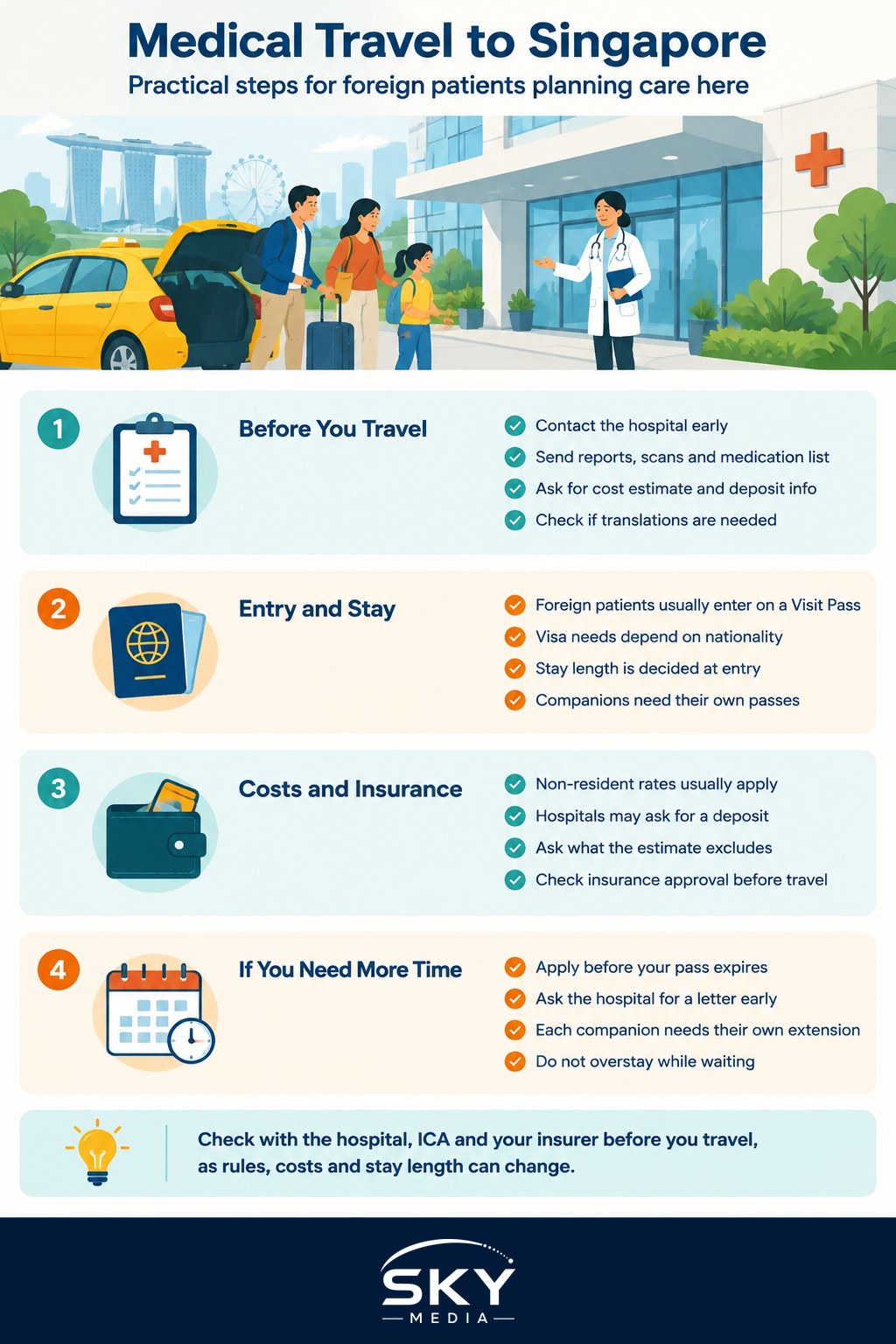
Step One: Contact the Hospital Before You Travel
Most public hospitals and many private hospitals in Singapore have an international patient service team, sometimes called an international patient centre or liaison office. Their role is to help overseas patients before, during and after treatment. Typical services include:
- Reviewing your medical reports and arranging an appointment with a suitable specialist.
- Giving a written cost estimate for the consultation, tests or procedure.
- Explaining the deposit and payment process.
- Issuing letters you may need for travel or a visa application.
- Helping with airport transfers, accommodation suggestions and interpreters, depending on the hospital.
Send recent reports, scans, a list of current medication and a summary from your home doctor. If your records are not in English, ask the hospital whether it needs a translation. Getting this done before you book flights avoids arriving only to learn that a different specialist or further tests are needed.
Entry Permission: Visit Passes and Visas
Foreign patients normally enter Singapore on a Visit Pass, the short-term permission ICA grants at the checkpoint. Whether you need a visa before travelling depends on your nationality. Citizens of some countries can enter without a visa, while others must apply in advance.
Points to keep in mind:
- Check visa rules for your passport. ICA’s website lists which nationalities need a visa and how to apply, usually through an authorised visa agent or a Singapore overseas mission.
- The length of stay is decided at entry. The number of days granted is decided by ICA and can differ from what you planned. Check the duration recorded on your digital pass after arrival.
- Companions need their own passes. A spouse, parent or carer travelling with you must meet entry requirements in their own right.
- Carry supporting documents. A letter from the hospital confirming your appointment, proof of funds and a return or onward ticket can help if you are asked about the purpose of your trip.
Do not plan your stay on the assumption that a certain number of days will be granted. Build in a buffer and know how to extend if needed.
Costs, Deposits and Insurance
Foreign patients pay non-resident rates. Government subsidies for Singapore citizens and permanent residents do not apply, so bills are generally higher than what locals pay for the same care.
Hospitals usually ask non-resident patients for a deposit before admission or a major procedure. The deposit is based on the estimated bill, and you may be asked to top it up if treatment becomes more complex. Any unused balance is refunded after the final bill is settled, according to the hospital’s policy.
| Payment route | How it usually works | What to check first |
|---|---|---|
| Self-pay | You pay the deposit and the final bill directly, by card or bank transfer | Accepted payment methods, card limits and the refund timeline |
| International health insurance | The insurer may give a guarantee of payment to the hospital | Whether pre-authorisation is needed and which hospitals are covered |
| Employer or government sponsor from home | A sponsor letter or guarantee is sent to the hospital | Whether the hospital accepts that sponsor and what it covers |
| Mixed (insurance plus top-up) | Insurer covers part, you pay the rest | Exclusions, co-payments and pre-existing condition clauses |
Ask for an itemised estimate and clarify what is not included, such as doctor’s fees, implants, extra tests, medication to take home and follow-up visits. If you have insurance, contact the insurer before travelling. Many plans require approval in advance and will not cover treatment arranged without it. Your policy wording is the final word on what is covered.
If Treatment Runs Longer: Extending Your Stay
Recovery does not always follow the plan. If you or a companion need to stay beyond the period you were granted, apply to ICA for an extension before your current pass expires. Overstaying is an offence in Singapore, and it can affect future visits.
A practical approach:
- Ask the hospital for a letter early. The international patient team can usually provide a memo stating your diagnosis, ongoing treatment and the expected period of stay.
- Apply through ICA’s official channels. ICA provides an online service for visit pass extensions. Submit the application with the hospital letter and any documents requested.
- Plan for companions too. Each companion who needs to stay longer must apply for their own extension.
- Keep checking your status. Approval is at ICA’s discretion and is not guaranteed. Do not let your pass lapse while you wait without confirming what ICA advises.
For longer stays, such as ongoing cancer treatment, ask ICA and the hospital what other options may apply. Do not rely on informal advice from agents or forums.
Daily Life During Treatment
A medical trip often means weeks living near the hospital. Some practical points:
- Accommodation. Serviced apartments and hotels near major hospitals are popular with medical travellers. Check cancellation terms, since treatment dates can shift.
- Getting around. Singapore’s MRT, buses and taxis are reliable. If mobility is limited, private-hire cars and taxis with boot space for a wheelchair can be booked through ride-hailing apps.
- Prescriptions. If you bring your own medication, check the Health Sciences Authority (HSA) rules on bringing medicines into Singapore, as some need approval. Carry a doctor’s letter.
- Language support. Many hospital staff speak English plus Mandarin, Malay or other languages, and international patient teams can often arrange interpreters. Ask in advance if you need one.
- Phone and payments. A local prepaid SIM makes it easier to receive hospital calls and appointment reminders.
After Treatment: Records and Follow-Up
Before you leave, collect your discharge summary, test results, imaging on disc or via a download link, and a medication list. Ask how follow-up will work: some specialists can review you by teleconsultation, while others will want you back in person. Make sure your home doctor receives the summary so care continues smoothly.
Settle the final bill and confirm any refund of the deposit before departure. If an insurer is paying, ask the hospital whether anything is outstanding.
Planning Checklist for Foreign Patients
- Medical reports, scans and medication list sent to the hospital in advance
- Written cost estimate and deposit amount confirmed
- Visa or entry requirements checked on ICA’s website for each traveller
- Insurer pre-authorisation obtained, if applicable
- Accommodation near the hospital with flexible dates
- Hospital letter ready in case you need to extend your stay
- Discharge documents and follow-up plan collected before flying home
If you are weighing a longer-term move rather than a single trip, our guides on giving birth as a foreigner in Singapore and marrying a foreigner in Singapore cover other situations where foreigners deal with Singapore’s systems. For any medical decisions, rely on your doctors, and for entry and stay matters, rely on ICA.
Frequently Asked Questions
Can my spouse or carer stay with me during hospital treatment? Companions can travel with you, but each one needs entry permission in their own right. They must meet ICA’s requirements and, if they need to stay longer, apply for their own extension. Ask the hospital’s international patient team for a letter confirming your appointment, as it can help at the checkpoint.
Do I need a visa to enter Singapore for medical treatment? It depends on your passport. Citizens of some countries can enter without a visa, while others must apply in advance, usually through an authorised agent or a Singapore overseas mission. ICA’s website lists the requirements by nationality, and the days granted are decided at entry.
What happens if I overstay my Visit Pass because treatment takes longer? Overstaying is an offence and can affect future visits, so apply for an extension before the pass expires. Ask the hospital for a letter stating your treatment and expected stay, then apply through ICA’s online service. Approval is at ICA’s discretion and not guaranteed.
Will the hospital ask for money upfront from foreign patients? Usually yes. Non-resident patients are typically asked for a deposit before admission or a major procedure, based on the estimated bill. You may be asked to top it up if treatment becomes more complex, and unused funds are refunded according to hospital policy after the final bill.
Can I bring my own prescription medicines into Singapore? Some can be brought in, but certain medicines need approval first. Check the Health Sciences Authority’s rules on bringing medicines into Singapore before you pack. Carry a letter from your doctor and keep medicines in their original packaging.
Official sources: Ministry of Health (MOH)
Further reading: Hospital Costs for Foreigners in Singapore: Deposits, Rates and Insurance