
Singapore is a crossroads of the world, so it is no surprise that many couples here are cross-border pairings: a citizen or resident marrying a partner from another country. Marrying a foreigner in Singapore is entirely ordinary and well provided for, but it does add a few steps around documents, eligibility and, further down the road, immigration. This guide walks through the general shape of the process. It is background information rather than legal advice, and the Registry of Marriages (ROM), the Immigration and Checkpoints Authority (ICA) and, where needed, a lawyer are your authoritative sources.
Who Can Marry Under Singapore Law
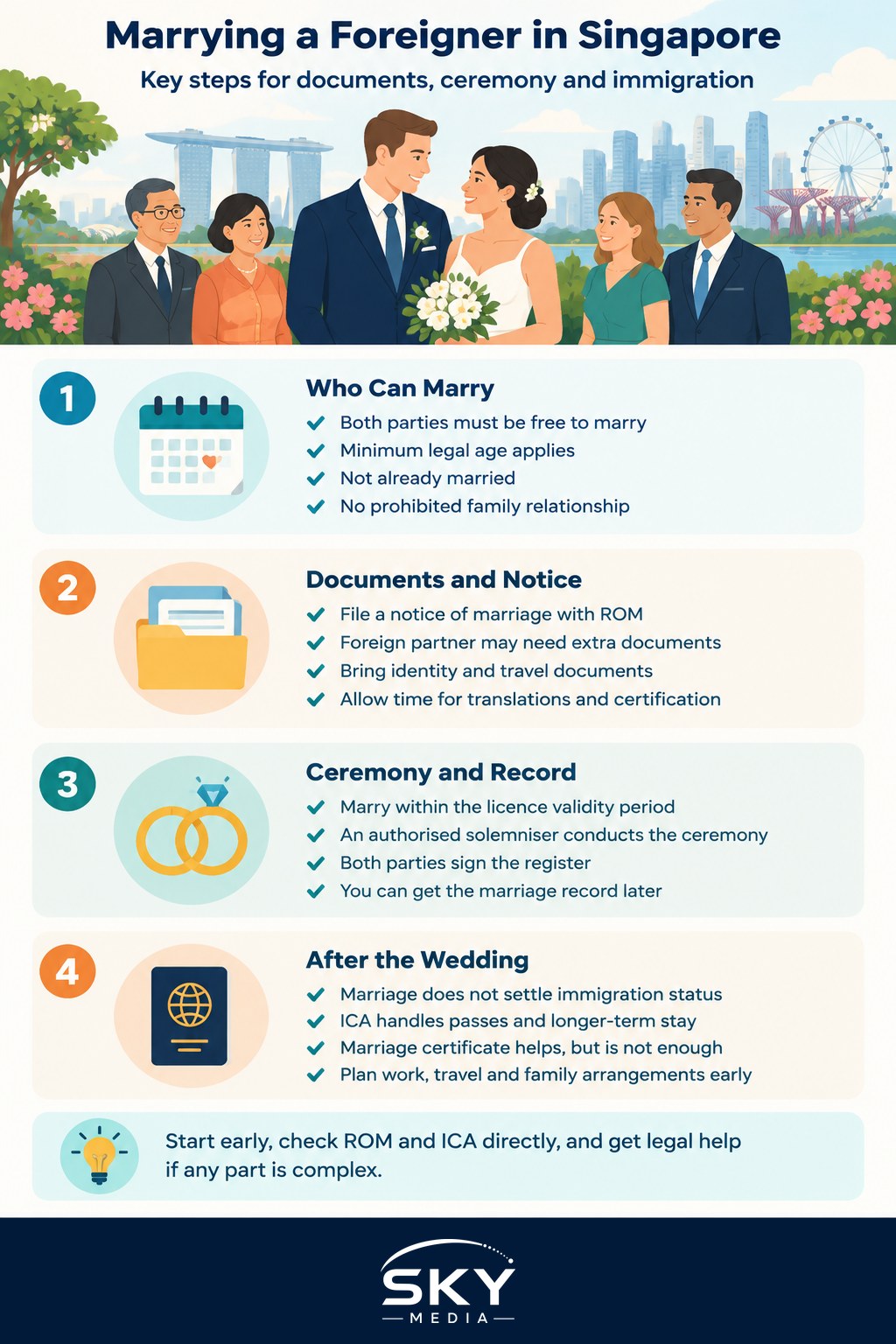
Before the paperwork, it helps to confirm eligibility. A civil marriage in Singapore falls under the Women’s Charter, and both parties must be free to marry: of the minimum legal age, not already married, and not within the prohibited degrees of relationship. Nationality itself is not a barrier, which is why marrying a foreigner is common and accepted. What matters is that each person genuinely meets the legal conditions.
Two situations deserve early attention. First, if either partner has been married before, that earlier marriage must have properly ended, whether by divorce or the death of a spouse, and you should be ready to show it. Second, Muslim marriages follow a separate track under the Registry of Muslim Marriages (ROMM) rather than ROM, so a couple marrying under Muslim law should direct their questions there. For couples who married overseas and want that union recognised here, see our guide on registering an overseas marriage in Singapore.
Documents and the Notice of Marriage
The civil process centres on filing a notice of marriage with ROM and then solemnising the marriage within the licence’s validity period. When one party is a foreigner, ROM typically asks for additional documentation to confirm identity, status and eligibility. Rather than list specific forms or fees, which the authorities set and update, it is safest to work from ROM’s current checklist.
In general terms, couples marrying a foreign partner should be prepared to provide:
- Valid identity and travel documents for the foreign partner.
- Evidence of immigration status or the terms of their stay in Singapore.
- Proof that any previous marriage has legally ended, if relevant.
- Any translations or certifications ROM requires for foreign documents.
Because a foreign partner’s documents may originate overseas, allow time to gather, translate or certify them. If a document is in another language or issued by a foreign authority, ROM may want it authenticated in a particular way. Confirm these details directly with the Registry so nothing is missed close to your intended date. If your timeline is unusually tight for a genuine reason, the separate grant of special licence to marry in Singapore may be worth understanding, though it is only for exceptional cases.
The Ceremony and Getting Married
Once the notice is filed and the licence granted, the marriage is solemnised by an authorised solemniser, in much the same way as for any civil marriage. The solemniser confirms identities, leads the declarations and witnesses consent, and the signing of the register makes the marriage legal. If you are curious about who may officiate, our guide on becoming a licensed wedding solemniser in Singapore explains that role. After the ceremony, you can obtain your marriage record when you need it.
The table below compares, in general terms, a marriage where both parties are local with one where a foreign partner is involved. It is a map of where the extra care usually lies, not a substitute for ROM’s guidance.
| Stage | Both partners local | One partner a foreigner |
|---|---|---|
| Eligibility | Standard checks | Standard checks plus status confirmation |
| Documents | Local identity documents | Additional foreign documents, possibly certified |
| Preparation time | Usually shorter | Allow more time for overseas paperwork |
| After marriage | Local admin only | Possible longer-term immigration planning |
| Best first stop | ROM | ROM and, for stay matters, ICA |
Life After the Wedding: Status and Support
Marrying a foreigner in Singapore does not automatically settle where the couple will live or a foreign spouse’s long-term immigration status. Those are separate questions handled by ICA through its own passes and schemes, each with its own criteria and processing. A marriage certificate is an important document in that journey, but it is not, by itself, a grant of residence. Plan the immigration side deliberately and consult ICA’s current information rather than assuming an outcome.
It is also wise to think ahead about the practical and financial side of married life across borders, especially if one partner’s ability to work or remain depends on a pass. Some couples choose to set out arrangements clearly between themselves; our overview of postnuptial agreements in Singapore explains one option, though any agreement should be drawn up with proper legal advice.
Couples also benefit from talking early about the bigger picture. Where will you build your life, and does one partner intend to work here? How will you handle time zones, family visits and the cost of travel while any longer-term status is being sorted out? None of these are legal questions in themselves, but they shape the choices you make around the wedding and the months after it. Facing them together, honestly, tends to prevent friction later, and it helps you give ROM and ICA accurate information about your intentions.
It is equally important to guard against well-meaning but wrong advice. Rules that applied to a friend a few years ago, or to a couple in another country, may not apply to you, and immigration frameworks in particular are updated from time to time. Treat online anecdotes as prompts to ask a proper question, never as the answer. When money, property or a spouse’s ability to remain is at stake, a short consultation with a qualified professional is far cheaper than a misstep.
A few habits make the whole experience smoother:
- Start gathering the foreign partner’s documents early.
- Confirm every requirement with ROM rather than relying on hearsay.
- Treat the marriage and the immigration questions as related but separate.
- Get a family or immigration lawyer’s help if anything is complex or contested.
Marrying across nationalities is one of the happier features of life in a global city. With the right documents, realistic timing and the official bodies as your guide, marrying a foreigner in Singapore can be as smooth and joyful as any other wedding, with the added richness of two backgrounds coming together. When something feels uncertain, ask ROM, check with ICA, and lean on qualified advice.
Frequently Asked Questions
Can my foreign spouse work in Singapore after we marry? Marriage alone does not give the right to work. A foreign spouse’s ability to work depends on the pass they hold, and passes have their own criteria. Check MOM for work pass rules and ICA for long-term visit or residence options before assuming a plan.
Can my partner marry me here on a short-term visit pass? It depends on ROM’s requirements for the foreign partner’s status and documents, so check before booking anything. Do not assume that lawful presence for a visit is enough for the paperwork, and do not overstay while arranging the marriage. Ask ROM and ICA early.
Will our marriage in Singapore be recognised in my partner’s home country? Often it is, but practice differs by country, and some require the marriage to be registered or documents to be certified. Contact your partner’s embassy or consulate to ask what is needed, and request a certified copy of your marriage record to keep handy.
Does marrying a citizen help a foreigner get PR or citizenship? Marriage may be a factor in an application, but it does not guarantee approval or an automatic change of status. ICA assesses each case under its own criteria and these can change. Check ICA’s current information, and get advice if the circumstances are complex.
Official sources: ICA · Ministry of Social and Family Development (MSF)
Further reading: Marrying a Work Permit Holder in Singapore: MOM Approval Explained · Marrying a Malaysian Partner: ROM in Singapore or Registration in Malaysia · Getting Married in Singapore as Two Foreigners