

Most people treat the Fort Siloso Skywalk as a quick photo stop: ride the lift up, snap the sea view, walk across, done. But this elevated walkway on Sentosa’s western tip is actually one of the best ways to understand why a fort was built here in the first place. From above the treetops you can see the shipping lanes, the harbour approaches and the hilly ground that shaped Singapore’s coastal defences for decades.
This guide focuses on the Skywalk itself: how the route works, what to look for from up high and how to connect the view to the history at the fort below. For a fuller account of the fort’s past, read our Fort Siloso history guide.
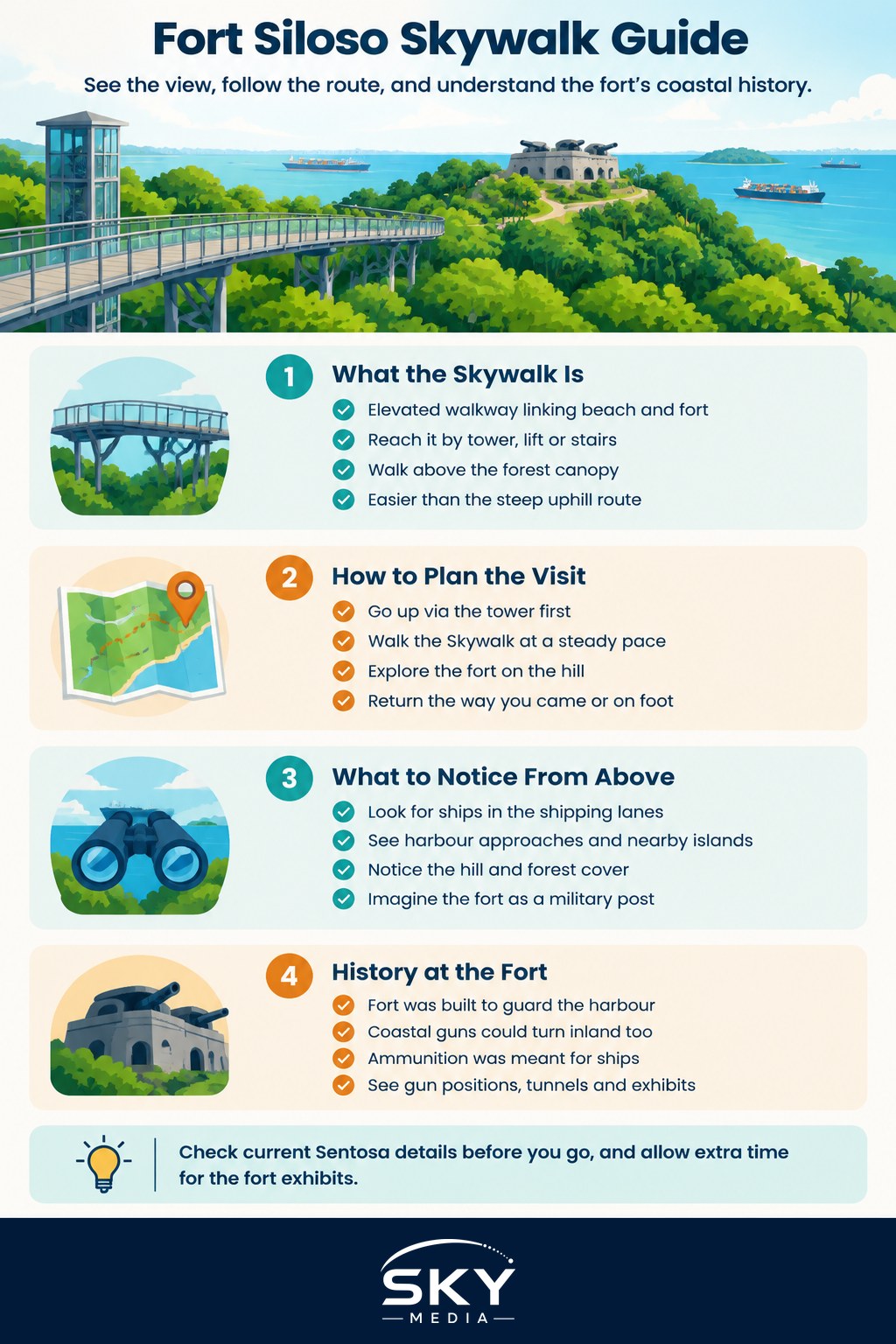
What the Fort Siloso Skywalk Is
The Skywalk is an elevated walkway that links the area near Siloso Beach to the grounds of Fort Siloso, which sits on a hill at Siloso Point. You reach it via a tall tower with a lift and stairs, then walk along a raised path above the forest canopy before arriving at the fort’s upper grounds.
Practically, it replaces a steep uphill walk with an easier, more scenic approach. Historically, it gives you something the soldiers stationed here would have valued: a high vantage point over the western entrance to Keppel Harbour.
Access arrangements, opening hours and any admission charges can change, so check the current details on the official Sentosa website before you go.
Planning Your Route
A sensible way to combine the Skywalk with the fort is to go up via the tower, walk the Skywalk, explore the fort at your own pace, then descend on foot or return the way you came.
| Part of the visit | What you do | What to look for |
|---|---|---|
| Base of the tower | Take the lift or stairs up | The forest edge and the beach below, a reminder of how close the fort was to the shore |
| Top of the tower | Pause at the viewpoint | Ships at anchor, the harbour approaches and nearby islands |
| Along the walkway | Walk slowly above the canopy | How the hill hides the fort from the sea, and the natural cover the forest gives |
| Fort grounds | Explore gun positions, tunnels and exhibits | Gun emplacements facing the water, bunkers and display panels |
| Return | Walk down or retrace your steps | Notice the slope you avoided, and imagine hauling equipment up it |
Allow enough time to read the panels at the fort. The Skywalk itself does not take long, but the fort rewards a slower visit.
Reading the Landscape From Above
The view is the main reason to come. Here is how to make sense of it.
The shipping lanes
Look out to sea and you will usually see vessels at anchor or on the move. Singapore’s prosperity has long depended on this sea traffic, and protecting the approaches to the harbour was the reason coastal forts were built on Sentosa (formerly called Pulau Blakang Mati) and along the southern shore.
The harbour entrance
Fort Siloso guarded the western approach to Keppel Harbour. Across the water on the mainland side, Labrador Park held another coastal battery. Together, positions like these covered the narrow waters ships had to pass through. Our Labrador Park heritage guide explains the mainland side of the story, and visiting both gives you a fuller picture.
The hill and the forest
From the walkway, notice how the fort sits on high ground screened by vegetation. Height gave gunners range and visibility, while the slope and trees offered concealment. This is a good moment to imagine the site as a working military post rather than a park.
Connecting the View to the Second World War
Fort Siloso is often linked to a popular idea that Singapore’s big guns “faced the wrong way” in 1942. The reality is more nuanced. Many coastal guns could turn inland, and some did fire during the Japanese invasion. The problem was more about the type of ammunition they carried, which was intended for ships rather than troops on land, and about the speed of the overall campaign.
As you look out from the Skywalk, it helps to keep that in mind. The fort was designed around threats arriving by sea, which is exactly the view in front of you. When the attack came largely overland from the north, coastal positions like this one could not change the outcome.
At the fort grounds, look for:
- Gun emplacements that show the field of fire over the water.
- Tunnels and underground rooms used for storing ammunition and sheltering crews.
- Exhibits on the occupation and surrender, which cover the end of the battle and the hardship that followed.
The surrender and occupation are painful history for many families in Singapore. Take time with the exhibits and treat the site with respect.
Tips for a Comfortable Visit
- Go early or late in the day. Singapore’s midday heat can be intense, and the walkway and fort grounds have exposed sections. Bring water and a hat.
- Check the weather. Afternoon storms are common. Exposed high structures are best avoided during lightning, so follow any closure notices.
- Wear comfortable shoes. The fort involves uneven paths, steps and slopes.
- Mind the wildlife. You may spot monkeys, birds or monitor lizards. Do not feed or approach animals, and keep food packed away.
- Accessibility. The lift helps with the climb, but some parts of the fort may involve stairs or uneven ground. Check current accessibility information with Sentosa if this matters for your group.
- Pair it with the beach. Siloso Beach is right below, so you can combine history in the morning with a swim or rest later. See our Sentosa beaches guide for ideas.
Making It Meaningful for Families and Students
For children, turn the Skywalk into a lookout game. Ask them to spot ships, guess which direction an enemy might come from and then find the guns at the fort that point that way. For older students, the visit is a chance to discuss why defences built for one kind of threat struggled against another.
Whoever you bring, the key is to slow down. The Fort Siloso Skywalk is not just a scenic shortcut. It is a vantage point that lets you see Singapore’s coastal history the way it was planned: from the high ground, looking out to sea.
Frequently Asked Questions
How do I get to the Fort Siloso Skywalk from the mainland? You first travel to Sentosa, for example by the Sentosa Express monorail from VivoCity, the cable car or on foot over the boardwalk. From there you head west to Siloso Beach, where the tower stands. Check the Sentosa website for current routes and service times.
Is the Skywalk and fort suitable for young children and strollers? Children usually enjoy the lift and the view, and the fort has tunnels and guns to explore. Some paths, steps and slopes in the fort can be hard for strollers, so a carrier may help. Ask Sentosa about accessibility if you need a step-free route.
How much time should I set aside for the Skywalk and the fort together? The Skywalk takes little time, so the fort is what decides it. Plan on a relaxed half-morning or afternoon if you want to read the panels and see the tunnels. Add time for the beach if you want to swim afterwards.
What happened at Fort Siloso after the surrender in 1942? After the Japanese took Singapore, the fort grounds were used to hold prisoners of war, and the island suffered during the occupation. The exhibits at the fort cover this period. It is a sombre part of the story, so give yourself time to read the displays.
Can I combine the Skywalk with Labrador Park in one day? Yes, since both sites guarded the same harbour approaches and tell connected stories. Visit one in the morning and the other later, with travel time between them. Bring water, as both involve walking in the heat.