

If you are house hunting here, the freehold vs leasehold Singapore question comes up almost immediately. It sounds technical, but it simply describes how long you own the property and the land it sits on. That single detail shapes the price you pay, how a bank and CPF treat your loan, and how easy the home may be to sell later. This guide walks through what each tenure means, where the trade-offs really sit, and what to check before you commit. It is general information to help you ask better questions, not financial or legal advice.
What Tenure Actually Means
Tenure is the legal length of your ownership. In Singapore you will mainly see three labels.
- Freehold, sometimes shown as “estate in fee simple”, means you own the property indefinitely with no fixed end date.
- 999 year leasehold is technically a lease, but with such a long runway that many buyers and valuers treat it much like freehold in practice.
- 99 year leasehold means you own the home for that fixed term from when the lease started, after which it returns to the state unless the lease is topped up, which is not guaranteed.
Almost all HDB flats are sold on 99 year leases. Private condos and landed homes come in both freehold and leasehold forms. A crucial point many first timers miss: the countdown starts from the lease commencement date, not your purchase date. A “99 year” development that launched years ago already has fewer years left, so always confirm the remaining lease, not the original one.
How Tenure Affects Price, Loans and CPF
Tenure influences money in several connected ways, and the rules behind them change over time, so treat the figures below as concepts to verify rather than fixed numbers.
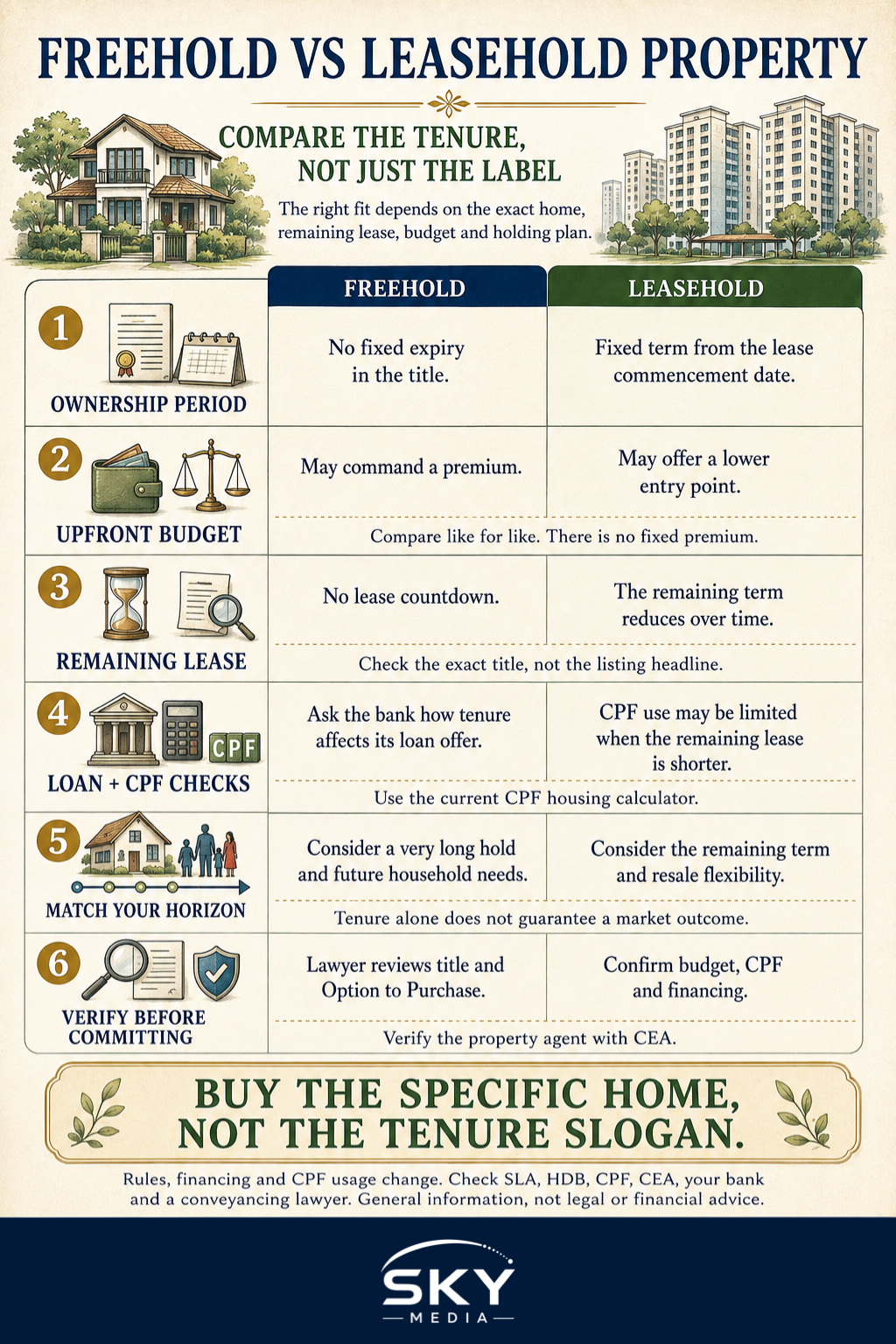
Purchase price. Freehold homes usually carry a higher price than a comparable leasehold unit in the same area, because you are paying for permanent ownership. How large that gap is varies by location, age and demand, so compare like for like rather than assuming a fixed premium.
Financing. Banks lend against a lease that comfortably outlasts the loan. A home with a short remaining lease can attract a smaller loan or a shorter tenure, which raises the monthly repayment. The exact loan to value limits and rules are set by MAS and your bank, so check the current position with them before you fall in love with an older leasehold unit.
CPF usage. CPF rules restrict how much of your Ordinary Account savings you can use when the remaining lease is short, and whether the lease can cover you and your co owner to a certain age. These rules are set by the CPF Board and are updated from time to time, so confirm the latest position on the CPF website rather than relying on older advice.
Because financing and CPF both tighten as a lease shortens, an ageing 99 year home can become harder for the next buyer to fund, which feeds back into its resale appeal.
Freehold vs Leasehold at a Glance
The table below sums up the practical differences. It is a general comparison, not a verdict, because the right choice depends on your budget, plans and the specific property.
| Factor | Freehold | 99 year leasehold |
|---|---|---|
| Ownership length | Indefinite | Fixed term from lease start |
| Typical entry price | Usually higher | Usually lower for a similar unit |
| Financing and CPF as home ages | Generally stable | Can tighten as lease runs down |
| Long term value pattern | Land value tends to hold | Value can ease as lease shortens |
| Redevelopment or en bloc | Land held indefinitely | Depends on lease and approvals |
| Common examples | Some condos and landed homes | HDB flats, many newer condos |
The Leasehold Depreciation Question
Leasehold homes face a feature that freehold ones do not: as the remaining lease falls, the value can decline, and the decline tends to accelerate in the later decades. This is often summarised by the idea that a lease eventually runs down to zero, so the land returns to the state at the end of the term. For an HDB flat this is why the Housing and Development Board and national agencies stress buying with your own housing needs and horizon in mind.
This does not make leasehold a poor choice. Many well located leasehold homes are comfortable, convenient and easier to afford than a freehold equivalent, and you may not intend to hold the property for its full term anyway. The key is to go in with clear eyes about the remaining lease and how it lines up with how long you plan to stay, and to avoid stretching your budget on the assumption that a specific future price is guaranteed. No one can promise how any market will move, so make timing a personal decision rather than a bet.
Who Each Tenure Tends to Suit
There is no single winner. Think about your own situation.
- A long horizon or a legacy focus. If you want to hold a home for generations or pass it on, freehold removes the worry of a lease running out.
- A tighter budget or a shorter stay. A leasehold home can put a better location within reach, and if you expect to move within a decade or two, the later years of the lease may matter less to you.
- HDB buyers. Most flats are leasehold by design. Your focus is usually the remaining lease, the location, and meeting the eligibility and Minimum Occupation Period rules, all of which HDB and CPF set and update.
- Investors and upgraders. Weigh the higher freehold outlay against the potentially stronger long term land value, and remember that cooling measures, stamp duties and loan limits set by MND, URA, IRAS and MAS apply and change, so check the current rules.
What to Check Before You Commit
Whatever tenure you lean towards, run through a short list before signing anything.
- Confirm the exact tenure and remaining lease on the title, not just the marketing brochure.
- Speak to your bank early about how the lease affects your loan amount and tenure.
- Check CPF usage rules for that remaining lease on the CPF Board website.
- Engage a lawyer or conveyancer to review the title and the Option to Purchase before you exercise it.
- Use a CEA registered agent and verify them on the CEA Public Register, and remember agent commission is negotiable, not a fixed rate.
- Match the lease to your plans, not to a hoped for future price.
Freehold and leasehold each have a place. The better question is not which is superior in the abstract, but which fits your budget, your timeline and the specific home in front of you. Take your time, verify the numbers on the official sources, and lean on qualified professionals for the money and legal steps.
Explore More
For related reading, see our guide to the condo buying process and what happens at each stage. If you are weighing property types, our overview of landed property types in Singapore pairs well with this one, and buyers comparing new builds can look at buying a new launch condo. Always confirm current rules with HDB, URA, CPF and your bank.