
Buying a game is simple: you pay for it and download it. Topping up is a different world. Platform wallets, gift cards, redemption codes, in-game currencies and third-party top-up sites all overlap, and it is not always obvious which one you need. A game top up in Singapore can happen at a convenience store counter, on a phone in two taps, or through a reseller website you have never heard of.
This guide explains how the local top-up ecosystem fits together, how to pick the right method, and how to avoid the region locks and scams that catch people out.
The Three Layers of Game Credit
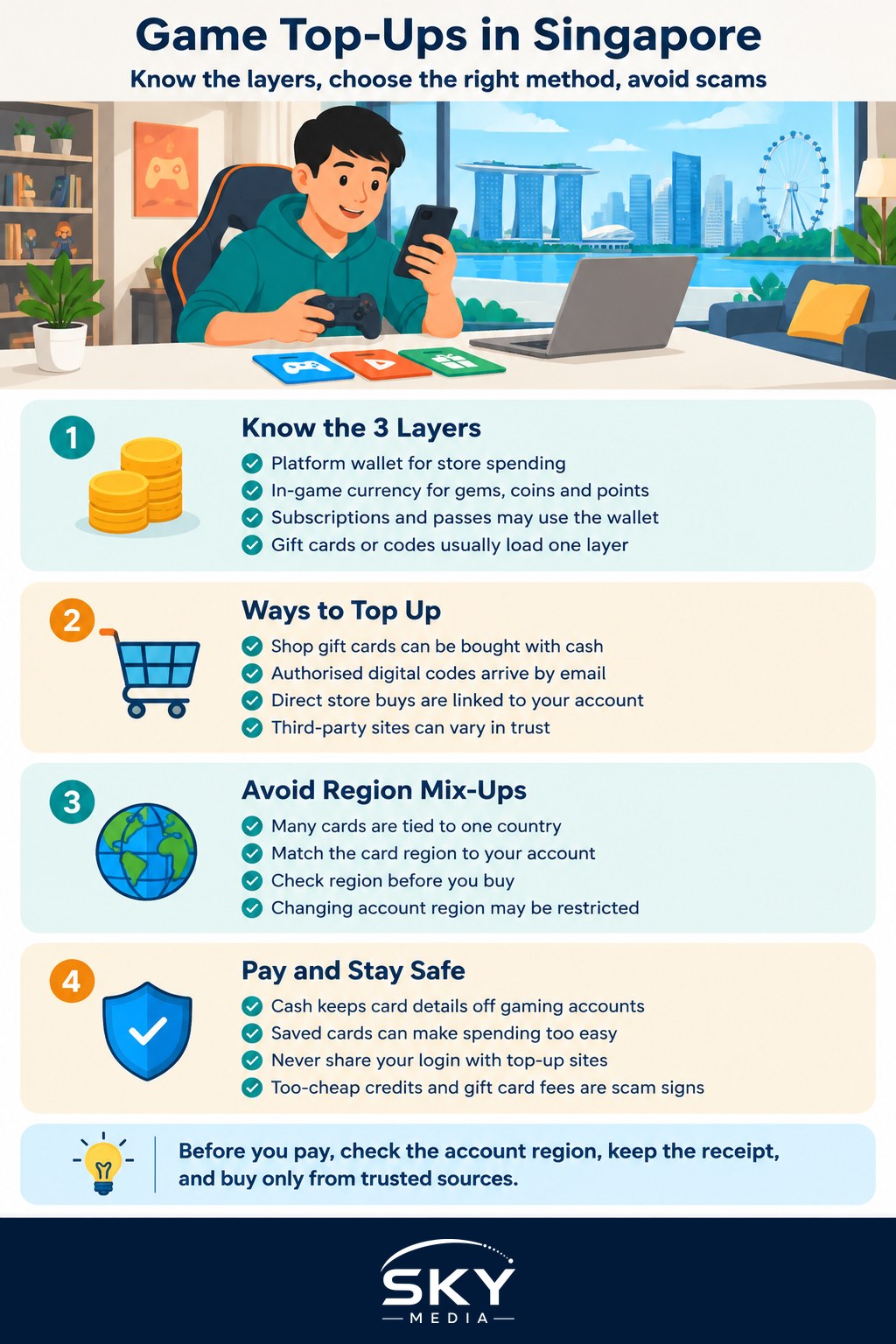
It helps to think of top-ups in three layers:
- Platform wallet. This is money held in your account on a store such as a console store, a PC game launcher, or a mobile app store. You can spend it on games, add-ons and subscriptions on that platform.
- In-game currency. Many games, especially free-to-play titles, use their own currency (gems, coins, points and so on). You buy it with real money, either directly or from your platform wallet.
- Subscriptions and passes. Online play memberships, battle passes and monthly bundles, often paid from the wallet or by card.
A gift card or code usually loads layer one or layer two. Knowing which one you are buying stops you from loading the wrong account.
Ways to Top Up in Singapore Compared
| Method | How it works | Pros | Watch out for |
|---|---|---|---|
| Physical gift card from a shop | Buy a card at a convenience store, electronics or game shop, then redeem the code | Pay in cash, good as a gift, no card details shared | Must match your account region; keep the receipt |
| Digital code from an authorised online retailer | Code sent by email or shown on screen after payment | Instant, often wider choice of values | Only buy from sellers the platform lists or recognises |
| Direct purchase in the platform store | Pay by credit card, debit card or digital wallet inside the store | Simplest, linked to your account | Saved cards make impulse spending easy |
| In-game shop | Buy currency inside the game | Fast, goes straight to your account | Prices in bundles can obscure the real cost |
| Third-party top-up website | Enter your player ID, pay, credits are delivered | Sometimes promotions or local payment options | Legitimacy varies a lot; risk of account bans or fraud |
| Mobile carrier billing | Charge purchases to your phone bill, where offered | No card needed | Easy for children to overspend; check carrier settings |
Region Locks: The Most Common Mistake
Many platform gift cards are tied to a country or region. A card bought for one country’s store usually cannot be redeemed on an account registered to another. This catches out:
- Newcomers to Singapore whose accounts were set up in their home country.
- Gift givers who buy a card overseas or from an online seller that ships regional codes.
- Families where children set up accounts with a different country selected.
Before buying, check the region of the account you want to top up (it is usually in account settings), and check the region printed on the card or listed on the product page. If they do not match, do not buy. Changing an account’s region is often restricted, and may affect existing balances or subscriptions, so read the platform’s own help pages first.
Paying for Top-Ups: Cash, Cards and Wallets
Each payment route has its place:
- Cash at a shop keeps your card details off gaming accounts and is handy for setting a firm budget, especially for teenagers.
- Credit or debit cards are convenient, but saved cards plus one-tap purchases make spending easy to lose track of. Our guide on using credit cards wisely covers habits that help.
- Digital wallets linked to your bank can add a layer between the store and your card.
If you see an in-game charge you do not recognise, contact the platform first, since most have a process for unauthorised purchases. If that does not resolve it, your bank may be able to help, and our explainer on disputing a credit card charge walks through how that process generally works. Policies differ by bank and platform, so check the current terms with them.
Spotting Top-Up Scams
Game credits are attractive to scammers because codes are easy to resell and hard to trace. Common patterns include:
- “Too cheap” credits. Sites or sellers offering in-game currency far below the official price may be using stolen cards or exploited accounts. The platform can reverse the credits or ban your account.
- Requests for your login. No legitimate top-up service needs your account password. Third-party sites that ask for it are a red flag.
- Gift card payment requests. Anyone asking you to pay a bill, a fine or a “fee” with gift cards is almost certainly running a scam. Government agencies and real companies do not ask for payment this way.
- Fake giveaways on social media or chat apps promising free credits in exchange for a code, a login or a “verification” payment.
- Unsolicited trade offers inside games or community servers.
If something feels off, stop and check with the official platform. The Singapore Police Force’s ScamShield resources are a useful place to learn about current scam types and how to report them.
Top-Ups and Younger Players
For parents, top-ups are where a lot of unexpected spending happens. Practical steps:
- Use family or child accounts offered by consoles and app stores, which let you set spending limits and require approval for purchases.
- Turn on purchase passwords or biometric confirmation on devices children use.
- Prefer gift cards over saved cards for children, so their budget is capped at the card value.
- Talk about in-game currency. Children may not connect gems or coins with real money, so explain the conversion.
- Check what loot boxes or random rewards are in a game, since paying for chance-based items can encourage repeat spending.
A Simple Checklist Before Every Top-Up
- Which account and platform am I topping up?
- Is it the platform wallet or the in-game currency I need?
- Does the card or code region match my account region?
- Am I buying from the platform itself or an authorised seller?
- Have I kept the receipt and the code until it is redeemed?
- Is the amount within the budget I set?
Game top-ups are convenient once you understand the layers. Match the region, buy from trusted sources, and keep a clear budget, and topping up in Singapore stays quick and safe.
Further reading: Are Cheap Game Key Sites Safe? Grey Market Game Keys Explained · Are Game Pre-Orders Worth It? · Buying or Selling Game Accounts: Risks and Rules