

Welcoming a baby in Singapore is a joyful moment, and soon after come the practical questions, especially about travel and nationality. For Chinese-national parents, one of the most important is how the little one will travel to visit family in the mainland. Sorting out a China travel document Singapore born baby matter early saves worry later, because a Singapore-born baby of Chinese-national parents may need a China Travel Document rather than a passport. This guide explains the topic factually and neutrally, and points you to the right authorities. It is general information, not legal advice, so confirm your situation with the Chinese Embassy and, for Singapore matters, the Immigration and Checkpoints Authority (ICA).
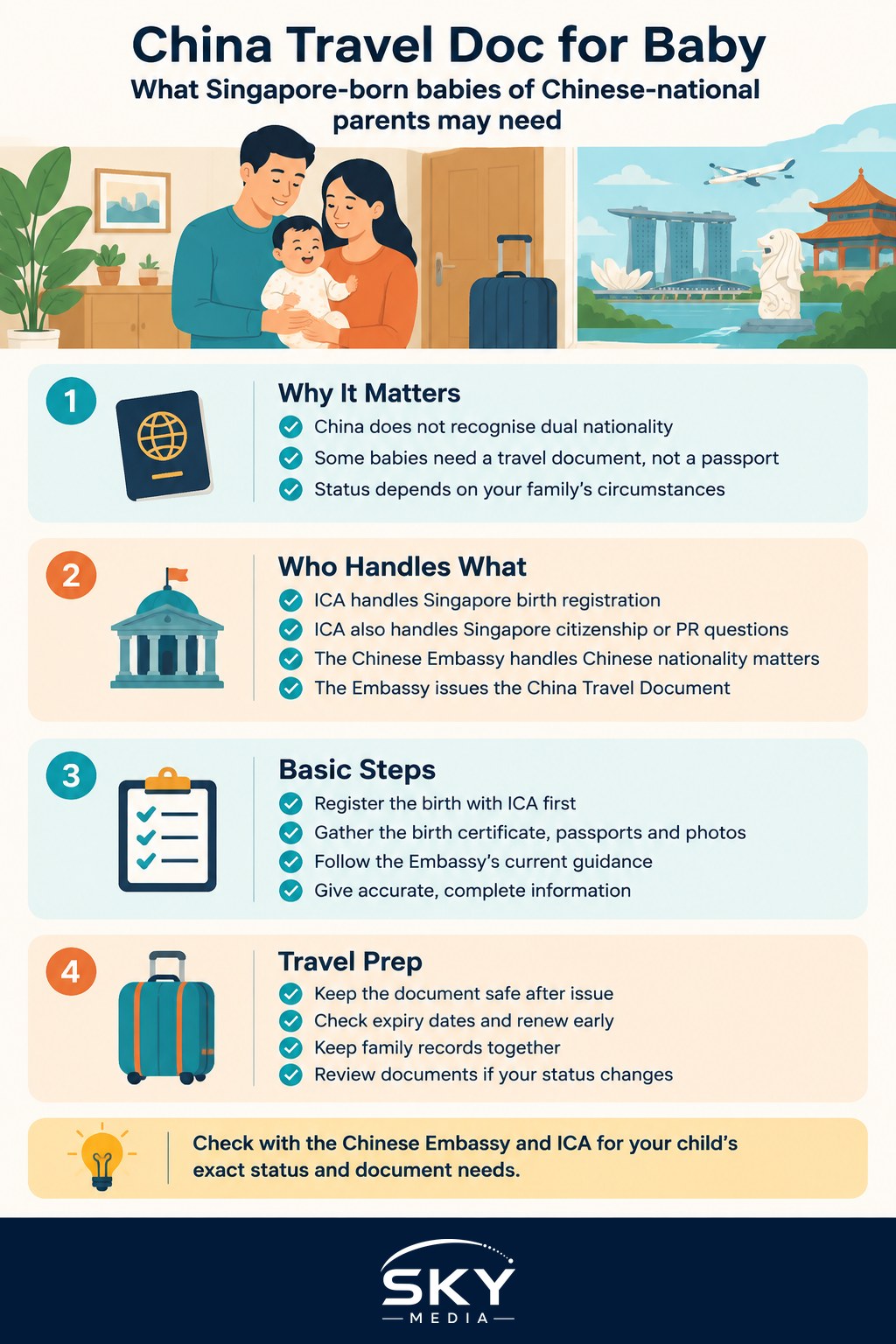
Why a Travel Document, Not Simply a Passport
The starting point is a fact of Chinese nationality law, stated here plainly and without judgement: China does not recognise dual nationality. This single principle shapes much of what follows for a baby born in Singapore to Chinese-national parents.
Because of it, the documents a child is eligible for depend on their nationality, which in turn depends on the parents’ status and the interaction of Chinese and Singaporean law. In many cases, a Chinese-national child born abroad is issued a China Travel Document, in Chinese the 中国旅行证, by a Chinese diplomatic mission, rather than a standard Chinese passport. The travel document serves as the child’s document for entering and leaving China where a passport is not issued.
This is different from what many parents expect, and it is not something to guess at. Whether your baby is regarded as a Chinese national, and therefore whether a travel document or a passport applies, is a determination for the Chinese authorities based on your family’s specific circumstances. The Chinese Embassy is the correct and authoritative source, so treat the general picture here as background and confirm the specifics there.
China and Singapore: Two Systems to Reconcile
A Singapore-born baby sits at the meeting point of two legal systems, and it helps to see both clearly.
- On the Singapore side, ICA handles birth registration and, where applicable, questions of Singapore citizenship or PR for the child, which turn on the parents’ status and Singapore law. Registering the birth with ICA is a standard early step.
- On the China side, the Chinese Embassy handles Chinese nationality questions and consular documents such as the travel document. This is where the nationality determination and any travel document are dealt with.
The two do not decide for each other. Singapore’s authorities apply Singapore law to Singapore status; China’s authorities apply Chinese law to Chinese nationality. Because China does not recognise dual nationality, a family’s choices and the documents that follow can interact in ways that are specific to their case. No article can rule on your family’s status, and this one does not try to. Instead, engage both bodies, keep the questions in their proper lanes, and let each authority speak to its own domain.
| Matter | Handle with | Notes |
|---|---|---|
| Registering the birth | ICA (Singapore) | A standard early step after birth |
| Singapore citizenship or PR | ICA (Singapore) | Depends on parents’ status and Singapore law |
| Chinese nationality question | Chinese Embassy | China does not recognise dual nationality |
| China Travel Document (旅行证) | Chinese Embassy | Issued in place of a passport in many cases |
| Travel to and from China | Chinese Embassy guidance | Use the document the Embassy issues |
The General Steps Parents Take
The exact requirements, forms, appointments, and fees are set by the Chinese Embassy and by ICA, and they change, so use this only as a general orientation and follow each body’s current instructions.
- Register the birth in Singapore. Complete the birth registration with ICA and obtain the birth certificate, an early and important document.
- Gather core documents. Typically the baby’s birth certificate, the parents’ passports and Chinese identity documents, and photographs to the required specification. Keep both digital and physical copies.
- Approach the Chinese Embassy. Check the Embassy’s current guidance on the travel document, appointments, and the documents it requires for a child in your situation.
- Submit accurately. Provide truthful, complete information. Accuracy protects your family and avoids delays; never fabricate anything.
- Collect and safeguard. Once issued, keep the travel document safe, note its validity, and plan renewals well before it expires.
Do not rely on agents promising a particular outcome or a shortcut. Nationality and consular decisions rest with the authorities, and honesty combined with the correct official channels is always the sound approach.
Planning Travel and Looking Ahead
With the right document in hand, visiting family in China becomes far simpler, but a little foresight keeps trips smooth.
- Check validity early. Travel documents have expiry dates and renewal cycles; diarise these long before a planned trip.
- Understand entry and exit. Follow the Embassy’s guidance on how your child enters and leaves China, and how the document works alongside any Singapore documents for the return journey.
- Keep records tidy. Maintain a family folder of the birth certificate, the travel document, and both parents’ identity papers, so nothing holds you up at short notice.
- Revisit as circumstances change. If the family’s status changes, for example through PR or a move, the documents and even the nationality picture may need review with the authorities.
As your child grows, questions of status will keep evolving, and they touch both systems. The steady, neutral course is to keep the Chinese Embassy as your authority on Chinese nationality and consular documents, and ICA as your authority on Singapore birth registration, citizenship, and PR. Ask each the questions that belong to it, keep your paperwork in order, and make decisions with full, accurate information rather than assumption. That way your Singapore-born baby can travel to see family and grow up with the documents that fit your family’s real situation.
Explore more
A baby’s status is part of the whole family’s picture. If you are mapping out residence questions, see what happens to your child’s PR status at 21 and, for the parents’ side, giving up your PR and what it means. Families settling several statuses together may also find the LTVP+ scheme for foreign spouses a helpful companion read.
Further reading: China Exit-Entry and Travel Documents Explained