
You have probably heard the phrase “five a day”, the friendly reminder to eat around five servings of fruits and vegetables daily. It sounds simple until you are standing at a hawker centre at 7pm, tired and hungry, and the greens feel like an afterthought. The good news is that getting your five a day fruits and vegetables does not require a special diet, an expensive grocery run or hours of cooking. It just takes a few small habits that fit the way Singaporeans actually eat.
This is general information to help you eat more colour day to day, not medical or dietitian advice. If you have a health condition, a food allergy or intolerance, or you are planning a big change to how you eat, speak to your doctor or an accredited dietitian for guidance that suits you.
What “Five a Day” Really Means
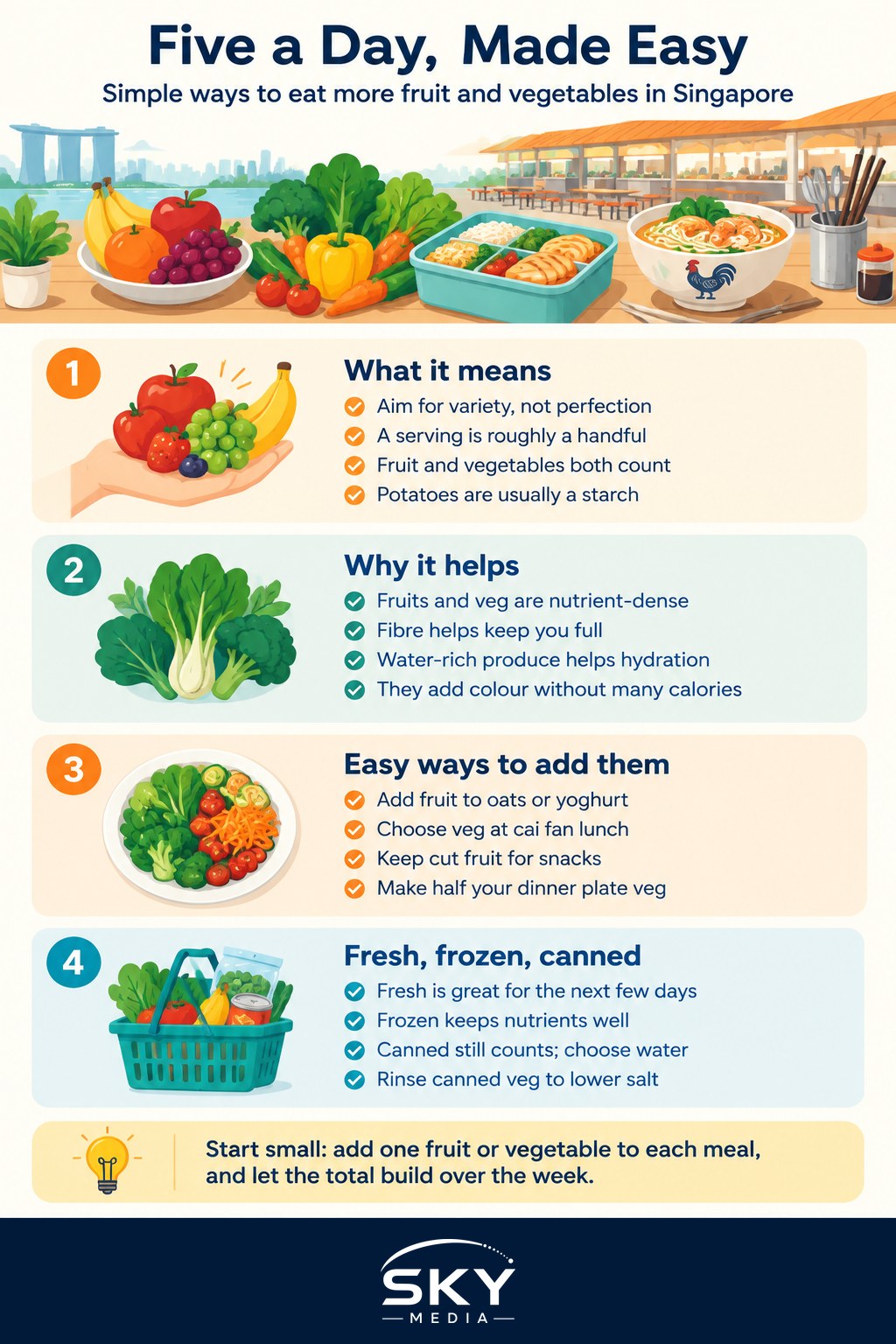
The idea behind five a day is variety and quantity, not a rigid rule you must hit perfectly. Roughly speaking, a serving is a handful: a piece of fruit like a small apple or banana, a couple of small fruits like mandarin oranges, a palm-sized scoop of cooked vegetables, or a bowl of leafy greens. You do not need a kitchen scale. Your own hand is a portion guide you always carry with you, which is why it pairs well with the ideas in our guide to understanding portion sizes.
A few things are worth knowing so you do not overthink it:
- Colour matters. Different colours tend to offer different vitamins, minerals and plant compounds, so a plate with green, red, orange and purple does more for you than five servings of the same thing.
- Vegetables and fruit both count, but most people find it easier to lean on vegetables for the bulk, with fruit adding natural sweetness.
- Potatoes are usually counted as a starch, not a vegetable, because they behave more like rice or noodles in a meal.
Think of five a day as a direction to head in, not a test to pass or fail. Three colourful servings is already a win if you are starting from one.
Why It Is Worth the Effort
Fruits and vegetables are among the most nutrient-dense foods you can eat, meaning they carry a lot of goodness for relatively few calories. They are rich in fibre, the part of plant food that keeps digestion moving and helps you feel full, plus a wide range of vitamins and minerals. Because they fill your plate without piling on energy, they are a natural ally if you are watching your weight, a theme we explore in understanding empty calories and nutrient density.
In Singapore’s climate, water-rich produce like cucumber, tomato, watermelon and leafy greens also helps you stay hydrated through hot, sticky days. And the fibre they provide supports steadier energy across a long working afternoon rather than the slump that follows a heavy, beige lunch.
None of this means fruit and vegetables are a cure for anything. They are simply one of the most reliable, affordable upgrades you can make to everyday meals, no supplements or superfoods required.
Fitting Five a Day into Real Singapore Life
The trick is to stop treating vegetables as a separate mission and start attaching them to meals you already eat. Here is how that looks across a typical day:
- Breakfast: Add a banana or a handful of berries to your oats or yoghurt, or slip tomato and cucumber into a wholemeal sandwich. Even a small glass of fruit as part of a mixed meal helps.
- Hawker and food court lunch: Order economy rice (cai fan) and make two of your choices vegetables. Ask for extra greens with your fishball noodles, or choose yong tau foo and load up on the vegetable and tofu pieces rather than the fried items.
- Snacks: Keep cut fruit, cherry tomatoes or edamame handy instead of reaching only for biscuits. Our healthy snacking ideas has more quick options.
- Dinner at home: Make vegetables half your plate. A quick stir-fry of kailan, xiao bai cai or French beans takes minutes, and frozen mixed vegetables are a perfectly good backup on lazy nights.
Food delivery can work too. When you order in, add a side of vegetables or pick dishes that already include them, an approach we cover in eating healthily with food delivery. Small, repeatable choices beat one heroic salad a week.
Fresh, Frozen or Canned: What to Choose
People often assume only fresh produce counts. It does not. Frozen and canned options can be just as nutritious, more affordable and far less likely to spoil in your fridge, which means you actually eat them. Here is how the common choices compare.
| Option | Nutrition | Cost & convenience | Best for |
|---|---|---|---|
| Fresh produce | High when eaten soon after buying; declines the longer it sits | Widely available at wet markets and supermarkets; can spoil quickly in the heat | Meals you will cook within a few days |
| Frozen produce | Frozen soon after harvest, so it holds nutrients well | Long-lasting, budget-friendly, no washing or chopping | Busy weeks, stir-fries, soups and last-minute meals |
| Canned or packed | Still counts; choose items in water or natural juice | Very long shelf life and cheap | Pantry backup; rinse canned vegetables to lower added salt |
| Juice | Provides some vitamins but little fibre and concentrated sugars | Convenient but easy to overdo | An occasional extra, not a daily replacement for whole fruit |
A sensible mix is the realistic answer: fresh for the next few days, frozen and canned as a reliable backstop so you are never caught with an empty vegetable drawer. When buying packaged options, the Healthier Choice Symbol can help you spot lower-salt or lower-sugar versions at a glance.
Simple Habits That Make It Stick
Getting five a day consistently is less about willpower and more about setup. A few habits do most of the work:
- Shop with produce in mind. Put fruits and vegetables in your basket first, before the snacks, as suggested in our healthy grocery shopping tips.
- Prep once, eat all week. Wash and cut some produce when you get home so it is ready to grab. A little healthy meal planning for the week removes the daily decision.
- Double up when you cook. If you are stir-frying greens, make extra for tomorrow’s lunch box.
- Anchor fruit to a habit. Keep it on the kitchen counter or your work desk where you will see and eat it, rather than hidden in the fridge.
- Widen your rotation slowly. Try one new vegetable or fruit each week so meals stay interesting instead of a repeat of the same two greens.
If mornings are chaotic, a smoothie with whole fruit and some vegetables blended in can cover two servings before you leave the house. Just keep whole fruit as your main source most of the time, since chewing and fibre matter.
Making Peace with an Imperfect Plate
Some days you will hit five, and some days you will barely manage two. That is completely normal and not worth guilt. What counts is the overall pattern across weeks, not any single meal. Diet-culture pressure to eat “perfectly” tends to backfire; a calm, flexible approach lasts far longer.
Aim to make vegetables the easy default and fruit your go-to sweet treat, then let the average take care of itself. Pair this habit with the broader principles in nutrition basics: a beginner’s guide and you have a foundation that supports steady energy, better meals and a friendlier relationship with food.
Remember, this is general guidance for everyday healthy eating. For advice tailored to your health, a medical condition, pregnancy, or any allergy or intolerance, check with your doctor or an accredited dietitian. You can also find trustworthy, Singapore-specific information through HPB’s HealthHub and the My Healthy Plate guide.
Official sources: Health Promotion Board
Further reading: Getting Kids to Eat More Vegetables