

If you are applying for a master’s degree, an MBA or a specialised business programme, there is a good chance you will need a GMAT or GRE score. Preparing for the GMAT or GRE in Singapore is very doable alongside work or studies, but it takes planning: choosing the right test, building a study routine, booking a slot and knowing what score you are aiming for.
This guide assumes you have already decided to apply. It focuses on the practical side of getting a strong score, not on whether postgraduate study is worth it.
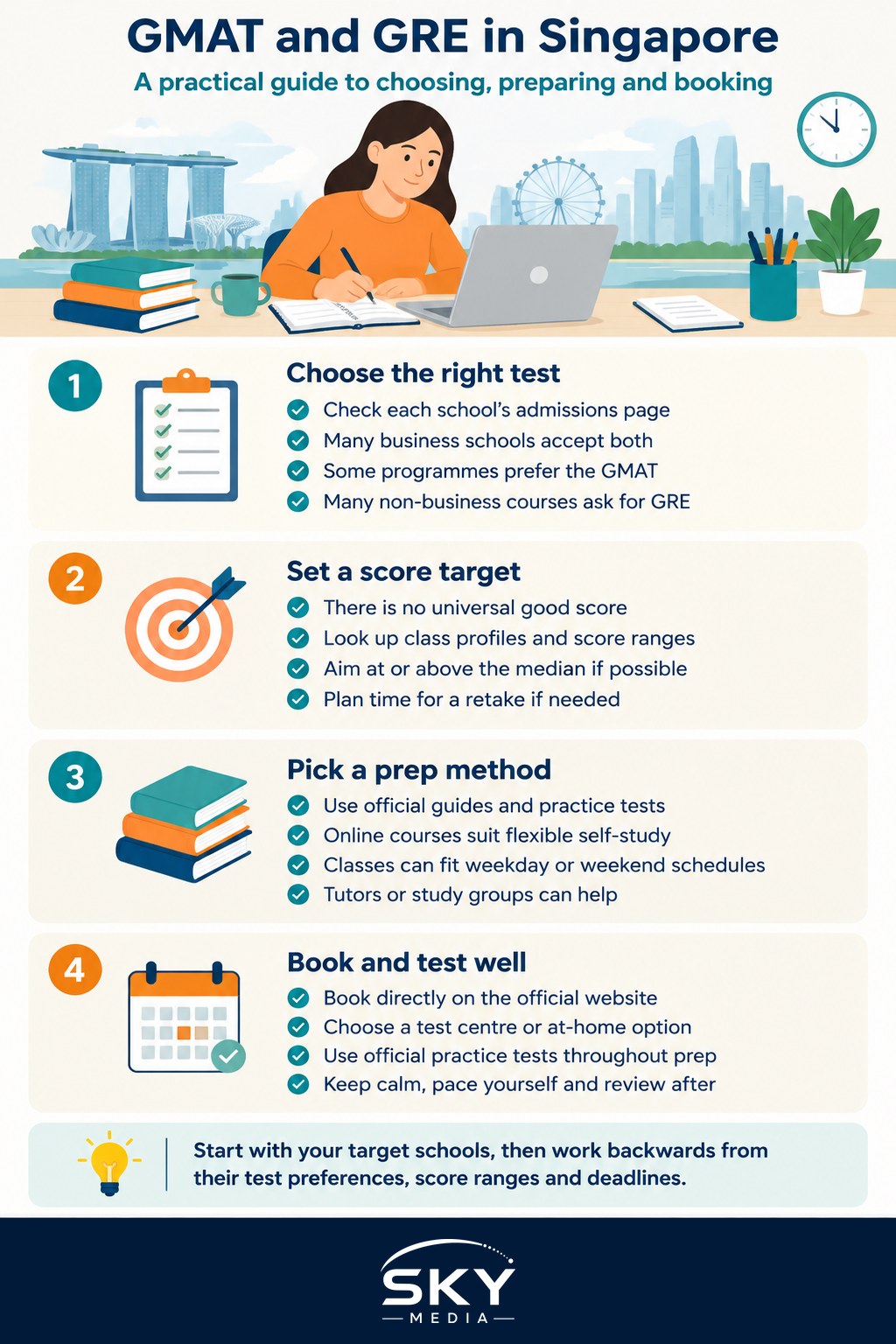
GMAT or GRE: Which Test Should You Take?
Start with your target programmes. Check each school’s admissions page to see which tests it accepts.
- Many business schools accept both the GMAT and GRE for MBA and business master’s programmes.
- Some business programmes prefer or require the GMAT, especially certain finance and management programmes.
- Most non-business graduate programmes, such as engineering, public policy or sciences overseas, ask for the GRE if they require a test at all.
- Some programmes waive tests for applicants with strong academic or work records. Waiver rules vary, so read them carefully.
If your schools accept both, take a free official practice test for each. Many people find one format suits them clearly better.
How the Two Tests Compare
Both tests have changed format in recent years, so always check the official websites (mba.com for the GMAT, ets.org for the GRE) for current details.
| Feature | GMAT | GRE General Test |
|---|---|---|
| Who runs it | Graduate Management Admission Council (GMAC) | Educational Testing Service (ETS) |
| Main sections | Quantitative Reasoning, Verbal Reasoning, Data Insights | Verbal Reasoning, Quantitative Reasoning, Analytical Writing |
| Maths style | Problem solving and data interpretation, no calculator in the Quant section | Broader maths content, on-screen calculator provided |
| Verbal style | Reading comprehension and critical reasoning | Reading, text completion and sentence equivalence, more vocabulary heavy |
| Typical users | Business school applicants | Wide range of graduate programmes, increasingly business schools too |
| Test options | Test centre or online at home | Test centre or at home |
Both tests are computer based and adaptive in some way, meaning question difficulty responds to your performance. Understanding how scoring works for your chosen test helps you pace yourself.
Setting a Realistic Score Target
There is no universal “good score”. Your target depends on the programmes you are applying to.
- Look up class profiles. Many schools publish the median or middle range of scores for their latest intake. Aim at or above the median for your top choices.
- Check section expectations. Some programmes look closely at your quantitative score, especially for finance, analytics and engineering.
- Factor in the rest of your application. Strong grades, work experience and essays can balance a slightly lower score, but a score well below the range is harder to overcome.
- Plan for a retake. Many applicants sit the test twice. Leave enough time before application deadlines to retake if needed, and check each test’s rules on retakes and score reporting.
Write your target down and compare it with your first diagnostic score. The gap tells you roughly how much preparation you need.
Prep Options in Singapore
There are several ways to prepare, and many people combine them.
Self-study with official materials. The official guides and practice tests from GMAC and ETS are the most accurate reflection of real questions. This is the most affordable option and suits disciplined learners.
Online courses and question banks. Self-paced platforms offer video lessons, adaptive drills and analytics. They suit working adults who study in the evening or on the MRT.
Classroom or small-group courses. Several test prep providers in Singapore run weekday evening and weekend classes. Compare class size, instructor experience, practice test access and refund or repeat policies before paying.
Private tutors. One-on-one coaching helps if you are stuck on a particular section. Ask for a trial session and check the tutor’s own scores and teaching track record.
Study groups. Classmates or colleagues applying in the same cycle can keep you accountable and share resources.
Whatever you choose, use official practice tests at the start, middle and end of your preparation to track progress honestly.
A Sample Study Plan for Busy Young Adults
Most people need several weeks to a few months, depending on their starting point and target. A simple structure:
- Weeks 1 to 2: Take a diagnostic test, learn the format and review core maths and grammar.
- Weeks 3 to 6: Work through topics section by section. Keep an error log noting why you got each question wrong.
- Weeks 7 to 10: Do timed mixed sets and full-length practice tests every week or two. Revisit weak areas from your error log.
- Final week: Light review, one last practice test, rest and logistics.
Short, regular sessions beat occasional long ones. An hour on weekdays plus a longer weekend block is a common rhythm for working adults. If you have taken an English proficiency test before, the routine will feel familiar, as covered in our guide to preparing for IELTS and TOEFL in Singapore.
Booking Your Test and Test Day Tips
You book directly on the official website of each test. When booking, you choose between a test centre in Singapore and the online at-home version, subject to availability. Test centres in Singapore are operated by appointed partners listed on the official booking pages. Fees, rescheduling charges and identification requirements are set by GMAC and ETS and can change, so check them at the time of booking.
Practical tips:
- Book early. Popular slots, especially weekends close to application deadlines, fill quickly.
- Use your passport as ID if it is required, and make sure the name matches your booking exactly.
- For at-home tests, check the technical and room requirements in advance and run the system check well before the day.
- For centre tests, arrive early, as late arrivals may not be admitted.
- Plan your score sending. Know which schools you will send scores to and how many free score reports are included.
On the day itself, eat properly, bring water if allowed during breaks and treat the test like a long practice session. Calm, steady pacing matters more than any last-minute cramming. Our guide on preparing for a professional exam in Singapore has more tips on exam-day routines and managing nerves.
After the Test
Once you have a score you are happy with, move on to the rest of your application: essays, recommendations, transcripts and interviews. If your score falls short, review your error log, adjust your plan and book a retake with enough time before deadlines. A thoughtful second attempt often brings a real improvement.
Frequently Asked Questions
How many weeks should I give myself to prepare for the GMAT or GRE? Most people need several weeks to a few months, depending on their starting point and target. A diagnostic test shows the gap between your score and your goal. Short, regular sessions beat occasional long ones.
Can I take the GMAT or GRE at home instead of a test centre? Both tests offer an online at-home option subject to availability, as well as test centres run by appointed partners. For at-home tests, check the technical and room requirements and run the system check well beforehand. Book on the official website.
What should I do if I score below my target? Review your error log, adjust your study plan and book a retake with enough time before deadlines. Many applicants sit the test twice, and a thoughtful second attempt often brings a real improvement. Check each test’s rules on retakes and score reporting.
Is it better to study alone or join a prep course? It depends on your discipline and budget. Official materials from GMAC and ETS are the most affordable and accurate, while classes, tutors and study groups add structure and accountability. Compare class size, instructor experience and refund policies before paying.
Do I need a perfect score to get into a good programme? No. Aim at or above the median published for your top choices, as there is no universal good score. Strong grades, work experience and essays can balance a slightly lower score, though one well below the range is harder to overcome.
Further reading: Is an MBA Worth It in Singapore?