

You pull into an HDB carpark to drop your parents at the lift lobby, or you circle a URA lot looking for a space that is not there, and then drive out. Will you be charged? The answer depends on the carpark grace period, Singapore’s built-in allowance for very short stays. Understanding how it works, and where it does not apply, saves you small but annoying charges and the occasional summons.
This guide covers grace periods for drop-offs, short stops and leaving a carpark. It does not repeat general parking rules or season parking, which our other guides handle.
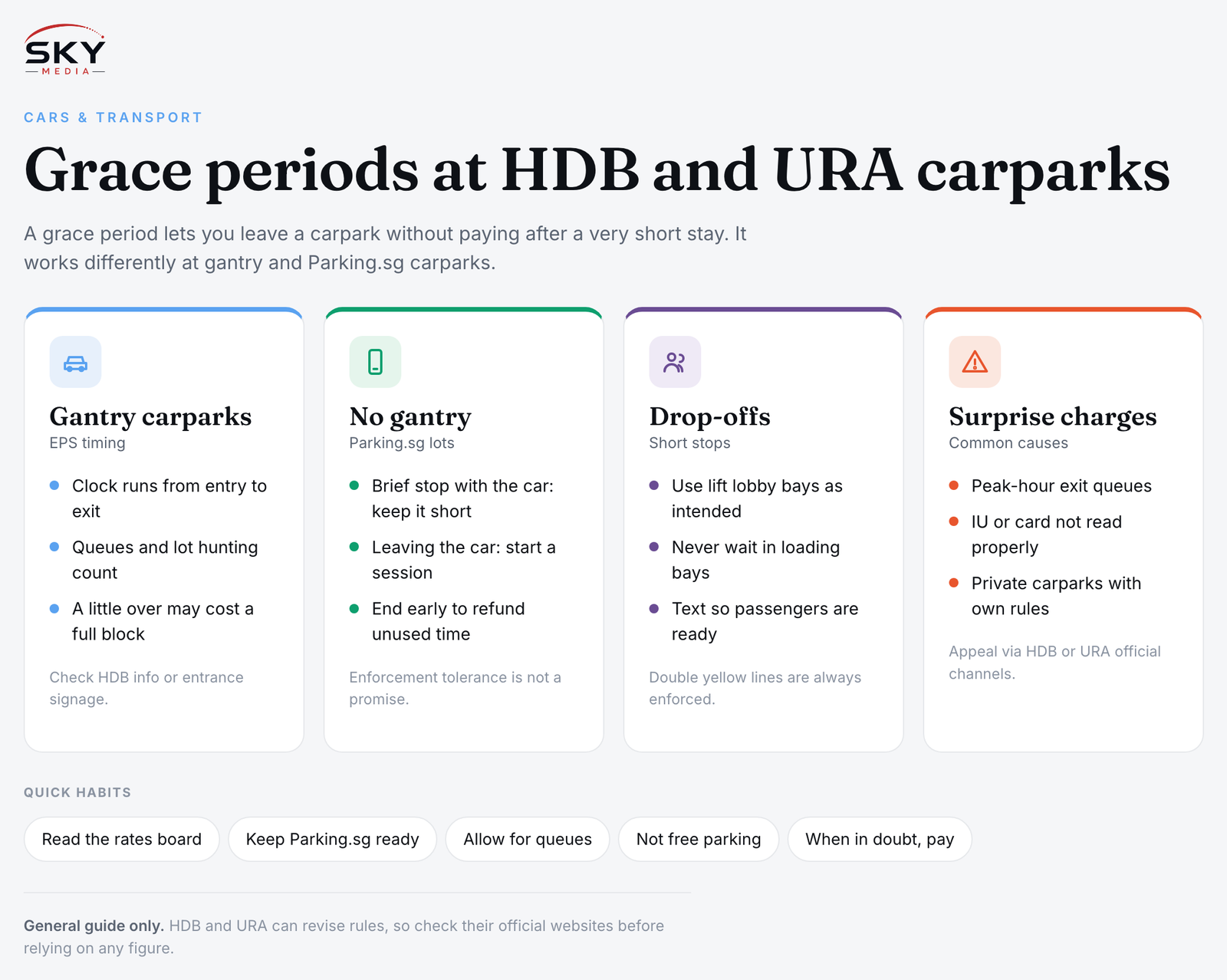
What a Carpark Grace Period Actually Is
A grace period is a short window after you enter a carpark during which you can leave without paying. It exists because many drivers enter carparks for reasons other than parking: dropping someone off, picking up a passenger, finding the carpark full, or simply taking a wrong turn.
In Singapore, public carparks fall into two main families:
- HDB carparks, run by the Housing & Development Board, found in housing estates. Many use the Electronic Parking System (EPS), where gantries read your in-vehicle unit and deduct charges automatically when you exit.
- URA carparks, run by the Urban Redevelopment Authority, including many kerbside and open-air lots in the city and older areas. Many URA and some HDB lots without gantries use Parking.sg, the government parking app, instead of gantries.
The grace period works differently in these two set-ups, which is where most confusion comes from.
How Grace Periods Work at Gantry Carparks
At EPS gantry carparks, the system records the time you enter and the time you exit. If the gap falls within the grace period, no parking charge is deducted. HDB has publicised a short free grace period for vehicles entering and leaving EPS carparks, commonly around 10 minutes, but the exact length and conditions are set by the operator and can change, so check HDB’s current car parking information or the signage at the entrance.
Points to keep in mind:
- The clock runs from entry to exit, not from when you park. Time spent queuing at the entrance gantry, hunting for a lot or waiting at the exit counts.
- Going even slightly over can mean paying for the parking block. Charges are generally calculated in time blocks, so a few minutes too long may trigger a full block charge.
- Repeated short entries may each be logged. If you drive in and out several times in quick succession, each visit is treated separately.
- Private and commercial carparks set their own rules. Shopping malls, hospitals and condominium visitor carparks may offer a grace period, a different one, or none at all. Look at the rates board at the entrance.
How It Works at Parking.sg Carparks Without Gantries
At carparks without gantries, there is no machine timing your stay. Instead, you are expected to start a parking session in Parking.sg once you park. This changes the picture:
- If you stop briefly to let someone in or out without leaving the car, you are generally not “parking” in the usual sense, but enforcement officers cannot read your intentions. Keep it brief and stay with the vehicle.
- If you leave the car, even for a few minutes, you should start a session. Parking.sg charges by the minute after a minimum, and you can end the session early to get a refund for unused time, so starting one is low-risk.
- Grace periods for parking enforcement and charging are not the same thing. Even where there is some tolerance before an enforcement officer issues a notice, that is not a promise; follow the rules rather than gambling on it.
Check the URA or Parking.sg website for current rules on minimum charges, session refunds and enforcement, since these are updated from time to time.
Short Stop Scenarios Compared
The table below shows how common situations usually play out. Treat it as a rough guide, not a guarantee.
| Situation | Gantry carpark (EPS) | Parking.sg carpark (no gantry) |
|---|---|---|
| Drop off a passenger at the lift lobby and drive straight out | Usually free if you exit within the grace period | Stay with the car and keep it brief; no session needed for a genuine momentary stop |
| Carpark is full and you leave after circling | Usually free if you exit within the grace period; long circling can exceed it | No charge as you never parked |
| Run up to a flat to collect something for 15 minutes | Likely charged once over the grace period | Start a session; leaving without one risks a notice |
| Wait in the car for a passenger who is running late | Charged once over the grace period | Waiting in a lot counts as parking; start a session |
| Enter by mistake and exit immediately | Usually free | Not applicable |
Drop-offs, Pick-ups and Loading
Many drivers assume any drop-off is automatically free. In practice, it depends on where you stop.
- Use drop-off points and lift lobby bays as intended. Many HDB blocks have short-stop bays near lift lobbies for picking up and setting down passengers. They are not for waiting or parking.
- Do not wait in loading bays or on double yellow lines. These are enforced regardless of grace periods, and stopping there can obstruct emergency access.
- Plan pick-ups so the passenger is ready. A quick text before you arrive keeps you within the grace period at gantry carparks and avoids the temptation to linger at a non-parking spot.
- Delivery and moving vans should check whether a carpark has height limits and designated loading areas, and start a session or pay for parking for anything beyond a brief stop.
Common Reasons Drivers Get Charged Anyway
Even careful drivers sometimes see an unexpected deduction. The usual causes:
- Peak-hour queues at the exit. Evening or weekend congestion can eat up the grace period while you are still in the carpark.
- Missing the gantry reading. If your in-vehicle unit or card is not detected properly, the system may treat your exit differently. Check that your unit and stored-value card are working before relying on the grace period.
- Different operator, different rules. A carpark next to an HDB block may be privately run. Rates boards at the entrance are the final word.
- Night or whole-day schemes. Special schemes change how charges are calculated. Our guide to the Night Parking Scheme at HDB and URA carparks explains how those work.
- EV charging lots. Bays reserved for charging may have separate time limits and fees. See charging an EV at an HDB carpark for what to check.
How to Dispute a Charge or Notice
If you believe you were charged incorrectly or received a parking notice for a genuine brief stop:
- Note the date, time, carpark number and what happened while it is fresh.
- Check your in-vehicle unit or card transaction record for the deduction.
- For HDB carparks, use the feedback or appeal channel on HDB’s official website. For URA carparks or Parking.sg, use URA’s official channels.
- Explain the circumstances briefly and attach any evidence, such as a receipt or a screenshot of your Parking.sg session.
Appeals are assessed case by case, and there is no guarantee of a waiver, so it is better to plan short stops carefully in the first place.
Quick Habits for Stress-Free Short Stops
- Read the rates board at the entrance, especially at carparks you do not use often.
- Keep the Parking.sg app logged in and ready on your phone.
- Treat the grace period as a buffer for genuine short visits, not as free parking.
- Allow for queues at busy times.
- If in doubt, start a session or accept the small charge rather than risk a notice.
Rules and grace period lengths can be revised by HDB and URA, so always check their official websites for the current position before relying on any figure.
Frequently Asked Questions
Do I have to pay if I drive into a mall carpark and leave immediately? It depends on the operator, since malls, hospitals and condominiums set their own rules and some have a grace period while others have none. Check the rates board at the entrance before you drive in. If you enter by mistake, leave promptly and keep any receipt.
What if the HDB carpark gantry did not read my in-vehicle unit properly? Check that your unit and stored-value card are working before relying on the grace period. If you think you were charged wrongly, note the date, time and carpark number, check your transaction record and appeal through HDB’s official feedback channel.
Can I wait in the car while my passenger runs upstairs at a Parking.sg lot? Waiting in a lot counts as parking, so start a session. Sessions are low-risk because you can end them early and get a refund for unused time. Brief, genuine drop-offs are different, but enforcement officers cannot read intentions, so stay with the vehicle.
Why was I charged after circling the carpark looking for a lot? The clock usually runs from entry to exit, so queuing, circling and exit queues all eat into the grace period. Busy weekends are the most common culprit. Check HDB’s current car parking information for the latest grace period.
Will a parking notice be cancelled if I appeal for a short stop? There is no guarantee. Appeals are assessed case by case, so give a brief explanation and attach evidence such as a receipt or a Parking.sg screenshot. Use HDB’s channel for HDB carparks and URA’s official channels for URA ones.
Further reading: Wheel Clamping in Private Carparks in Singapore: Is It Legal and What to Do