

Few things ruin a day faster than walking back to your car and finding a heavy yellow clamp locked onto the wheel. In Singapore, wheel clamping is mostly something that happens in private carparks, such as condominiums, commercial buildings, shophouse lots and private landed estates, rather than public HDB or URA carparks. If you are dealing with wheel clamping in Singapore, it helps to know why it happens, what is generally expected of the operator, and how to respond without making things worse.
This article is general information, not legal advice. If you have a serious dispute, speak to a lawyer or one of the bodies mentioned below.
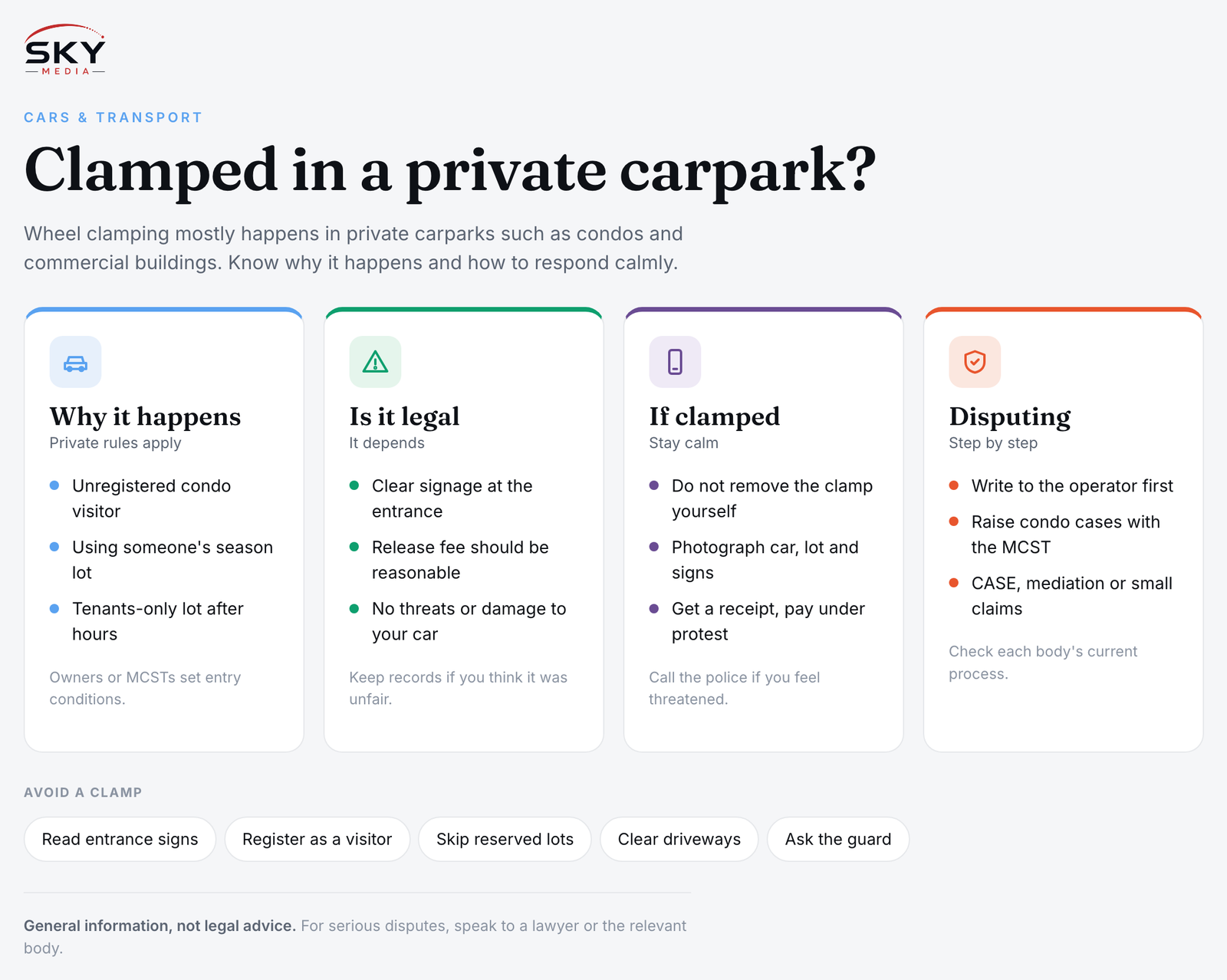
How Private Carpark Clamping Differs From Public Carparks
Public carparks run by HDB and URA are enforced with parking offence notices and fines under public parking rules. Enforcement officers do not usually clamp cars there for simple parking breaches. Towing of vehicles in public areas is a separate matter handled by the authorities for situations such as obstruction or abandoned vehicles.
Private carparks work differently. The land belongs to a private owner, or to an MCST (Management Corporation Strata Title) in the case of a condo. The owner or its appointed carpark operator sets the conditions of entry, such as who may park, where, and for how long. Clamping is one way some private operators enforce those conditions.
Common situations where people get clamped include:
- Parking in a condo carpark without registering as a visitor, or staying beyond the visitor time limit.
- Using a season parking lot or a reserved lot that belongs to someone else.
- Parking in a private commercial carpark after hours when it is marked for tenants only.
- Parking across driveways, loading bays or fire engine access ways on private land.
- Leaving a car in a private lot for a long time without permission.
| Situation | Public HDB or URA carpark | Private carpark (condo, commercial) |
|---|---|---|
| Who sets the rules | Public agencies under parking legislation | The landowner, MCST or appointed operator |
| Usual enforcement | Parking fines issued by enforcement officers | Clamping, release fees, warning notices or towing by the operator |
| Where rules are shown | Signs and the official parking app or website | Signboards at entrances and within the carpark, condo by-laws |
| Where to raise a complaint | The agency that issued the notice | The operator or MCST first, then mediation, consumer or legal channels |
Is Wheel Clamping Legal?
There is no simple yes or no answer that fits every case. Whether a particular clamping was lawful depends on the circumstances, including whether you entered on terms you could reasonably see, whether those terms mentioned clamping and a release fee, whether the fee was reasonable, and how the clamping was carried out.
In practice, operators who clamp usually rely on clear notice. Things that matter include:
- Signage. Signs at the entrance and around the carpark should state who may park, the conditions, that vehicles may be clamped, and how to get a clamp released.
- Condo by-laws. For condos, the MCST’s by-laws and visitor parking rules set out what is allowed. Our guides on driving in multi-storey carparks and the night parking scheme cover the public side of parking for comparison.
- Reasonableness. A release fee that seems far out of proportion to the breach, or clamping that blocks you from leaving even after you have offered to pay, may be open to challenge.
- Conduct. Operators should not threaten you, damage your car, or refuse to tell you who they are.
If you believe a clamp was applied unfairly, keep records and raise it through the proper channels rather than trying to remove it yourself.
What to Do When You Find Your Car Clamped
Staying calm makes everything easier. A sensible sequence is:
- Do not try to remove or damage the clamp. Forcing it off could damage your car and could expose you to claims for damaging someone else’s property.
- Take photos. Capture the clamp, your car’s position, the lot markings, and every sign nearby, including the entrance signage. Note the time.
- Read the notice on your car. It should state who clamped the vehicle and how to contact them.
- Call the number shown and ask for the operator’s name, the reason for clamping, the release fee, and how and when the clamp will be removed.
- Ask for a receipt with the company name, amount, date and reason when you pay.
- Pay under protest if you dispute it. If you need your car urgently, you can pay to get it released and state in writing, such as by message or email, that you are paying under protest and intend to dispute the charge.
- Check your car for damage before driving off, and photograph anything new.
If you feel threatened, or someone refuses to release your car after payment, contact the police.
How to Dispute a Clamping Charge
If you think the clamping or the fee was unfair, work through these steps in order:
- Write to the operator or landowner. Explain what happened, attach your photos and receipt, and ask for a refund or a reduction. Keep it factual and polite.
- Go to the MCST for condo cases. If a condo’s appointed operator clamped you, the MCST is responsible for its by-laws and contractors. Owners and residents can raise concerns at council or general meetings.
- Seek advice from consumer bodies. The Consumers Association of Singapore (CASE) may be able to advise on whether a charge looks unfair and how to proceed.
- Consider mediation. For neighbourly disputes, such as within a condo, the Community Mediation Centre can help both sides reach a settlement.
- Small claims. The Small Claims Tribunals hear certain types of claims, and may be an option to recover money in some disputes. Check on the State Courts website whether your situation qualifies.
- Strata disputes. Disputes between condo owners and an MCST about by-laws may in some cases go to the Strata Titles Boards.
Check current procedures and eligibility with each body, as their processes and limits may change.
How to Avoid Getting Clamped
Prevention is cheaper than any release fee:
- Read signs at the entrance before you drive in, especially at condos and private office buildings.
- Register at the guardhouse or visitor system when visiting a condo, and note the time limit.
- Never park in reserved, season or numbered lots unless you have been given that lot.
- Avoid driveways, loading bays, yellow boxes and emergency vehicle access areas.
- If you are unsure, ask the security guard or management office before leaving your car.
- For long stays, use a public carpark nearby where the rules and charges are published.
For Condo Residents and MCSTs
If you live in a condo that clamps, the rules affect your visitors and contractors too. Good practice for MCSTs includes clear and visible signage, by-laws approved at a general meeting, a reasonable and published release fee, a 24-hour contact number, and a fair appeal process. Residents who feel the system is too harsh can raise it at the next general meeting.
Wheel clamping is stressful, but most cases are resolved quickly once you know who to call and what to document. Should you also find damage on your car, our guide to carpark scratches and hit-and-run incidents explains the next steps.
Further reading: Grace Periods at HDB and URA Carparks: How Long Before You Pay · Number Plate Rules in Singapore: Legal Fonts, Sizes, Placement and Fines