

Once you have been collecting for a while, you will notice that some cards are sold sealed in hard plastic cases with a number on the label, and that those numbers can make a big difference to price. That is professional grading. For collectors of Pokemon, sports cards, Yu-Gi-Oh!, Magic: The Gathering and newer games, card grading Singapore style usually means sending cards overseas to an established grading company, then waiting weeks or months for them to return.
This guide explains how grading works, how Singapore collectors submit cards, what it really costs in time and money, and how to decide whether a particular card is worth grading. If you are still building your first binder, start with our guide to getting into collecting trading cards.
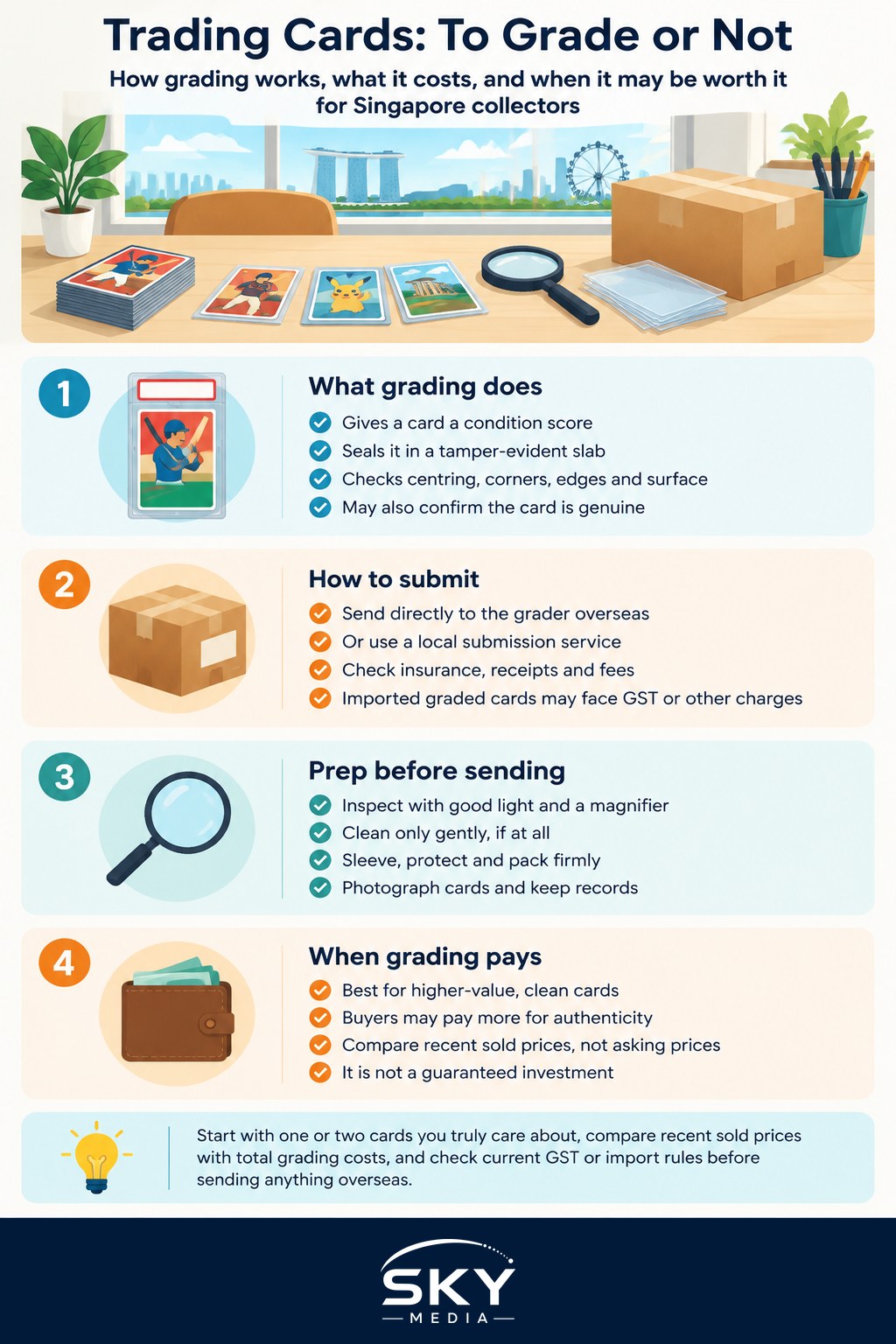
What Professional Grading Actually Does
A grading company examines a card and gives it a condition score, usually on a scale up to 10. The card is then sealed in a tamper-evident plastic holder, often called a “slab”, with a label showing the card details, grade and a certification number that buyers can look up online.
Graders typically assess four things:
- Centring: how evenly the image sits within the borders, front and back.
- Corners: whether they are sharp or show wear, whitening or bends.
- Edges: chipping, whitening or roughness along the sides.
- Surface: scratches, print lines, dents, stains or fingerprints.
Some companies also authenticate the card, confirming it is genuine and not altered. This authentication is a big part of why graded cards often sell more easily: a buyer who cannot inspect the card in person can trust the slab more than a photo.
Well-known international graders include PSA, Beckett (BGS), CGC and SGC. Each has its own grading scale, label style and reputation in different collecting communities. Prices and turnaround times differ by company and service level, and they change often, so check each company’s official website for current details.
How Singapore Collectors Submit Cards
There are two main routes for collectors here.
Submitting directly. You create an account with the grading company, fill in their online submission form, choose a service level and ship your cards to their facility overseas. This gives you the most control, but you handle the packaging, international shipping, insurance and return import yourself.
Using a local submission service. Some hobby shops and independent groups collect cards from many local collectors and send them together in bulk. This can lower shipping cost per card and simplify paperwork, but you are trusting someone else with your cards for a long time.
If you use a submission service, check:
- How long they have operated and what other collectors say about them
- Whether they give written receipts listing every card
- How cards are insured during transit both ways
- Their full fee breakdown, including service fee, grading fee, shipping and any taxes
- What happens if a card is lost, damaged or delayed
Whichever route you choose, remember that graded cards coming back into Singapore are imported goods and GST (Goods and Services Tax) or other charges may apply depending on value and how they are shipped. Check current rules with Singapore Customs or IRAS rather than assuming.
Preparing Your Cards Before Sending
Good preparation reduces disappointment and damage.
- Inspect carefully. Use good lighting and a magnifier or phone zoom. Look at corners, edges and surface at an angle to catch scratches.
- Clean gently, if at all. A soft microfibre cloth can remove dust or fingerprints. Never use liquids or try to press out bends; graders may detect alterations and refuse to grade the card.
- Sleeve and protect. Place each card in a soft “penny” sleeve, then in a semi-rigid holder or top loader as the grading company or submission service instructs.
- Record everything. Take clear photos of the front and back of each card before sending, and keep a list with values. This helps with insurance claims and disputes.
- Pack firmly. Cards should not slide around. Use sturdy cardboard and padding, and seal against moisture, which matters in Singapore’s humidity.
Raw vs Graded: When Grading Pays
Grading costs money and time, and it does not automatically make a card more valuable. The decision comes down to the card’s value, its likely grade and how you plan to use it.
| Situation | Keep it raw | Consider grading |
|---|---|---|
| Card value | Low-value or common cards, where fees could exceed any gain | Higher-value cards where a top grade sells for clearly more than raw copies |
| Condition | Visible wear, off-centre printing or surface damage | Very clean, well-centred cards likely to score highly |
| Purpose | Playing in tournaments or enjoying in binders | Selling to buyers who want authenticity and a recognised grade |
| Authenticity concerns | Card bought from a trusted source and not intended for resale | Expensive card where buyers will want third-party authentication |
| Time horizon | You need the cash or the card soon | You can wait through long turnaround times |
A simple way to judge: look up recent completed sales (not asking prices) for the same card in raw condition and at different grades. Compare the gap with your total grading cost, including shipping, fees and any taxes. If only a perfect 10 makes it worthwhile, ask yourself honestly how likely that is. Many cards that look perfect to the eye come back a grade or two lower.
Selling Graded Cards in Singapore
If you grade to sell, think about where your buyers are.
- Local marketplaces and collector groups are convenient for meet-ups and avoid shipping. Meet in busy public places, such as a mall, and check the certification number together.
- Hobby shops may buy outright or sell on consignment. Compare their offer with recent market prices.
- International platforms reach more buyers but add shipping, fees and the risk of disputes.
For buyers, always look up the certification number on the grading company’s website and check that the label and slab match what is shown there. Fake slabs and swapped labels exist, so be cautious with deals that look too good.
Treat trading cards as a hobby first. Prices for popular cards can rise and fall sharply with new releases, reprints and online trends. Grading can protect and showcase a special card, but it is not a guaranteed investment, and this guide is not financial advice.
A Sensible Approach for Most Collectors
Start small. Grade one or two cards you genuinely care about or that clearly justify the cost, learn how the process and timelines work, then decide whether to do more. Keep your records, protect your cards from humidity and handle them carefully at every step. Whether the slab adds resale value or simply keeps a favourite card safe on your shelf, knowing why you are grading is what makes it pay.
Further reading: A Beginner’s Guide to Collectible Card Games in Singapore