
When you move from mainland China to Singapore, your name suddenly has to fit into many different systems: your work pass, your bank account, your child’s school, your phone contract, your insurance and more. Each form asks for your name in a slightly different way. Should the surname come first or last? Are the syllables of your given name joined or separated? Where do the Chinese characters go?
This guide explains how your hanyu pinyin name in Singapore usually appears across common documents, and how to keep it consistent so you avoid problems later. It is general information, not legal advice. For official records, always follow the instructions of the agency concerned, such as the Ministry of Manpower (MOM) or the Immigration and Checkpoints Authority (ICA).
Your Passport Is the Starting Point
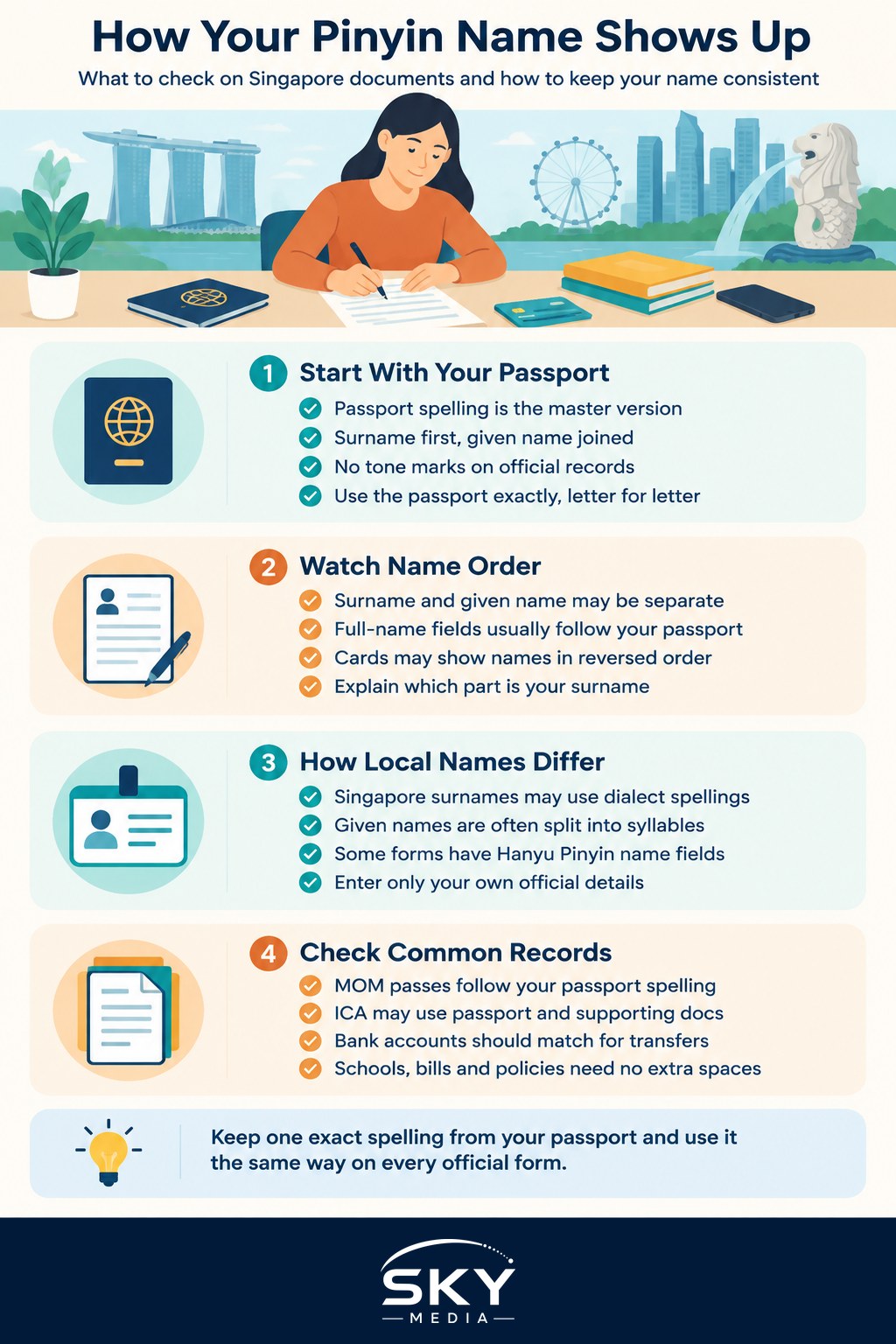
In Singapore, almost every official record for a foreigner is based on the name in your passport. Your Chinese passport shows your name in Chinese characters and in hanyu pinyin, usually in capital letters, with the surname and given name in separate fields.
A few things to notice about your passport name:
- Surname first. The surname field is your family name, for example ZHANG or CHEN.
- Given name joined. A two-character given name is normally written as one word in pinyin, for example XIAOMING rather than XIAO MING.
- No tone marks. Pinyin on official documents does not show tones.
- Special letters. The pinyin letter ü does not exist on most keyboards and systems. Chinese passports commonly write it as YU (so a surname like 吕 may appear as LYU), but you may see LV or LU in older documents or other systems. Use exactly what your passport shows.
Treat your passport spelling as your “master” name. Copy it letter for letter on every form, including spaces and order. If your passport is renewed and anything changes, update other records promptly. Passport matters are handled by the Embassy of the People’s Republic of China in Singapore, so check with them for renewal details.
Name Order: Why Forms Can Be Confusing
China, like Singapore’s Chinese community, puts the surname first. Many international systems, however, are built around Western names, where the given name comes first and the family name last. This is where mix-ups happen.
Common situations:
- Forms with separate fields for “Surname” or “Family name” and “Given name” or “First name”. Put ZHANG in the surname field and XIAOMING in the given name field, regardless of the order they appear on screen.
- Forms with one “Full name” field. Most Singapore systems expect the name as it appears in your passport. If the passport shows ZHANG XIAOMING, write ZHANG XIAOMING.
- Name displayed on cards. Some banks and companies show your name as XIAOMING ZHANG on cards, emails or ID badges because their system reverses it automatically. This is usually a display issue. What matters is that the record behind it matches your passport.
When someone in Singapore addresses you, they may use your given name, your full name, or “Mr Zhang” or “Ms Chen”. Locals are used to Chinese name order, so it is fine to explain which part is your surname.
How Singapore Chinese Names Differ From Yours
You will notice that many Singaporean Chinese names look different from mainland pinyin names. This is not a mistake on either side.
- Dialect spellings. Many Singaporean families registered their surnames in dialect romanisation, such as Tan (陈, Chen in pinyin), Lim (林, Lin), Ng (黄, Huang) or Goh (吴, Wu).
- Separated syllables. Singaporean given names are often written with each syllable separate, for example Tan Wei Ming, while your passport shows a joined given name such as CHEN WEIMING.
- Hanyu pinyin names on local records. Some Singaporeans have both a dialect name and a hanyu pinyin name recorded, and you may see both on forms or school lists.
This is useful to understand because some Singapore forms, including some school and government forms, have extra fields for a “Hanyu Pinyin name” or “Chinese name”. Fill these only with your own details as they appear in your official documents.
Where Your Name Appears and What to Check
Here is a quick guide to how your name usually appears on common records in Singapore, and what to watch.
| Record | How the name usually appears | What to check |
|---|---|---|
| Work pass, Dependant’s Pass or other MOM pass | Based on your passport name in English letters | Spelling and order exactly match your passport |
| ICA records (for PR or citizenship applicants) | Based on passport and supporting documents, may include Chinese characters | Follow ICA’s instructions on name fields and character forms |
| Bank account and cards | Full passport name on the account, card may be shortened or reordered | Account name matches passport for transfers and verification |
| Child’s school records | Based on the child’s passport or birth certificate, sometimes with a Chinese name field | Spelling, order and characters match, especially for Mother Tongue classes |
| Phone, utilities, insurance, tenancy | Usually typed from your pass or passport | No missing letters, swapped order or extra spaces |
Chinese characters: mainland China uses simplified characters. Some Singapore forms that allow Chinese characters also use simplified characters, while others may not support them at all. If a system cannot store characters, the English-letter version is what counts. Do not worry if your characters do not appear on every document.
Avoiding Mismatches That Cause Problems
Small differences can cause surprising trouble: a bank transfer flagged because the payee name does not match, a delayed insurance claim, or an airline booking that does not match your passport. To avoid this:
- Copy your name exactly from your pass card or passport every time. Avoid nicknames or English names on official records unless the organisation specifically allows an alias field.
- Keep spacing consistent. CHEN WEIMING and CHEN WEI MING may be treated as different names by some systems.
- Check every new record when it arrives. Read your pass, bank letters and policy documents carefully and request corrections early.
- Use your English name only where appropriate. Many China newcomers use an English name at work. That is fine socially and on email signatures, but legal and financial records should follow your passport.
- Keep a short note of your exact passport spelling, including the YU, LV or LU form if relevant, to share with HR, agents or anyone filling in forms for you.
If You Need to Change or Correct Your Name
If an organisation has misspelled your name, contact them with a copy of your passport and pass and ask for a correction. For agency records, follow the correction process on the agency’s official website.
A legal change of name is different. If you are considering one, for example after marriage, read up on the process and check with the relevant authorities in both countries before acting. Our guides on changing your name by deed poll in Singapore and changing your name after marriage cover the basics. Foreigners should confirm with ICA, MOM and the PRC Embassy how any change would affect their pass and passport.
For families, helping children understand their name in characters and pinyin is also part of feeling at home here. Our guide on teaching hanyu pinyin to your child at home has practical ideas. Getting your name right on day one saves a surprising amount of time later.