
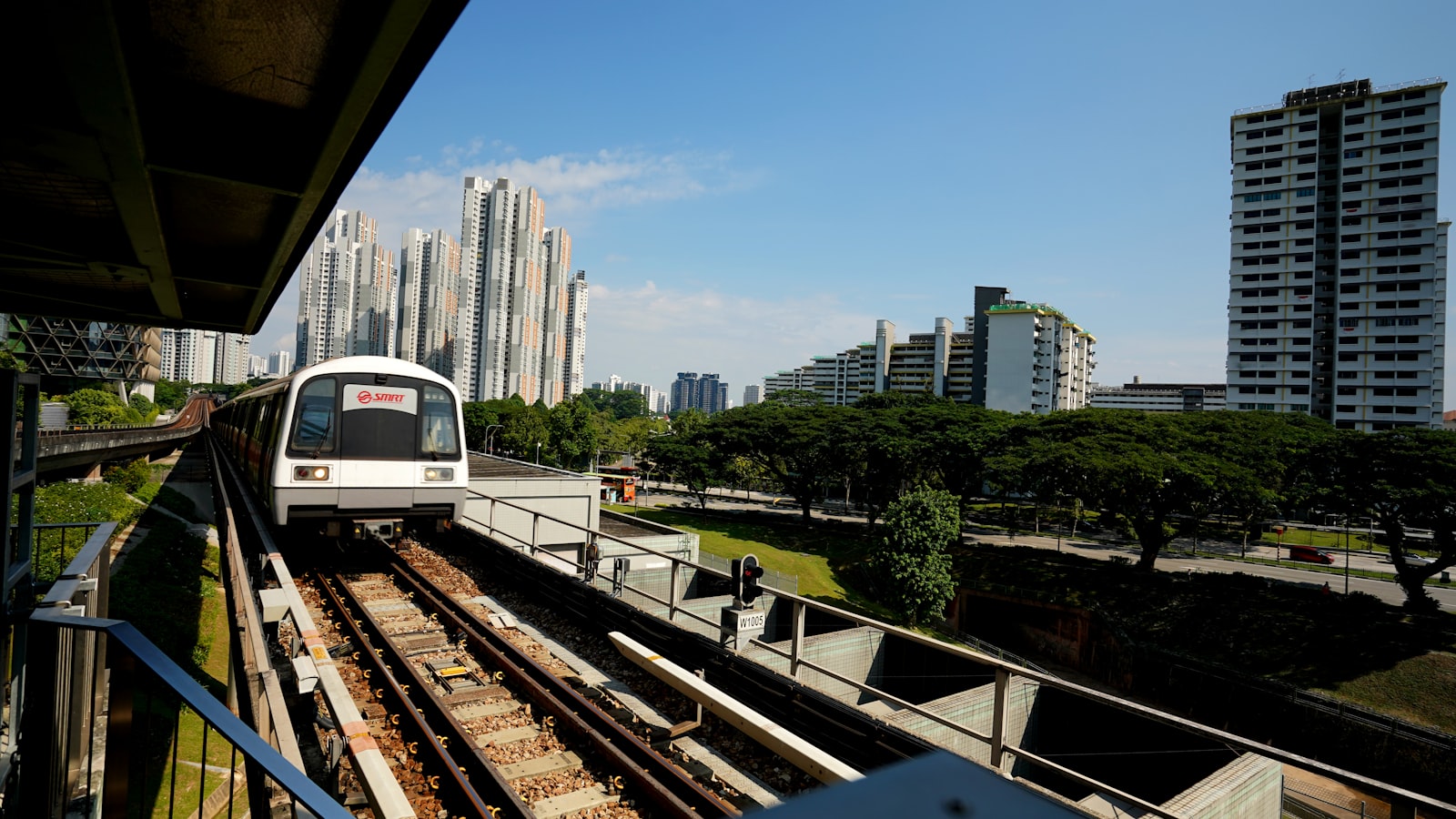
Whether you have lived here for years or landed last week, getting around is wonderfully easy once you know the basics. This singapore mrt guide walks you through the rail network, the buses that fill in the gaps, how to pay, and the small courtesies that keep everyone moving. Public transport in Singapore is clean, affordable and covers almost every corner of the island, so most residents happily skip owning a car altogether.
The MRT and LRT network
The MRT (Mass Rapid Transit) is the backbone of public transport in Singapore. It runs as a set of colour-coded lines that criss-cross the island, connecting the airport, the city centre, the heartlands and most major malls and attractions. Each line has a name and a colour, for example the red North-South Line and the green East-West Line, and every station carries a letter-and-number code that makes it easy to plan a trip even if the station name is unfamiliar.
The LRT (Light Rail Transit) is a smaller feeder system. These driverless trains loop through a few residential towns such as Bukit Panjang, Sengkang and Punggol, ferrying people between their flats and the nearest MRT interchange. You pay and tap the same way on both, so you rarely need to think about which one you are on.
To see how it all fits together, look up an official MRT map. Stations, interchanges and lines are shown clearly, and the map is refreshed as new lines and stations open, which happens fairly regularly.
Not sure which station is closest to you? Use our finder below.
Find your nearest MRT station
Your location stays in your browser and is never sent anywhere.
Riding somewhere specific? Our journey tracker follows you stop by stop with a flashing light, so you always know exactly where you are, even underground.
MRT journey tracker
Pick your line and where you are heading, then follow your progress stop by stop, even underground where GPS cannot reach. On above-ground stretches it can locate you automatically.
How it works. Straight-line GPS matching finds your nearest station when you have signal; underground, tap "Next stop" as each station is announced. Station data covers the MRT and LRT network but new stations open over time, so confirm on the official map. Nothing about your location leaves your device.
Prefer to see the whole network at a glance? Explore our schematic map below, a clean recreation of the rail diagram that you can pan, zoom and search.
Singapore MRT schematic map
The whole rail network on one interactive map. Pick a journey and a dot tracks your position stop by stop, even underground. Drag to pan, zoom with the buttons, and tap any station for its details.
Tap a station to see its name and codes, or pick a journey above.
Our own recreation. Drawn from public station coordinates as a simplified reference, not the official diagram; layout and colours are our own. New stations open over time, so check LTA for the authoritative map and live status. Location matching happens in your browser and never leaves your device.
Buses fill in the gaps
Where the trains do not reach, the buses do. Singapore has an extensive bus network with both trunk services that cover long routes and shorter feeder services that circle a neighbourhood. Buses are the quiet heroes of the system: they take you the last stretch from the station to your door, and they often reach places a train never will.
A few things worth knowing:
- Board through the front door and tap your card on the reader.
- Tap again on the reader by the exit door when you get off. This is important because fares are distance-based.
- Press the bell in good time to signal the driver you want to alight.
- At quieter stops, raise your hand so the driver knows to stop.
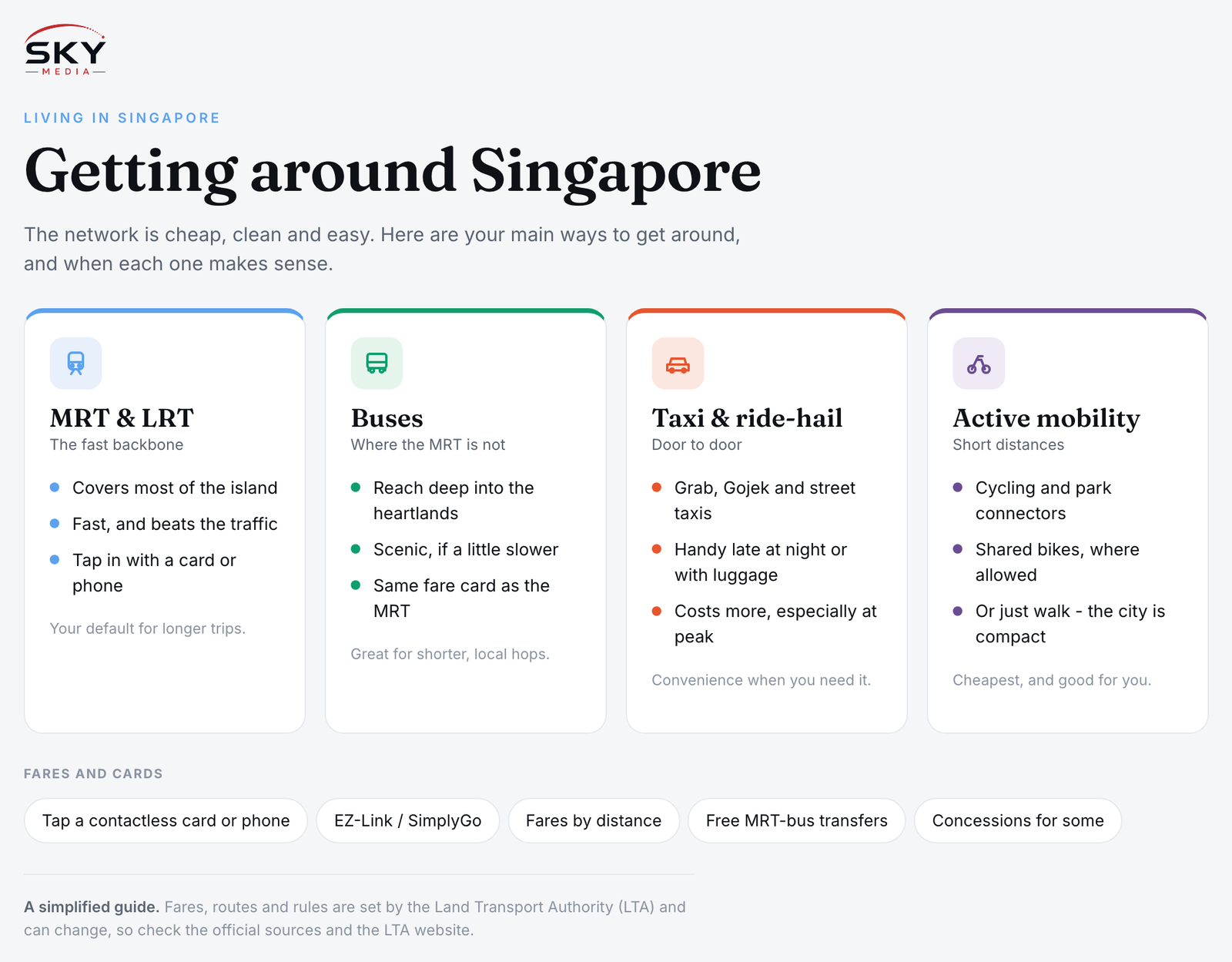
Here is how the main ways to get around compare:
| Mode | Best for | Good to know |
|---|---|---|
| MRT and LRT | Fast travel across the island | The backbone of the network, and it avoids road traffic |
| Bus | Routes the trains do not reach, and scenic trips | Extensive coverage, but slower in traffic |
| Taxi | Door-to-door travel when you are in a hurry | Metered, with possible surcharges at peak times |
| Ride-hailing | Booking a car from your phone | Upfront fares, handy away from the rail lines |
| Cycling and active mobility | Short trips and park connectors | A growing network of paths, follow the rules |
| Walking | Short hops, especially on sheltered links | Covered walkways help in the heat and rain |
Paying for your ride
You have a few ways to pay, and the good news is you no longer need to fuss with cash or paper tickets. Pick whichever suits you.
EZ-Link and other stored-value cards
An EZ-Link card is the classic option: a physical stored-value card you top up and tap at the gantry or on the bus. It is a solid choice if you prefer not to link a bank card, if you are buying a card for a child, or if you simply like keeping travel money separate. You can top up at station machines, ticketing kiosks and convenience stores.
SimplyGo
SimplyGo is the account-based system that lets you tap and pay using a contactless bank card, your phone or a SimplyGo-enabled travel card, with fares charged to your linked account rather than a stored balance. The companion app lets you review your trips and fares after the fact. It is convenient because there is nothing to top up, though the fare shows up in your transaction history rather than on the card itself.
Contactless bank card or phone
Many visitors and residents simply tap a contactless Visa or Mastercard, or a phone or watch loaded with one. Tap in, tap out, and the fare is billed to your card. It is the fastest way to start travelling on day one, with no separate card to buy.
Quick tip: whichever method you use, always tap in and tap out. Forgetting to tap out can mean being charged the maximum fare for that journey.
How fares work
Fares on trains and buses are distance-based, not flat. You are charged for how far you actually travel, so a couple of stops costs less than crossing the island. As a rough guide, a typical adult journey tends to fall somewhere in the region of one to two Singapore dollars, with longer trips costing a little more. Treat that as a ballpark only, since fares are reviewed periodically.
Transfers are handled kindly. If you switch between bus and train, or between two buses, within a single continuous journey and within the allowed transfer window, the system usually treats it as one trip rather than charging you a fresh boarding fee each time. This is another reason to tap out every time: the system needs to see the full journey to work out the fare correctly.
Bus fares in Singapore follow the same distance-based logic as the trains, so the two systems feel consistent whichever you use.
Concession cards
If you qualify, a concession card can meaningfully lower your costs. Concession schemes exist for groups such as students, senior citizens, full-time national servicemen and persons with disabilities, and they typically offer reduced fares or monthly travel passes. Eligibility and application steps vary by category, so check the official concession card information to see which one fits you and how to apply.
Apps to make life easier
A good app turns a confusing trip into a simple one. Journey-planning apps and official transport apps will map your route, estimate travel time, and show live bus arrival timings so you know whether to stroll or dash to the stop. Look for the official LTA and operator apps as well as the SimplyGo app for managing your account and viewing fares.
Because timings, routes, service changes and fares can all be updated, always lean on these official apps and the LTA website for live, accurate information rather than relying on any figure quoted here.
Etiquette that keeps things smooth
Singaporeans are proud of how orderly the system is, and a few simple habits keep it that way:
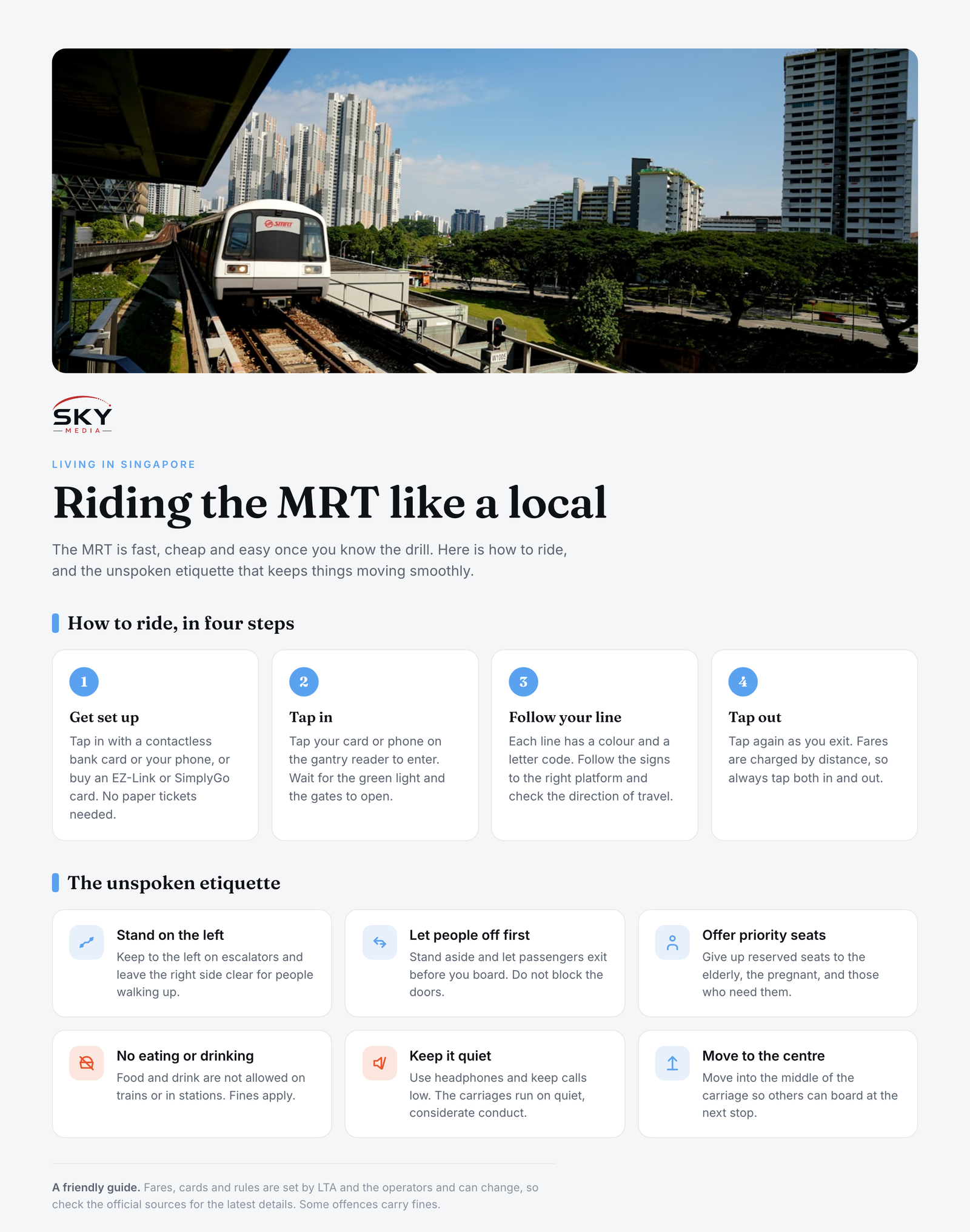
- No eating or drinking on trains and buses, and no smoking. This is taken seriously and fines apply.
- No durians. The beloved fruit is famously not allowed on board because of its powerful smell.
- Let people alight first before you board. Stand aside at the doors and wait.
- Give up reserved seats to those who need them more, such as the elderly, expectant mothers and anyone less mobile.
- Move to the centre of the train or the rear of the bus so others can get on.
- Keep the volume down. Use headphones and keep calls brief and quiet.
First and last trains
Trains generally run from around the start of the day, roughly 5.30am, until about midnight, with buses covering similar hours and a limited set of late-night services on some routes. These times vary by line and station, and by day of the week, so check the official first and last train timings for the specific station you are using before an early start or a late night out.
Quick-start checklist
- Pick a payment method: EZ-Link, SimplyGo, or a contactless bank card or phone.
- Download an official journey-planning app and the SimplyGo app.
- Save or bookmark a current MRT map.
- Always tap in and tap out, on both trains and buses.
- Check first and last train times if you are travelling at the edges of the day.
- Mind the etiquette, and leave the durians at home.
Once these become second nature, you will find that getting around Singapore is genuinely one of the easiest parts of living here. Trust the official apps for anything time-sensitive, keep a little flexibility for the occasional service change, and enjoy the ride.
Explore more: Moving to Singapore checklist · Free things to do in Singapore · Cost of living in Singapore