

Every October, talk turns to haunted places in Singapore. Friends swap stories about the old hospital on the hill, the cemetery in the middle of the city and the mansion that nobody wants to stay in after dark. But behind almost every local ghost story is a real piece of history: wartime suffering, migration, faith and the way a fast-changing city treats its past.
This guide looks at the places themselves: what happened there, why the legends grew and, importantly, what the access rules are today. It is not a guided tour list, and it does not claim anything is actually haunted. Treat these as heritage stories, and treat the sites, many of which are graves or memorials, with respect.
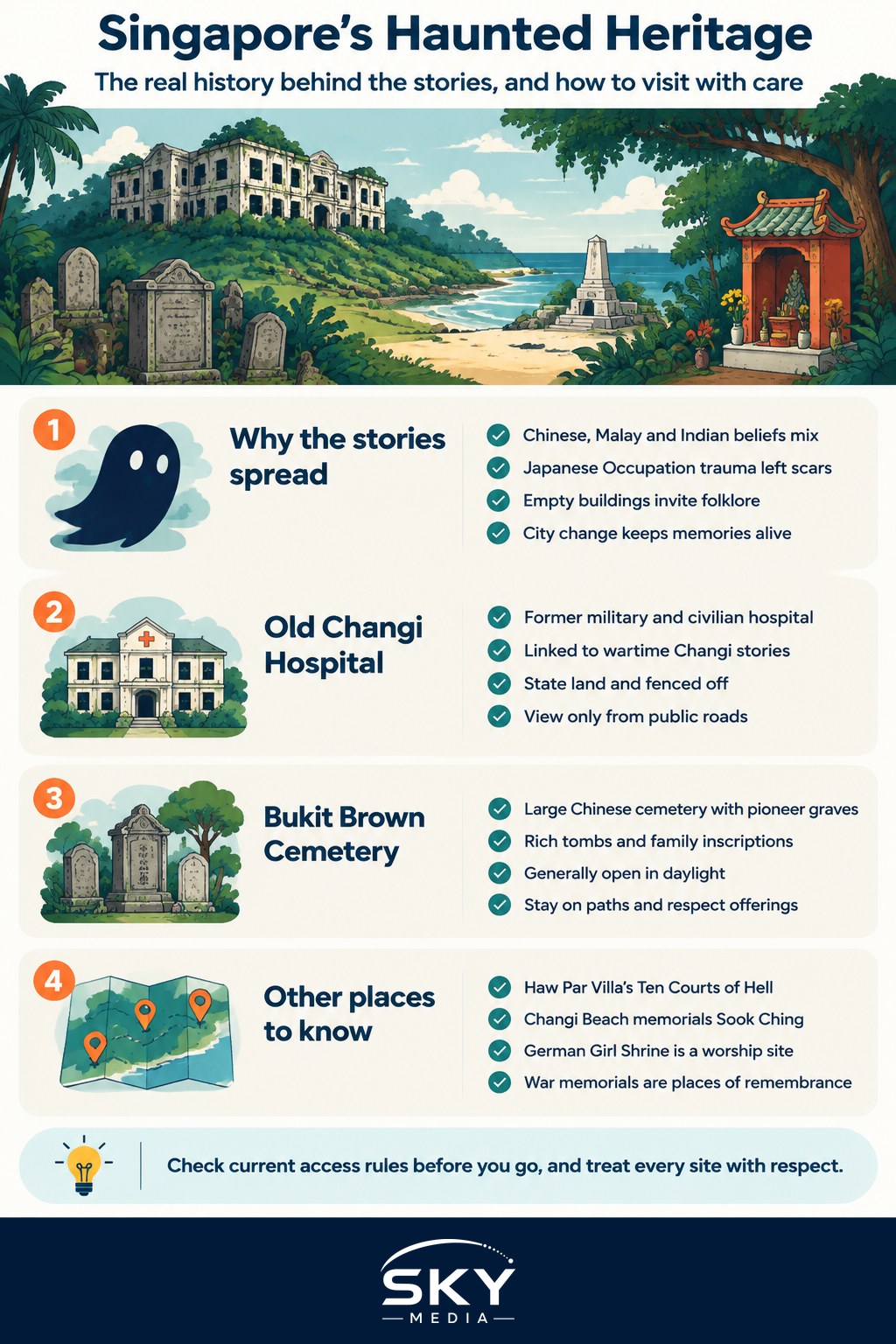
Why Singapore Has So Many Ghost Stories
Singapore’s ghost lore draws from several traditions at once. Chinese beliefs about hungry ghosts and the Seventh Month, Malay folklore about the pontianak and other spirits, and Indian and colonial-era stories all mix together. Add the trauma of the Japanese Occupation from 1942 to 1945, when many civilians were killed, and it is not surprising that some locations carry a heavy reputation.
Rapid redevelopment also plays a part. When old buildings stand empty, or cemeteries are cleared for roads and housing, people fill the silence with stories. Many “haunted” sites are simply places where the city’s memory is still visible.
Old Changi Hospital: The Most Famous Abandoned Site
Perched on a hill near Changi Village, the old hospital buildings began life as part of a British military base before the Second World War. During the Japanese Occupation, the wider Changi area was associated with internment and prisoner-of-war camps, and stories link the site to that period. After the war it returned to military medical use, and later became a civilian hospital before services moved to a newer facility in the late 1990s.
Once empty, the buildings became the subject of countless urban legends, ghost-hunting videos and even a local horror film. Most of the frightening details circulating online cannot be verified.
Access today: the site is state land and is fenced off. Entering without permission is trespassing and can lead to penalties. Plans to redevelop the area have been discussed publicly over the years, so check news and official announcements rather than relying on old blog posts. You can view the exterior respectfully from public roads, but do not climb fences or enter the buildings.
Bukit Brown Cemetery: History Among the Graves
Bukit Brown, off Lornie Road, is one of the largest Chinese cemeteries outside China and holds the graves of many Singapore pioneers. It is a rich heritage landscape with elaborate tombs, carved guardians and inscriptions that tell stories of early migrant families.
Part of the cemetery was exhumed to make way for a road, which drew public attention to its heritage value. Volunteer heritage groups have documented many of the tombs, and walks led by them are a respectful way to learn.
Access today: the cemetery grounds are generally open to the public, but paths are uneven and overgrown in places. Visit in daylight, wear proper shoes and insect repellent, carry water and stay on established trails. Do not touch, move or photograph offerings in a disrespectful way. During Qing Ming and the Seventh Month, families visit graves to pay respects, so give them space.
Other Sites With Stories Behind Them
Haw Par Villa. Built in the 1930s by the brothers behind Tiger Balm, this park is famous for its “Ten Courts of Hell”, a series of dioramas depicting punishments in the Chinese afterlife. It was intended as a moral lesson rather than a horror show, but its graphic scenes have given generations of children nightmares. It is a legitimate attraction that you can visit; check its official website for current opening times and any age guidance for the hell section.
Changi Beach. This popular beach is also a memorial site. During the Sook Ching operation in early 1942, many Chinese civilians were killed along parts of the Changi coast, and a heritage marker records this history. Ghost stories here grew from that loss. It is a public park managed by NParks, so you can visit freely, but remember what the marker stands for.
The German Girl Shrine on Pulau Ubin. A small shrine on Pulau Ubin is linked to a story about a young girl who died during the First World War era. The tale has many versions and is hard to confirm, but the shrine is visited by people who leave offerings. Treat it as a place of worship and do not disturb items.
Old cemeteries and war memorials elsewhere. Sites such as the Kranji War Memorial and various former cemeteries carry deep history. They are places of remembrance first, so behave as you would at any memorial.
| Site | Real history behind the legend | Can you visit? |
|---|---|---|
| Old Changi Hospital | Former military and civilian hospital, linked to wartime Changi | Exterior only from public roads; entering is trespassing |
| Bukit Brown Cemetery | Large Chinese cemetery holding many pioneer graves | Generally open; daylight visits on established paths |
| Haw Par Villa | 1930s park with Ten Courts of Hell dioramas | Yes, as an attraction; check official opening times |
| Changi Beach | Sook Ching massacre site, now a public beach park | Yes, an NParks park with a heritage marker |
| German Girl Shrine, Pulau Ubin | Folk story about a girl from the early 20th century | Yes, as a shrine; do not disturb offerings |
How to Visit Respectfully and Safely
If you want to explore these places around Halloween, a few principles keep you safe and on the right side of the law.
- Never trespass. Fenced, abandoned or military sites are off limits. Ghost-hunting is not a valid reason to enter, and police can act on trespass.
- Go in daylight. Uneven ground, poor lighting and wildlife make night visits risky, particularly at cemeteries and on Pulau Ubin.
- Respect graves and shrines. Do not sit on tombs, move offerings, or make jokes at memorials. Many families still visit their ancestors here.
- Be careful with photos and videos. Avoid filming people praying, and think twice before posting “haunted” content that could upset descendants.
- Prepare for nature. Bring water, wear covered shoes, use repellent and tell someone where you are going. Follow NParks guidelines in parks and do not feed or approach wild animals.
- Check current rules. Access can change because of redevelopment or conservation work, so look up the managing agency’s website before you go.
Finding the History Behind the Legends
If the stories hook you, the best next step is to read the real history. The National Heritage Board’s Roots.sg portal, the National Archives and the National Library’s Infopedia all hold well-researched articles on Changi, Bukit Brown, the Sook Ching operation and wartime Singapore. Many heritage volunteers also share research through talks and walks.
Photographers drawn to atmospheric spots can find tips in our guide to the best places to photograph in Singapore, and history lovers might enjoy the story behind Singapore’s old town clocks and clock towers. Whatever you believe about ghosts, these places are worth knowing for what really happened there.