
Most of us check the time on a phone without thinking. For much of Singapore’s history, though, knowing the time meant looking up: at a tower above a civic hall, a clock on a market roof or a dial on a church or shopfront. Clock tower Singapore history is a small, often overlooked heritage theme, but it says a lot about how the city organised work, trade, worship and daily routine.
This guide traces the role of public clocks and timepieces across civic, commercial and religious sites, highlights a few you can still see today, and suggests how to spot them on a heritage walk.
Why Port Cities Needed Public Clocks
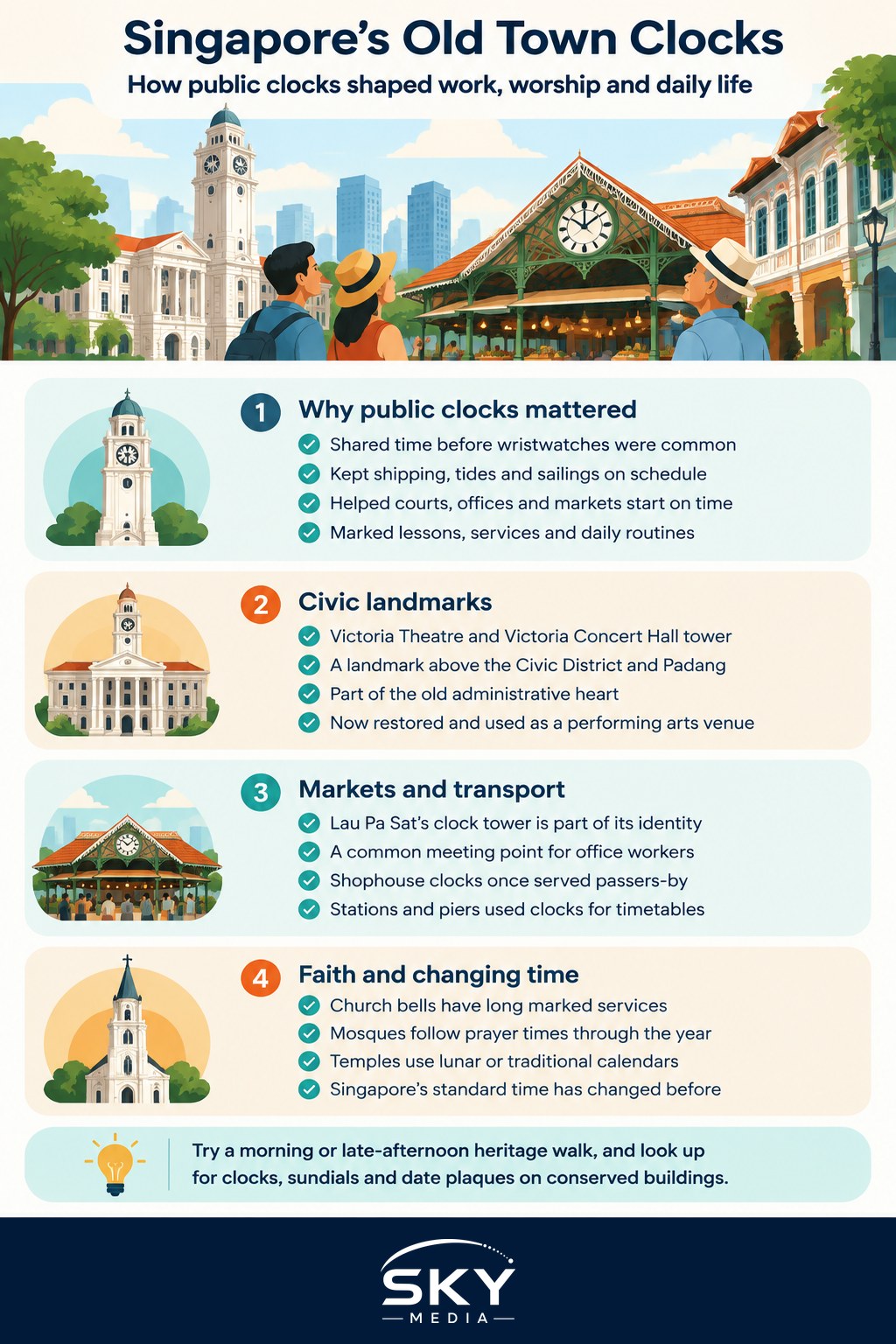
Before wristwatches were common and affordable, a shared public clock was a practical necessity. In a busy port like colonial Singapore, time mattered for:
- Shipping and tides. Harbour work, cargo handling and sailings ran to schedules, and ships’ officers needed to check their chronometers against a reliable reference.
- Government and courts. Offices, hearings and official business started at fixed hours.
- Markets and trade. Traders, hawkers and shop assistants worked to opening and closing times.
- Schools and churches. Bells and clocks marked lessons and services.
A clock on a tall tower could be seen across a square or down a street, and a striking bell could be heard further still. Building one was also a statement. A grand tower clock signalled order, permanence and civic pride, which is why so many sit on prominent public buildings.
Victoria Memorial Hall and Its Landmark Tower
The best-known example is the clock tower of what is now the Victoria Theatre and Victoria Concert Hall in the Civic District. The Victoria Memorial Hall was built in the early twentieth century to commemorate Queen Victoria, and its tall clock tower rises between the two halls. It has long been one of the most recognisable silhouettes along the Singapore River and the Padang.
The tower is a reminder of how civic buildings were designed to be seen. It lines up with the open space of the Padang and sits close to other landmarks of the period, including the old Parliament building now known as The Arts House and the former Supreme Court and City Hall. Together they formed the administrative heart of colonial Singapore, and the clock above them was the area’s public timekeeper.
The building and its tower have been restored over the years, and the complex is now a performing arts venue. If you want accurate dates for its construction and restoration, the National Heritage Board’s Roots.sg portal and the Victoria Theatre’s own heritage information are the best places to check.
Market and Commercial Clocks
Clocks were not just for government buildings. Markets and commercial spaces also needed them.
- Lau Pa Sat (Telok Ayer Market). This octagonal cast-iron market in the Central Business District has a central clock tower that has become part of its identity. Workers in the surrounding offices still use it as a meeting point, and the tower is one of the market’s most photographed features.
- Shophouse and bank clocks. Some older commercial buildings had clocks set into their facades, both as a service to passers-by and as a subtle advertisement of reliability. Many have gone, but a few survive on heritage buildings.
- Transport hubs. Railway stations, piers and bus interchanges historically carried large clocks so travellers could keep to timetables.
The common thread is that a public clock was a shared resource. Everyone, from a merchant to a trishaw rider, could use the same reference.
Bells, Spires and Religious Timekeeping
Religious sites marked time in their own ways, and these traditions are part of the same story:
- Church towers and bells. Several of Singapore’s older churches have towers or belfries, and bells have traditionally called people to services and marked particular moments in the day or week. Practices vary between congregations.
- Mosques and the call to prayer. Prayer times follow the position of the sun and change through the year, so mosques publish timetables and the call to prayer marks these times for the community.
- Temples and festival calendars. Many Chinese and Hindu temples organise ceremonies around lunar or traditional calendars, with drums, gongs or bells used during rituals.
These forms of timekeeping were less about clock towers and more about rhythm and community. They remind us that “time” in a multicultural city was never just one system.
How Singapore’s Time Itself Has Changed
One surprising twist in clock tower Singapore history is that the time shown on these clocks has not always been the same offset from Greenwich. Singapore has changed its standard time several times over the past century. During the Japanese Occupation, local clocks were set to Tokyo time. In the early 1980s, Singapore adjusted its time zone to align with Malaysia, which is why sunrise and sunset feel later here than you might expect for a city so close to the equator.
So a clock that has stood in the same spot for decades has, in a sense, told several different versions of local time.
Old Clocks Then and Now
| Setting | Role in the past | What you are likely to see today |
|---|---|---|
| Civic buildings | Official public time for government, courts and the Padang | Restored towers kept as landmarks, now part of arts and heritage venues |
| Markets | Opening hours for traders and shoppers | Clock towers as meeting points and photo spots |
| Churches | Bells for services and community life | Belfries and towers preserved, bells used in line with each church’s practice |
| Transport hubs | Timetables for trains, boats and buses | Digital displays, with some heritage clocks kept for character |
| Shophouses and banks | Service to passers-by and a sign of reliability | A handful of surviving facade clocks on conserved buildings |
Spotting Old Clocks on a Heritage Walk
You can build a short self-guided walk around timepieces:
- Start at the Civic District. Look up at the Victoria Theatre and Concert Hall tower from the Padang side and from across the river.
- Walk along the river. Our guide to the story of the Singapore River explains how this stretch grew into a trading hub that ran on schedules.
- Head to Lau Pa Sat. Visit at lunchtime or in the evening to see the clock tower in use as a gathering point.
- Keep your eyes up in conserved streets. Older facades sometimes hide a clock, a sundial motif or a date plaque.
A few tips: walk in the cooler morning or late afternoon, carry water, and respect places of worship by dressing modestly and following any posted guidance.
Why These Clocks Still Matter
Today, almost nobody needs a tower clock to know the time. Yet these landmarks still anchor neighbourhoods, give people a place to meet and quietly connect the modern city to the routines of earlier generations. The next time you pass one, pause and look up. You are seeing a piece of how Singapore learned to keep time together.
Further reading: Haunted Places in Singapore and the Stories Behind Them