

Balloting for a Build-To-Order (BTO) flat can feel like pure luck, but HDB sets aside a share of flats for families in certain situations. The best known is the married child priority scheme, which gives an edge to parents and married children who want to live together or close by. Several other priorities exist too, and knowing which one fits your family can meaningfully improve your odds.
This guide focuses on those family priorities rather than the general ballot and queue process. HDB adjusts these schemes from time to time, so treat this as an overview and confirm the current eligibility rules, quotas and conditions on the HDB website or HDB Flat Portal before you apply.
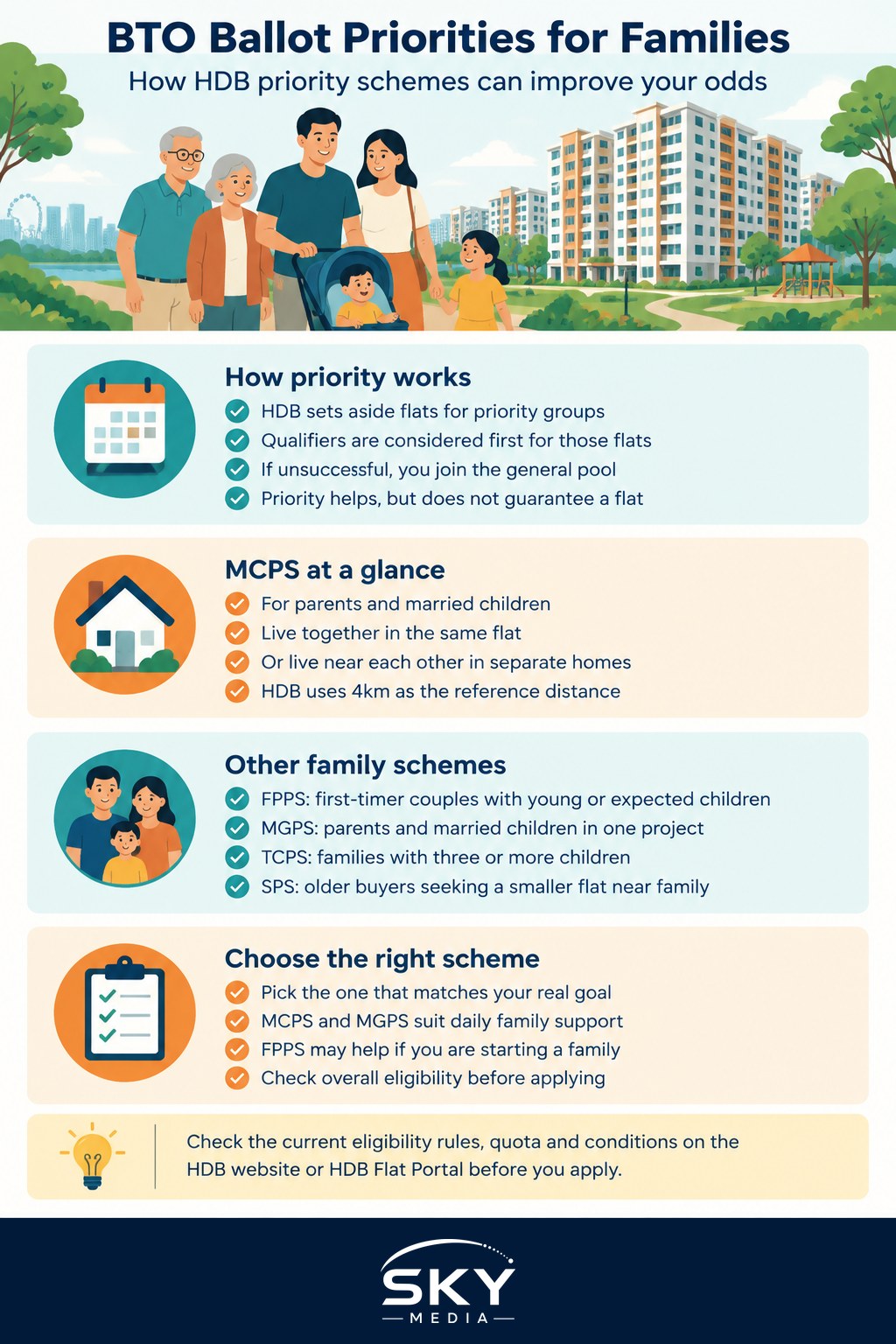
How Priority Schemes Fit Into a BTO Ballot
In each BTO sales exercise, HDB sets aside a portion of flats for specific priority groups. Applicants who qualify for a priority scheme are considered for those set-aside flats first. If they are not successful within that quota, they are usually still considered alongside everyone else in the general pool.
In practice, a priority scheme does not guarantee a flat. What it does is give you an extra or earlier chance at the flats reserved for your group. The benefit is largest when the reserved quota is generous relative to the number of applicants in your category, which varies by project and location.
You generally apply for priority through your BTO application itself, by indicating the scheme and providing the details HDB asks for. Applying for a scheme you do not qualify for can lead to your application being rejected later, so read the conditions carefully first.
The Married Child Priority Scheme in Detail
The Married Child Priority Scheme (MCPS) supports families who want to provide mutual care and support across generations. It is aimed at two arrangements:
- Living with each other: parents and their married child live in the same flat, applying together for one flat.
- Living near each other: parents and their married child live in separate homes within a set distance of each other, with HDB currently using 4km as the reference.
Some common scenarios where MCPS applies:
- A married couple applies for a BTO flat close to the wife’s parents’ existing HDB flat.
- Parents downsizing from a larger home apply for a smaller BTO flat near their married son’s home.
- Parents and their married daughter apply together in the same BTO exercise for flats near each other.
Things to keep in mind:
- “Married child” is the key condition. A single adult child does not qualify for MCPS in the same way, though singles may have other options. HDB also extends the scheme to certain divorced or widowed children with children of their own, so check if this applies to you.
- The distance is measured by HDB, not by your own map app. Use HDB’s tools to check whether two addresses fall within range before applying.
- Conditions may apply after you get the flat, for example on continuing to live with or near the family member. Read the terms in your application and letters from HDB.
- You usually choose one priority. If you qualify for several schemes, check with HDB which one to apply under, as combinations are limited.
For newlyweds navigating this alongside wedding paperwork, our guide on getting married in Singapore covers the marriage registration side, which you will need done before applying as a married couple.
Other Family-Focused BTO Priorities Compared
MCPS is only one of several schemes. Here is how the main family-related priorities compare at a glance. Names and details are as commonly described by HDB; confirm the current version before applying.
| Scheme | Who it is meant for | What it helps with |
|---|---|---|
| Married Child Priority Scheme (MCPS) | Parents and married children | Buying a flat to live with or near each other |
| Family and Parenthood Priority Scheme (FPPS) | First-timer married couples with young children or expecting a child | Getting a flat sooner while starting a family |
| Multi-Generation Priority Scheme (MGPS) | Parents and married children applying together in the same project | Securing two flats, often a smaller one for parents, in the same BTO project |
| Third Child Priority Scheme (TCPS) | Families with three or more children | Recognising larger families with extra priority |
| Senior Priority Scheme (SPS) | Older buyers, often looking at smaller flats | Living near their children or their existing neighbourhood |
There are also schemes outside the family category, such as priority for public rental tenants moving to ownership, and assistance for divorced or widowed parents buying a second flat. HDB also runs a separate priority framework for first-timers, giving extra ballot chances to first-timer families and young couples, and further chances to first-timers who have been unsuccessful several times.
Choosing the Right Scheme for Your Family
If more than one scheme seems to fit, think about what you actually want from the arrangement, not only the odds.
If daily support is the priority, MCPS or MGPS makes sense. Families with working parents who rely on grandparents for childcare, or adult children who help elderly parents with appointments and meals, gain the most from living close by. MGPS suits families who want both households in the same project; MCPS offers more flexibility since one side can stay put.
If you are starting a family, FPPS may give you a stronger chance as a first-timer couple. It rewards parenthood rather than proximity, so it can help even if your parents live far from the estates you are targeting.
If you have three or more children, look at TCPS, which is designed to recognise larger families.
If you are an older buyer, SPS may help you secure a smaller flat close to family or your current neighbourhood, which can make ageing in place easier.
Some practical questions to ask before you decide:
- Which BTO projects in the coming exercises are within reach of your parents’ or children’s homes?
- Is the flat type you want likely to have a meaningful priority quota in that project?
- Are both households comfortable with the commitment to live with or near each other for the long term?
- Have you checked your overall eligibility, including income ceilings and citizenship, under the main HDB rules?
Our guide to HDB eligibility schemes for buyers explains the core household categories, such as the Public Scheme and Fiancé/Fiancée Scheme, that sit underneath these priority options.
Common Mistakes to Avoid
Priority schemes have rules that trip applicants up. Watch for these:
- Assuming distance from memory. Two estates that feel close may fall outside the qualifying distance. Always check using HDB’s tools.
- Using the wrong address. The parent’s or child’s address must generally be their actual registered home, owned or rented in line with HDB’s rules for that scheme.
- Overlooking the marriage requirement. Couples applying under the Fiancé/Fiancée Scheme need to understand how their status affects MCPS eligibility at each stage.
- Ignoring post-purchase conditions. If a scheme requires you to live near family, plan for what happens if circumstances change, and ask HDB before making assumptions.
- Missing better options. Couples sometimes apply under MCPS out of habit when another priority would serve them better.
Where to Get Accurate Answers
Because quotas and criteria are reviewed periodically, the HDB website and HDB Flat Portal are the authoritative sources. Use the portal’s eligibility checker, read the brochure for each BTO exercise, which lists the priority quotas for that launch, and contact HDB directly if your family situation is unusual, such as a blended family or a recent change in marital status.
Explore more: Adjusting to Married Life in Singapore
Frequently Asked Questions
Does a single adult child qualify for the married child priority scheme? Not in the same way, as the scheme turns on the child being married, though singles may have other options. HDB also extends it to certain divorced or widowed children with children of their own. Check the current rules on the HDB website.
How does HDB measure the distance for living near parents? HDB measures it, not your own map app. It currently uses 4km as the reference for living near each other, but check HDB’s tools to see whether two addresses qualify before you apply. Estates that feel close may fall outside the range.
Can I apply for more than one BTO priority scheme at once? Usually you choose one, since combinations are limited. If you qualify for several, check with HDB which one to apply under. Applying for a scheme you do not qualify for can lead to rejection later.
Which scheme suits a couple expecting their first child? The Family and Parenthood Priority Scheme is meant for first-timer married couples with young children or expecting a child. It rewards parenthood rather than proximity, so it can help even if your parents live far from your target estates. Confirm the current conditions on the HDB Flat Portal.
Does a priority scheme guarantee I get a BTO flat? No. It gives you an extra or earlier chance at the flats set aside for your group, and you are usually still considered in the general pool if unsuccessful. The benefit depends on how generous the quota is relative to applicants in your category.
Official sources: HDB
Further reading: The HDB Senior Priority Scheme Explained · The HDB Joint Singles Scheme: Buying an HDB Flat With a Friend or Sibling