

Not everyone wants to wait years for a new flat, and this is where the resale market comes in. Buying a resale HDB flat means purchasing an existing home from its current owner, with no construction wait. The process differs from a BTO, so this guide walks through the resale journey step by step.
This is a general overview, not official guidance. Rules and steps are set by HDB and change, so confirm current details with HDB before acting.
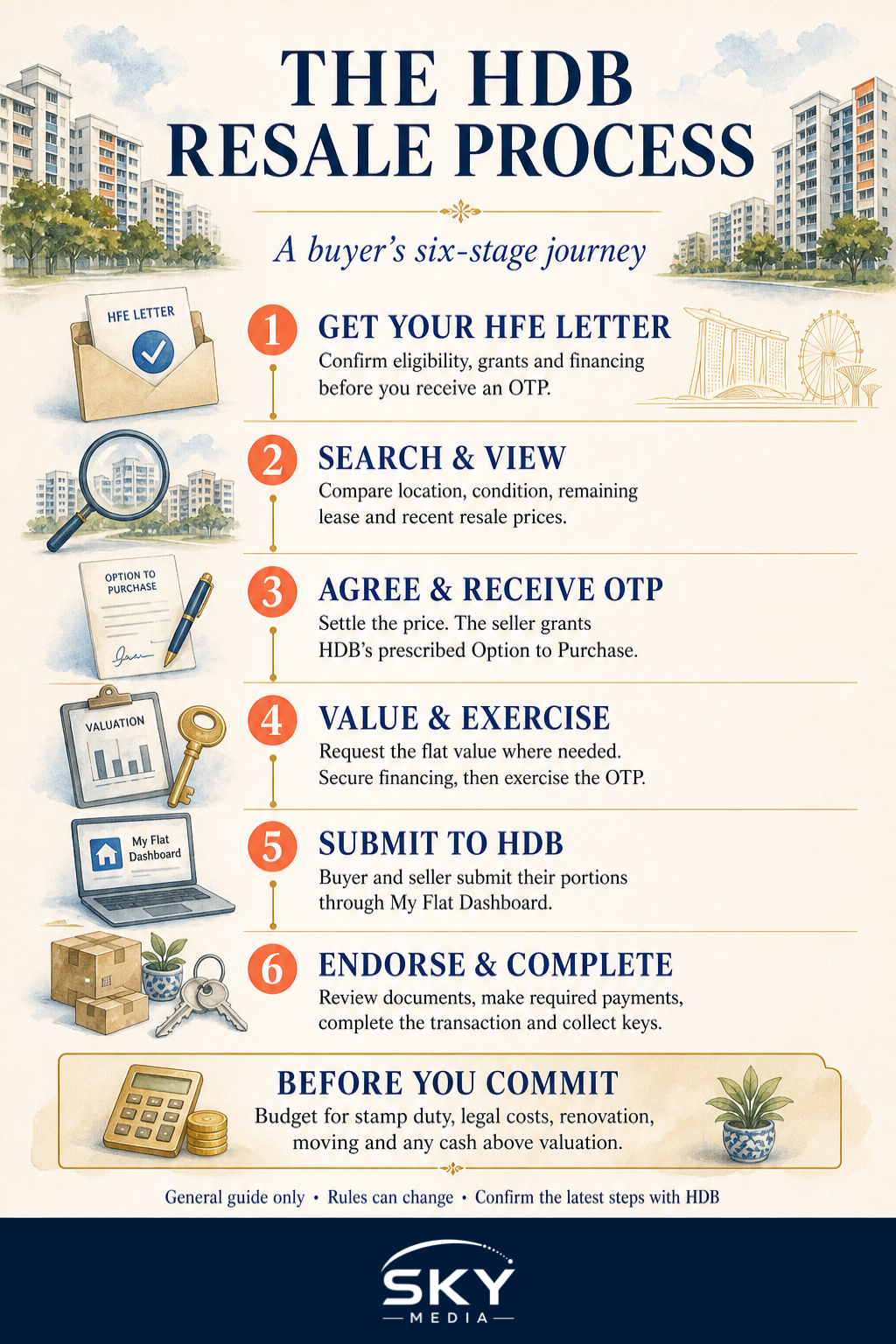
Why buy resale
The main appeal of a resale flat is speed and choice. Instead of balloting and waiting for a flat to be built, you buy an existing unit and can move in relatively soon after completing the process. You also get a wider choice of locations, including mature estates, and can see the actual flat before buying. The trade-off is that resale flats are priced by the market, so they can cost more than a comparable new BTO.
Step one: check eligibility and budget
As with any HDB purchase, confirm you meet the eligibility conditions for the scheme you are buying under, covering citizenship, family nucleus and income where relevant. At the same time, work out your budget, including how much CPF and loan you can use and the cash you will need. Getting your financing clarity early, such as an HDB loan eligibility letter or bank approval in principle, puts you in a strong position.
Step two: find a flat
Search for flats that fit your needs, considering location, flat type, size, remaining lease and price. The remaining lease matters, both for your own use and for financing, so factor it in. Viewing flats in person helps you judge condition and suitability. Many buyers work with a property agent, though it is not compulsory.
Step three: the Option to Purchase
When you find the flat and agree on a price with the seller, the seller grants you an Option to Purchase, or OTP, in exchange for a fee. The OTP gives you a period to exercise your right to buy. This is a key document in the transaction.
| Stage | What happens |
|---|---|
| Agree price | You and the seller settle on a price |
| Option to Purchase | Seller grants the OTP for an option fee |
| Valuation | A valuation is obtained where required |
| Exercise OTP | You commit, paying the next amount |
| Resale application | Both parties submit to HDB |
| Completion | Legalities settle and keys are handed over |
Step four: valuation and cash over valuation
A valuation of the flat is obtained as part of the process, and it affects how much CPF and loan you can use, since financing is based on the lower of price or value. If you agree to pay more than the valuation, the difference is cash over valuation, which must be paid in cash. Understanding this helps you avoid an unexpected cash shortfall.
Step five: resale application and completion
Both buyer and seller submit the resale application to HDB, which reviews and processes it. There are approvals and legal steps to complete, after which the transaction is finalised and you receive the keys. The timeline from OTP to completion is much shorter than waiting for a BTO to be built, which is a major reason people choose resale.
Costs to budget for
Beyond the flat price, budget for stamp duty, legal fees, the option fee, any cash over valuation, and moving and renovation costs. As with any home, the sticker price is only part of the total, so plan for these extras from the start.
The takeaway
Buying a resale HDB flat is the route for those who want a home sooner, more choice of location, and the ability to see exactly what they are buying, in exchange for market pricing. The journey runs from checking eligibility and budget, to finding a flat, securing the Option to Purchase, handling valuation and any cash over valuation, submitting the resale application, and finally completing and collecting keys. Sort your financing early, mind the remaining lease and valuation, and budget for the full costs. With that preparation, the resale process is a clear and relatively quick path to your home.
Grants that can lower your cost
One reason resale can be more affordable than the sticker price suggests is that eligible buyers may qualify for CPF housing grants. These grants are disbursed into your CPF account and go towards the flat, reducing the amount you need to finance. The exact schemes, amounts and conditions depend on factors such as your citizenship, household income, whether you are a first-timer, and in some cases how close you choose to live to family. Because the framework is reviewed periodically, treat any figure you read online as indicative only and confirm what you actually qualify for with HDB and CPF Board before you commit.
A few points are worth keeping in mind when you factor grants into your sums:
- Grants are not cash in hand. They usually land in your CPF Ordinary Account and are applied to the purchase, so they lower your loan and CPF outlay rather than giving you spare money to spend.
- Eligibility is assessed at application. Your income is typically averaged over a defined period, so plan around your assessed figure, not just your latest payslip.
- First-timer status matters. Buyers who have not previously enjoyed a housing subsidy generally have access to more support, so understand where you stand before assuming an amount.
Working out your likely grant early gives you a clearer picture of your real budget and can widen the range of flats within reach. Check the current schemes and calculators on the official HDB and CPF Board channels rather than relying on hearsay.
Common pitfalls to avoid
Most resale problems come from rushing or from focusing only on price. A few mistakes come up again and again, and all of them are avoidable with a little preparation.
- Ignoring the remaining lease. A flat with a short remaining lease can limit how much CPF and loan you may use, and it affects the flat as a long-term asset. Check the numbers before you fall in love with a unit.
- Underestimating cash needed. Cash over valuation, the option fee, stamp duty and legal fees are often paid in cash or upfront, so a buyer who plans only for the loan can be caught short. Map out every cash milestone from OTP to completion.
- Skipping a careful viewing. The advantage of resale is that you see the actual flat, so use it. Look past staging and note the condition of ceilings, flooring, windows and any signs that hint at bigger renovation costs.
- Committing before financing is confirmed. Exercising the OTP without a firm loan position is risky. Sort out your HDB loan eligibility letter or bank approval in principle first.
- Assuming timelines are fixed. Approvals and completion depend on both parties submitting correctly and on HDB processing, so build in some buffer rather than booking movers for a rigid date.
None of these require special expertise, only discipline. Confirm the current rules and processing details with HDB, keep your paperwork tidy, and treat each step as a checkpoint rather than a formality. That mindset is what turns the resale route into the smooth, relatively quick path to a home that it is meant to be.
Explore more: HDB BTO vs resale · HDB BTO application: step by step · Using your CPF to buy a home