
For most people in Singapore, home ownership starts with an HDB flat. Understanding the hdb bto vs resale choice is the first big decision you will make, because the two routes suit very different timelines, budgets and life stages. This guide walks you through who can buy, how the options compare, and how to weigh them up, in plain language.
A quick but important note: HDB rules, prices, grant amounts and eligibility schemes change from time to time. Treat everything here as a general guide, not financial advice, and always confirm the current details on the official HDB website before you commit.

Who Can Buy an HDB Flat?
Buying an HDB flat in Singapore comes with eligibility conditions. In broad terms:
- Singapore Citizens can buy both new and resale HDB flats, and typically need to form a family nucleus (for example, with a spouse, children or parents) under one of HDB’s eligibility schemes.
- Singapore Permanent Residents (PRs) face more restrictions. PRs generally cannot buy a new flat directly from HDB and can only buy a resale flat under certain conditions, such as a household of two or more PRs who have held PR status for a set period.
- Foreigners who are neither citizens nor PRs cannot buy an HDB flat at all. Renting is the usual route until status changes.
There are also schemes for singles, for couples, and income ceilings that affect which flats and grants you qualify for. Because the exact combinations shift over time, use HDB’s eligibility checker rather than assuming.
Think of eligibility as the gate you pass through before anything else. It decides not just whether you can buy, but which flats and which grants are open to you.
HDB BTO: Build-To-Order Flats
A Build-To-Order (BTO) flat is a brand-new flat that HDB builds only after enough buyers commit to a project. This is the cheapest way onto the property ladder for most eligible citizens, but it asks for patience.
Here is how BTO usually works:
- HDB launches sales exercises with new projects in various towns.
- You apply during the launch window and enter a ballot.
- If your queue number is called, you select a unit from what is still available.
- You wait for the flat to be built, then collect your keys.
The trade-offs:
- Lower price. BTO flats are typically the most affordable option and are priced by HDB rather than the open market.
- Balloting and demand. Popular projects, especially in mature towns, can be heavily oversubscribed, so there is no guarantee you will get a flat on your first try.
- A long wait. Construction can take several years from application to keys, though timelines vary by project.
- Brand new. You get a fresh flat with a full 99-year lease and no previous owner.
BTO suits people who are planning ahead, can wait, and want the lowest price for a new home.
Resale Flats: Buy Now, More Choice
A resale flat is an existing HDB flat sold by its current owner on the open market. You buy it through a negotiated price rather than a ballot.
The trade-offs:
- No waiting for construction. You can move in soon after the sale completes, which suits urgent timelines.
- More choice of location and size. You can shop across established, mature towns and pick a flat near family, work or schools.
- Higher price. Resale flats are usually more expensive than BTO flats because you pay the market rate.
- Grants available. Eligible buyers can receive housing grants that soften the higher price (more on this below).
- Remaining lease matters. Because these flats are older, always check the remaining lease, as it affects value and financing.
Resale suits buyers who need a home sooner, want a specific location, or do not qualify for (or do not want to wait for) a BTO.
Sale of Balance Flats and Other Launches
Between the two main routes sits the Sale of Balance Flats (SBF) exercise. These are unsold or returned units from earlier BTO projects, plus some repurchased flats. They can be a middle path: often newer than resale flats and sometimes ready sooner than a fresh BTO, though choice is limited to what is left over. HDB also runs open booking exercises from time to time. Keep an eye on the official listings if you want a shorter wait without going fully resale.
The General Buying Process
While the details differ, buying an HDB flat in Singapore broadly follows these steps:
- Check eligibility. Confirm you meet the scheme, citizenship and income requirements.
- Sort out finances. Get an HDB Flat Eligibility (HFE) letter, which gives you a clear picture of your budget, loan options and grant eligibility before you shop.
- Choose your route. Apply for a BTO or SBF launch, or search the resale market.
- Select or negotiate. Book a new unit, or agree a price with a resale seller.
- Complete the paperwork. Sign the agreements, arrange financing, and go through HDB’s process to completion.
- Collect your keys and begin any renovation.
Understanding Housing Grants
Housing grants are subsidies that help eligible citizens with the cost of a flat. The concept is simple: depending on your household type, income and the flat you choose, the government may contribute a sum that reduces what you effectively pay.
Grants come in several forms, some aimed at first-time buyers, some at families buying resale flats near their parents, and some tied to income. The amounts and rules are adjusted periodically. Rather than memorise figures that may be out of date, check what you qualify for through HDB when you apply. This is one area where a quick official check can meaningfully change your budget.
What Is the Minimum Occupation Period (MOP)?
The Minimum Occupation Period (MOP) is the length of time you must physically live in your flat before you can sell it on the open market or, in some cases, rent out the whole flat. For most flats this period is commonly around five years, calculated from when you collect your keys, though it can differ by flat type and scheme.
The MOP matters because it shapes how quickly your flat becomes a flexible asset. If there is any chance you will need to move or sell within a few years, factor the MOP into your decision from the start.
HDB BTO vs Resale: How to Decide
There is no single right answer. The best choice depends on your timeline, budget and priorities.
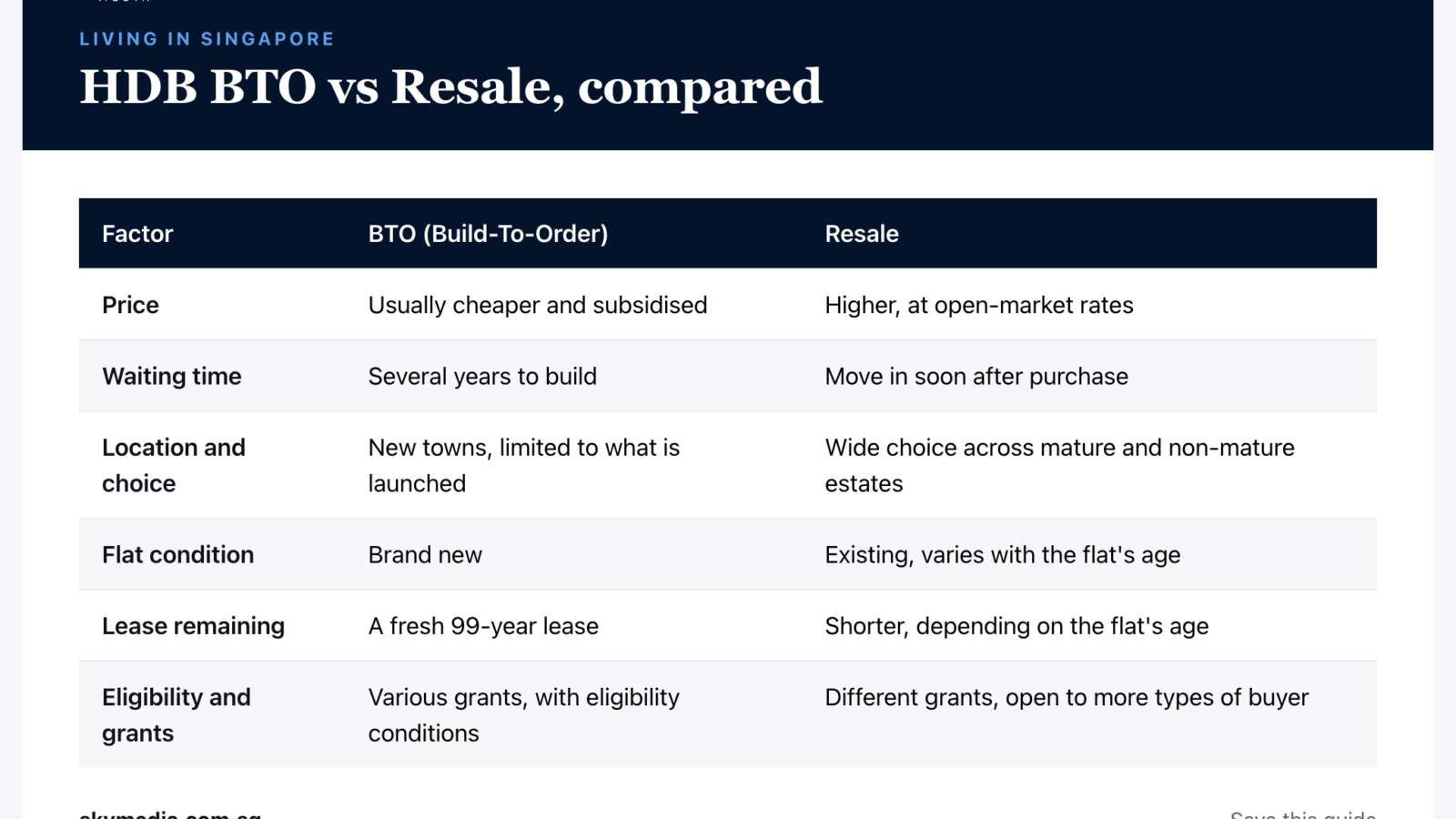
| Factor | BTO (Build-To-Order) | Resale |
|---|---|---|
| Price | Usually cheaper and subsidised | Higher, at open-market rates |
| Waiting time | Several years to build | Move in soon after purchase |
| Location and choice | New towns, limited to what is launched | Wide choice across mature and non-mature estates |
| Flat condition | Brand new | Existing, varies with the flat’s age |
| Lease remaining | A fresh 99-year lease | Shorter, depending on the flat’s age |
| Eligibility and grants | Various grants, with eligibility conditions | Different grants, open to more types of buyer |
Quick checklist to guide you:
- Choose BTO if you can wait a few years, want the lowest price, and are comfortable with balloting for a brand-new flat.
- Choose resale if you need a home soon, want a specific mature-town location, or value certainty over queueing, and can afford the higher price with grants factored in.
- Consider SBF if you want something in between: newer than most resale flats, potentially sooner than a fresh BTO.
- Always weigh the remaining lease, your grant eligibility, and the MOP before committing.
Take your time, run the numbers with your HFE letter, and remember that eligibility, grants and prices all change. Confirm the current rules directly with HDB before you make any decision. Nothing here is financial advice; it is a starting point to help you ask the right questions.
Explore more: Renting in Singapore: a practical guide · The cost of living in Singapore · Where to live in Singapore