

In Singapore, exam season can take over a whole household. Timetables go up on the fridge, tuition schedules tighten, and conversations at dinner drift towards marks. Most exam season parents want the same thing: to help without making things worse. The difficulty is that the most natural instinct, reminding and checking, often lands as nagging and adds pressure instead of reducing it.
This guide focuses on your role at home during revision season. It is not about teaching content or motivating a reluctant learner. It is about the conditions you control: routines, emotional support, rest, and the general temperature of the house. These matter more than many parents realise, and they work whether your child is facing PSLE, O Levels, A Levels or school-based assessments.
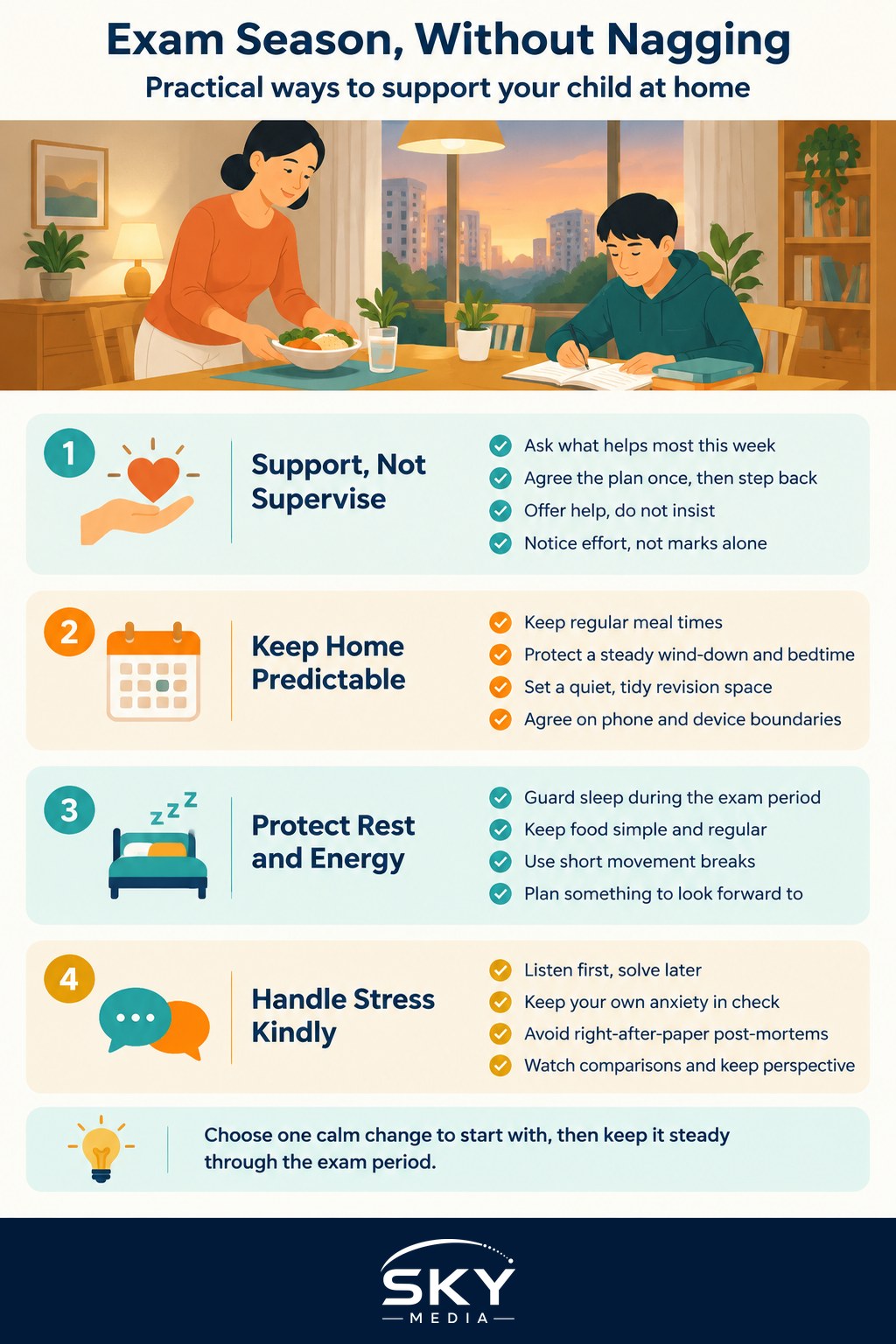
Shift From Supervisor to Support Crew
During exams, your child already has teachers, tutors and their own worries telling them what to do. Adding another supervisor rarely helps. A more useful role is support crew: the person who makes revision easier, not the person who checks it.
In practice, that means:
- Ask, do not assume. A simple “What would help you most this week?” gives your child some control and tells you where support is actually needed.
- Agree a plan once, then step back. Sit down together at the start of the exam period to map out papers and revision blocks. After that, let the plan do the reminding.
- Offer, do not insist. “I can quiz you on your flashcards after dinner if you like” lands very differently from “Have you revised yet?”
- Notice effort, not just output. “You stuck with that maths paper for a long time” encourages more than praise for marks alone.
If you find yourself repeating the same reminder, that is often a signal to change the system rather than raise your voice. Our guide on motivating your child without nagging covers longer-term strategies for this.
Build a Calm, Predictable Home Routine
Children and teenagers cope better with pressure when the rest of life is predictable. A steady routine removes small daily decisions, which frees up mental energy for revision.
Useful anchors include:
- Regular meal times, ideally with at least one shared meal where exams are not the main topic.
- A consistent wind-down and bedtime, even on weekends during the exam period.
- A set revision space that is reasonably quiet and tidy. It does not need to be a separate room. A corner of the dining table that is cleared each evening works.
- Clear device boundaries agreed together, such as phones charging outside the bedroom at night. Rules agreed jointly hold up far better than rules imposed in a tense moment.
- Fewer household disruptions where possible. If you can, postpone big gatherings, renovations or late outings until after the papers.
Siblings matter too. Younger children may need gentle reminders to keep noise down, and older siblings can be quietly asked to avoid comparisons or teasing.
If your child struggles to structure their own time, managing your time during exams in Singapore offers practical scheduling ideas you can share with them.
Protect Rest, Food and Movement
When exams loom, sleep and exercise are often the first things sacrificed. Yet rest is when the brain consolidates what was learned, and a tired child reads questions less carefully.
- Guard sleep. Late-night cramming tends to trade tomorrow’s focus for tonight’s extra hour. If your child is staying up very late, talk about it calmly in the morning rather than at midnight.
- Keep food simple and regular. Balanced meals and easy snacks such as fruit, nuts or yoghurt are better than skipping meals or relying on sugary drinks. If you are unsure about your child’s nutritional needs, a doctor or polyclinic can advise.
- Encourage short breaks with movement. A walk around the block, a few minutes on the void deck or a short swim can reset concentration.
- Schedule something to look forward to. A favourite meal after a tough paper or a family outing after the last exam gives a sense of light at the end of the tunnel.
Respond to Stress Without Adding to It
Some worry before exams is normal and can even help focus. Your goal is not to remove all stress but to help your child manage it.
Helpful responses include:
- Listen first, solve later. When your child vents about a hard paper, resist jumping straight to advice. “That sounds really frustrating” often does more than a list of tips.
- Keep your own anxiety in check. Children pick up on parental tension quickly. If you are worried, talk it through with your partner or a friend rather than in front of your child.
- Avoid post-mortems right after a paper. Asking for a question-by-question review the moment they walk in can be draining. Let them decompress first and raise it later only if they want to.
- Watch the comparisons. Mentioning cousins, classmates or your own school results rarely motivates and often hurts.
- Keep perspective. Remind your child, and yourself, that one paper is one part of a long journey with many routes.
Helpful Habits Versus Pressure Habits
Small changes in phrasing and timing can make the same intention feel supportive rather than stressful. Here is a quick comparison.
| Situation | Pressure habit | Supportive alternative |
|---|---|---|
| Checking progress | “Have you revised yet?” several times a day | One agreed check-in time, such as after dinner |
| After a paper | Asking for marks and mistakes straight away | Offering a snack and asking how they feel |
| Late-night study | Arguing about bedtime at midnight | Discussing the sleep plan calmly the next morning |
| Weak subject | Comparing with siblings or classmates | Asking what kind of help would be useful |
| Free time | Treating any break as wasted time | Encouraging short planned breaks with movement |
When to Seek Extra Help
Most children get through exam season with some ups and downs. Occasionally, stress becomes more than a passing phase. Signs worth paying attention to include persistent trouble sleeping, frequent headaches or stomach aches, withdrawing from friends and family, tearfulness that does not ease, or talking about themselves in very negative ways.
If you notice these, do not wait for the exams to end:
- Talk to the form teacher or school counsellor. Schools in Singapore have counselling support and teachers can often share what they observe in class.
- See a family doctor or polyclinic if there are physical symptoms or ongoing sleep problems.
- Seek professional mental health support if your child seems very distressed. Your doctor or the school counsellor can point you to suitable services.
Reaching out early is a sign of good parenting, not a failure.
Looking After Yourself Too
Exam season is tiring for parents as well. You may be juggling work, tuition runs and household tasks while worrying about outcomes you cannot fully control. Take short breaks, share driving or meal duties with your partner or relatives where possible, and accept that you do not need to be perfect.
The most valuable thing you can give your child during exams is often not more help with content but a calm, steady home where they feel supported whatever the results. That is something every parent can offer, and it lasts well beyond the final paper.
Further reading: Chicken Essence and Bird’s Nest for Kids During Exams: Worth It?