

The weeks around the Lunar New Year are among the busiest in Singapore’s wedding calendar. Families are gathered, the mood is festive, and red is everywhere already. For some couples, a wedding during Chinese New Year feels like a natural fit. For others, it raises questions about cost, guest attendance and whether the timing is considered auspicious at all.
This guide looks specifically at planning around the festive period: how venue pricing and availability shift, what to expect from guests, how families tend to view CNY dates, and how ang bao etiquette works when a wedding and the new year overlap. For general advice on picking a date in any month, our wider wedding planning guides cover the basics.
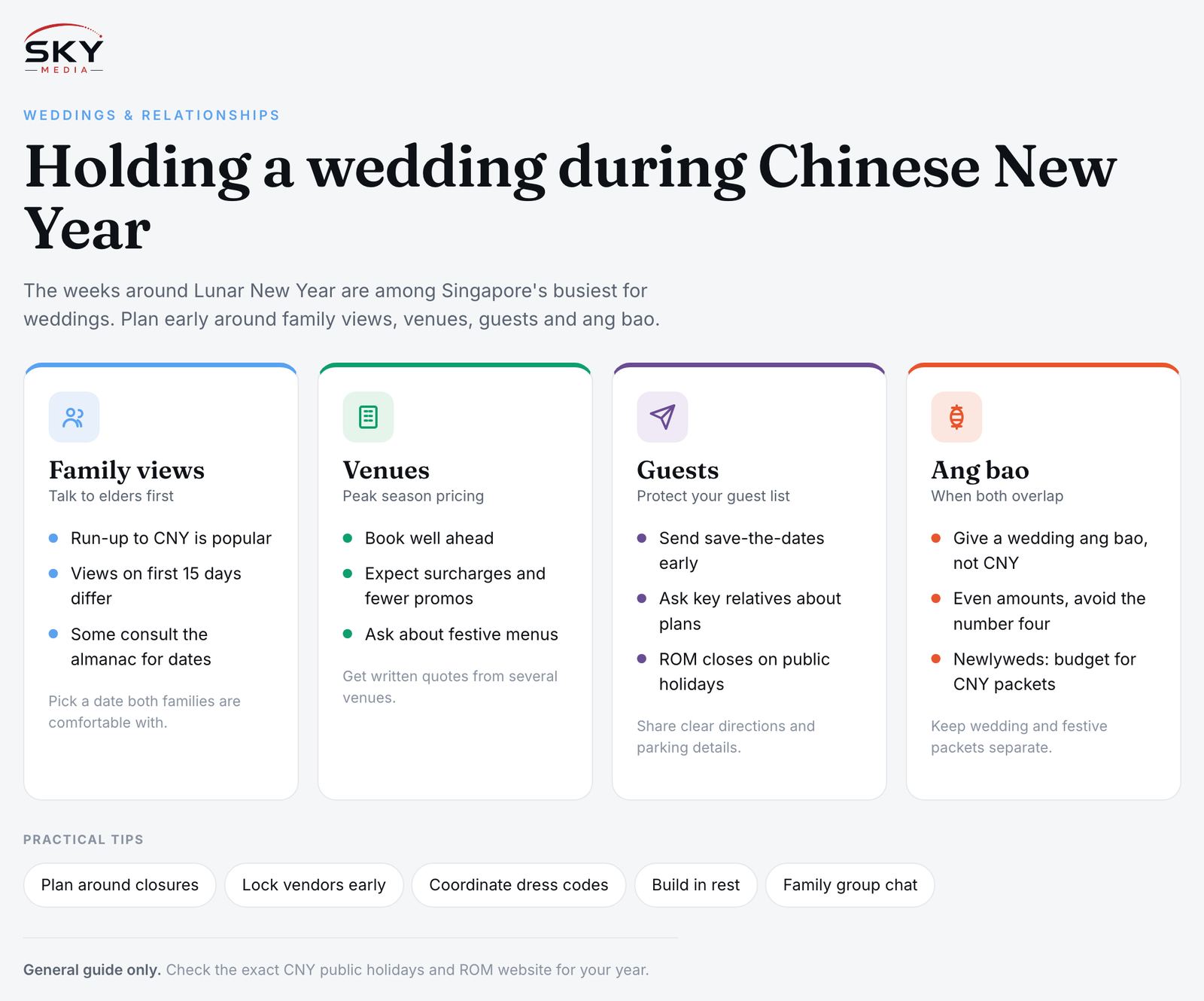
How Families View a CNY-Period Wedding
There is no single rule. Views differ between dialect groups, generations and individual families, so the most important conversation is with your own parents and elders.
Some commonly seen views:
- The run-up to CNY is popular. Many couples aim to marry in the weeks before the new year, so they start the year as a married household. In some families, newlyweds also take on the role of giving ang bao for the first time that CNY.
- The first fifteen days are seen differently by different families. Some see the festive glow as a blessing for a new marriage. Others prefer to keep those days for family visiting and avoid adding a wedding.
- Auspicious dates matter to many families. Some consult the Chinese almanac (通书, tong shu) or a geomancer to pick a date that suits the couple’s birth details. Others simply avoid dates they consider unlucky.
- The zodiac year can be a factor. Some families pay attention to whether the coming lunar year is considered favourable for marriage.
If elders have strong preferences, raise them early. Choosing a date that both families are comfortable with is usually worth more than securing a particular venue.
Venue Pricing and Availability Around CNY
Hotels and banquet restaurants are in high demand in the lead-up to the new year. Reunion dinners on New Year’s Eve, festive menus and corporate spring dinners all compete with weddings for the same ballrooms.
What that tends to mean for couples:
- Book early. Popular venues and auspicious dates in the pre-CNY weeks can be taken well over a year ahead.
- Expect peak pricing. Some venues apply higher minimum spends or surcharges on festive dates, and promotions are less common.
- Check festive menus. Some restaurants switch to CNY menus, which may change what is available for your banquet, and dishes like yu sheng may be added or offered as an option.
- Ask about public holiday surcharges. If your date falls on or near the public holidays, ask clearly whether extra charges apply.
- Confirm staffing and suppliers. Photographers, florists, bridal studios and make-up artists also have heavy festive demand, and some take leave over the new year.
Prices and packages vary a lot, so request written quotations from several venues and compare exactly what is included.
Comparing Your Timing Options
The festive season splits into distinct windows, each with its own pros and cons.
| Timing | Advantages | Challenges |
|---|---|---|
| A few weeks before CNY | Popular, festive mood, couple enters the new year married | High demand, peak pricing, tight vendor availability |
| New Year’s Eve and first two days | Family already gathered | Most families keep these days for reunion and visiting; many businesses closed or on holiday rates |
| Remainder of the first fifteen days | Festive atmosphere, red decor everywhere | Clashes with visiting schedules; some families avoid it |
| After the fifteenth day (Chap Goh Mei) | Calmer bookings, guests back to routine | Less festive feel; may sit close to other busy dates |
Note that the dates of Chinese New Year move each year with the lunar calendar, so check the exact public holidays for your year before shortlisting dates.
Guest Availability and Travel
CNY is a peak time for both family reunions and overseas trips. Some guests travel to visit relatives in Malaysia, China or elsewhere, while others take advantage of the long weekend for a holiday.
To protect your guest list:
- Send save-the-dates early, especially to guests who usually travel over CNY.
- Ask key relatives directly about their plans before fixing the date.
- Consider overseas relatives. Relatives who come to Singapore for the new year may be able to attend, which can be a bonus.
- Mind transport. Public transport and taxis can be busier on festive evenings, and some services adjust their schedules over the public holidays. Share clear directions and parking details.
If you are planning a solemnisation with the Registry of Marriages (ROM), the official body for civil marriages in Singapore, remember that government offices close on public holidays and booking slots around festive periods can fill quickly. Check the ROM website for current procedures, notice periods and available dates.
Ang Bao Etiquette When Wedding and New Year Overlap
Ang bao, the red packets given as gifts, play a role in both weddings and the new year, which can cause confusion when the two coincide.
For guests attending a CNY-period wedding:
- Give a wedding ang bao, not a CNY one. The wedding gift is separate from any new year red packets.
- Write your name on the packet so the couple can keep track, unless your family custom differs.
- Use even amounts and avoid the number four, a common practice, as four sounds like the word for death in Mandarin and several dialects.
- Gauge the amount sensibly. Many people consider the venue and their closeness to the couple. There is no fixed rate, so ask friends or family if unsure.
For the newlyweds:
- Prepare CNY ang bao. In many families, being married means you now give red packets to children and unmarried relatives during visiting, so budget for this alongside wedding costs. Our guide on budgeting for Chinese New Year helps.
- Separate the two piles. Keep wedding ang bao received at the banquet apart from festive red packets, so your records stay clear.
- Thank guests promptly, especially those who adjusted holiday plans to attend.
Practical Planning Tips
A few final points make a CNY-period wedding smoother:
- Plan around closures. Many shops, bridal boutiques and service providers close for the first few days of the new year. Our guide on what is open and closed during Chinese New Year shows what to expect.
- Coordinate dress codes. Guests may already have festive outfits in mind. If you prefer guests to avoid certain colours, say so politely on the invitation. For inspiration, see what to wear for Chinese New Year.
- Build in rest. Back-to-back reunion dinners, visiting and wedding events can be exhausting. Leave buffer days.
- Keep everyone informed. A simple family group chat with key dates, gift arrangements and visiting plans saves confusion.
A wedding during the festive season can feel joyful and meaningful, as long as your families are on board and the logistics are planned early. Start with the date conversation, then lock in the venue and the rest will follow.
Further reading: The Hui Men Homecoming Visit After a Chinese Wedding