

Many Employment Pass holders reach a point where renting stops making sense: you like your neighbourhood, your job looks stable and rents keep climbing. Buying is possible, but getting a home loan as a foreigner in Singapore works differently from the process locals and permanent residents (PRs) go through. Banks look harder at your pass, your income and your plans, and some costs that locals can pay from CPF must come from your own cash.
This guide focuses on work pass holders, mainly Employment Pass (EP) and S Pass holders. It is general information, not financial or legal advice. Rules from the Monetary Authority of Singapore (MAS), IRAS and the Singapore Land Authority (SLA) change from time to time, and each bank sets its own criteria, so confirm the current position before you commit.
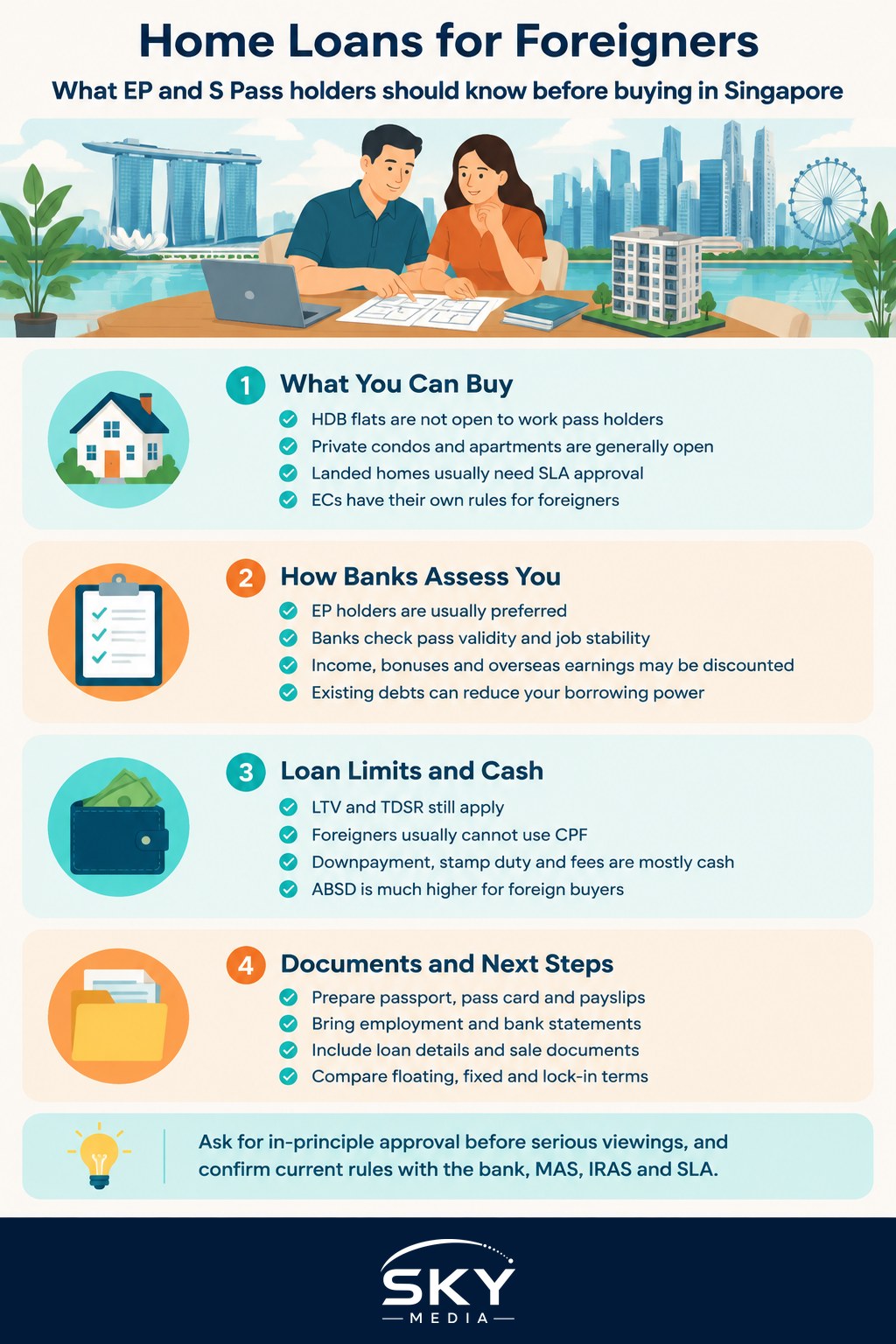
What Foreigners Can and Cannot Buy
Before thinking about the loan, be clear about the property itself:
- HDB flats are not open to foreigners on work passes. Resale and BTO flats require citizenship or PR status for at least one owner, under HDB’s own eligibility rules.
- Private condominiums and apartments are generally open to foreigners. This is where most work pass holders buy.
- Landed homes (terraces, semi-detached, bungalows) are restricted residential property under the Residential Property Act. Foreigners generally need approval from the SLA, which is not routinely granted. Sentosa Cove is a notable exception with its own approval route.
- Executive condominiums (ECs) are not open to foreigners when new, and resale purchases are subject to their own rules once the minimum occupation period ends.
Foreign buyers also pay Additional Buyer’s Stamp Duty (ABSD) at a much higher rate than citizens and PRs, on top of the usual Buyer’s Stamp Duty. Check the current rates on the IRAS website. Some nationalities have treatment under free trade agreements, so ask IRAS or your lawyer whether this applies to you.
How Banks Assess a Work Pass Holder
Most major Singapore banks do lend to foreigners on work passes, but they look at a few things more closely.
- Pass type and validity. Banks usually prefer EP holders and may ask how much time is left on the pass. A pass that expires soon, or a recent job change, can lead to more questions.
- Income level and type. Many banks set a minimum income for foreign borrowers, which varies by bank. Fixed salary is counted fully, while bonuses, commissions and allowances are often discounted or averaged over time.
- Employment history. A stable record with your current employer helps. Probation periods may delay approval.
- Income currency. Salary paid in a foreign currency, or income earned overseas, may be subject to a haircut, meaning the bank counts only part of it.
- Existing debts. Car loans, credit card balances, personal loans and any mortgage you hold back home can all reduce what you can borrow here.
If your partner is a Singapore citizen or PR, buying together changes some rules on stamp duty and eligibility. Our guide on choosing a joint home loan borrower explains the trade-offs.
LTV, TDSR and the Cash You Need
Two MAS rules set the ceiling on your loan, whatever your nationality.
Loan-to-Value (LTV) limits cap the loan as a percentage of the property’s price or valuation, whichever is lower. For a first housing loan, the limit is commonly 75%, but it drops for borrowers with existing housing loans and when the loan tenure or your age at the end of the loan exceeds certain thresholds. Check the current LTV table on the MAS website.
Total Debt Servicing Ratio (TDSR) caps your total monthly debt repayments as a share of your gross monthly income. The bank calculates this using a stress-test interest rate, not today’s rate, so the loan you qualify for can be smaller than you expect. Our explainer on TDSR and MSR walks through the maths. The Mortgage Servicing Ratio (MSR) applies only to HDB flats and ECs, so it is generally not relevant to a private condo purchase.
The big difference for foreigners is the downpayment. Locals and PRs can use CPF for part of it. Most foreigners on work passes do not contribute to CPF, so the entire downpayment, plus stamp duties and legal fees, must come from cash.
| Cost item | Citizens and PRs | Foreigners on a work pass |
|---|---|---|
| Downpayment | Partly cash, the rest can come from CPF | Fully in cash, as most have no CPF |
| Additional Buyer’s Stamp Duty | Lower rates, or none for a citizen’s first home | Highest rate tier, payable in cash |
| Monthly instalments | Can often use CPF Ordinary Account | Paid from salary or savings |
| Property types available | HDB, ECs and private homes | Mainly private condos and apartments |
Documents to Prepare
Requirements differ by bank, but a typical application from an EP holder asks for:
- Passport and work pass card, front and back
- Employment letter or contract showing your role, salary and start date
- Latest three to six months of payslips
- Recent IRAS Notice of Assessment, if you have filed tax in Singapore
- Bank statements showing salary credits and the funds for your downpayment
- Details of existing loans and credit card limits, in Singapore and overseas
- Option to Purchase or sales and purchase documents, once you have chosen a unit
- Proof of overseas income or assets, if you want these considered
Ask for an in-principle approval (IPA) before you start serious viewings. An IPA gives you an indication of how much the bank may lend, so you do not pay an option fee on a unit you cannot finance.
Choosing a Loan Package and Planning Ahead
Once you know your budget, compare packages on more than the headline rate:
- Floating versus fixed. Floating packages are commonly pegged to SORA (Singapore Overnight Rate Average). Fixed packages give certainty for a set period. See how SORA affects your rate.
- Lock-in period. Many packages charge a penalty if you sell or refinance during lock-in. If your job could take you overseas, a shorter lock-in or flexible terms may matter more than a slightly lower rate.
- Legal and valuation subsidies, and the clawback conditions if you repay early.
- What happens if you leave Singapore. Ask the bank whether you can keep the loan, rent out the unit and service it from overseas, and what documents it would then need.
It is also worth thinking about your exit plan. Foreign owners who later become PRs may find some costs change, while those who relocate abroad need to manage the property, tenants and taxes remotely. For a wider view of loan structures, read our overview of home loan options in Singapore.
A mortgage broker or the bank’s own mortgage specialist can help compare offers, and a conveyancing lawyer will handle the legal side. Treat their input alongside the official rules from MAS, IRAS and the SLA, and confirm the current requirements before you sign anything.
Frequently Asked Questions
Can I get a home loan in Singapore on an S Pass? Some banks may lend to S Pass holders, but they usually look harder at pass validity, income level and stability. Criteria differ by bank, so ask several for in-principle approval before you view properties. Also check ABSD and property rules for foreign buyers.
Can I rent out my condo if I move overseas? Foreign owners of private condos can generally rent out their units, but check your loan terms, the condo’s house rules and any tenancy requirements. Rental income may be taxable, so check IRAS. You will also need a way to manage tenants and repairs remotely.
What happens to my mortgage if my Employment Pass is not renewed? The loan does not automatically end, and you remain responsible for instalments. However, losing your income can make repayment hard and may limit options such as refinancing. Speak to your bank early to discuss what is possible, rather than waiting until you miss a payment.
Do I get any ABSD back if I later become a PR? Refunds are limited and depend on specific conditions set by IRAS, so do not count on getting money back. Becoming a PR may change the stamp duty on later purchases, but not necessarily on one already made. Check IRAS, or ask a conveyancing lawyer, before you buy.
Should I rent or buy if my pass is valid only briefly? Buying carries large upfront costs, including stamp duty and legal fees, so it usually makes more sense when you expect to stay for several years. If your plans are uncertain, renting gives flexibility. Weigh your job security, total costs and exit plan.
Further reading: What to Do If Your Home Loan Application Is Rejected · Can Foreigners Inherit Property in Singapore?