

Cooking for your dog or cat feels like the ultimate act of love. You know exactly what goes in the bowl, you skip the mystery ingredients, and your pet tucks in with obvious joy. It is no wonder homemade pet food has grown so popular among Singapore owners who want the best for a much-loved companion. Yet the appeal hides a real risk. A meal that looks wholesome to us can be dangerously unbalanced for a pet, and getting it wrong over months can quietly cause harm. This is general information, not veterinary advice, so please treat it as a starting point and speak to a licensed vet before you change how you feed your animal.
Why Homemade Food Appeals, and Where It Goes Wrong
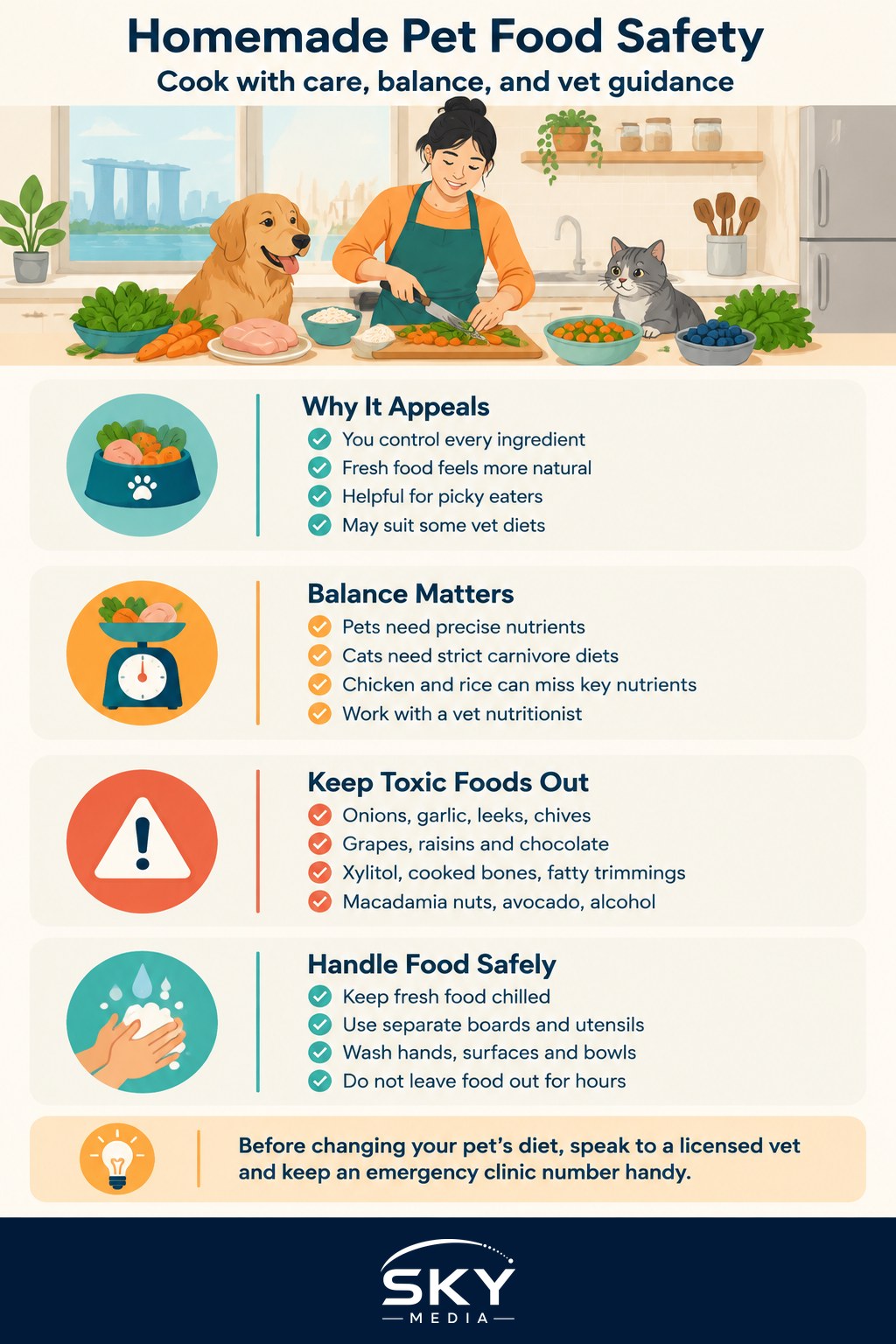
The pull towards home cooking is easy to understand. Owners worry about recalls, fillers and ultra-processed kibble, and they want fresh, recognisable food for a fussy eater or a pet with a sensitive stomach. Home cooking can also help when a vet has diagnosed an allergy and prescribed a specific diet. Done properly, it gives you full control.
The trouble is that a pet’s nutritional needs are nothing like ours. Dogs and cats require dozens of nutrients in precise amounts and ratios, and cats in particular are strict carnivores who need certain nutrients that a plant-heavy or improvised meal simply cannot supply. A bowl of chicken and rice may look complete, but it is usually short on calcium, essential fatty acids, several vitamins and trace minerals. The gaps do not show up at dinner time. They build slowly, and by the time a pet looks unwell the deficiency may already have done damage to bones, skin, heart or nerves.
This is why homemade feeding is not a casual do-it-yourself project. A recipe pulled from a social media post or a well-meaning friend is not the same as a diet formulated for your individual animal.
The Balance Problem and Who Should Formulate the Diet
If you take one thing from this guide, make it this: a home-cooked diet must be formulated with a vet or a veterinary nutritionist, not guessed at. A veterinary nutritionist is a vet with advanced training in animal diets, and they can build a recipe that meets your pet’s full requirements for its age, weight, breed and health.
A properly formulated plan does several things a homemade recipe off the internet cannot:
- It sets the right calories for your pet’s ideal weight, not its current one.
- It balances calcium and phosphorus, which raw meat alone gets badly wrong.
- It fills gaps with a specific supplement blend rather than a random multivitamin.
- It accounts for any medical condition, such as kidney disease, allergies or a sensitive gut.
- It is reviewed over time, because a growing puppy, a pregnant animal and a senior pet all need different things.
Growing animals are especially unforgiving. A puppy or kitten fed an unbalanced homemade diet during its fast growth phase can develop skeletal problems that no later correction fully undoes. If you want to cook for a young or unwell pet, professional input is not optional.
Foods That Are Toxic to Pets
Even with a good recipe, your kitchen holds ingredients that are safe for us but genuinely poisonous to pets. Keep these out of the bowl and off the counter entirely. If your pet eats any of them, call a vet or a 24-hour emergency clinic straight away rather than waiting to see what happens.
- Onions, garlic, leeks and chives, raw or cooked, which damage red blood cells
- Grapes and raisins, linked to kidney failure in dogs
- Chocolate, caffeine and anything with cocoa
- Xylitol, a sweetener found in some peanut butters, baked goods and sugar-free items
- Cooked bones, which splinter, and fatty trimmings that can trigger pancreatitis
- Macadamia nuts, avocado, raw bread dough and alcohol
- Grapes aside, many stone fruits whose pits are a choking and cyanide risk
Cats are even more sensitive than dogs to some of these, so never assume a pet-safe human snack is safe across species. When in doubt, leave it out and check with your vet.
Safe Handling in a Hot, Humid Kitchen
Singapore’s warmth is kind to bacteria, so food hygiene matters more here than in a cooler climate. This is doubly true for raw feeding, where uncooked meat carries a real risk of salmonella and other pathogens that can sicken both pets and the people in the household, especially young children, the elderly and anyone with a weak immune system.
The table below contrasts a casual, guessed-at approach with a safer, vet-supported one so you can see the difference at a glance.
| Element | Risky casual approach | Safer approach |
|---|---|---|
| Recipe source | A random online post or friend’s tip | Formulated by a vet or veterinary nutritionist |
| Nutrient balance | Assumed from how food looks | Calculated, with a specific supplement blend |
| Raw meat handling | Left out, shared boards, warm room | Fridge or freezer stored, separate boards, prompt clean-up |
| Storage in the heat | Bowl sits out for hours | Uneaten food removed within the hour, chilled leftovers |
| Review over time | Never revisited | Re-checked as the pet ages or its health changes |
Beyond that table, some simple habits keep everyone safe. Store fresh and raw ingredients in the fridge or freezer, never at room temperature. Use separate chopping boards and utensils for pet food, and wash hands, surfaces and bowls thoroughly afterwards. In our climate, do not leave a full bowl out for grazing. Serve a portion, and clear and refrigerate what is not eaten within the hour. Thaw frozen food in the fridge, not on the counter.
Making Homemade Food Work Long Term
None of this means you should abandon the idea. It means treating home cooking as the committed, ongoing project it is rather than a weekend experiment. If you are keen, book a proper consult with your vet, ask whether a referral to a veterinary nutritionist makes sense, and get a written recipe with exact quantities and the specific supplements your pet needs. Follow it precisely, because swapping ingredients or skipping the supplement blend unravels the balance.
Watch your pet over the following months. A good diet shows up as steady weight, a glossy coat, firm stools, healthy energy and clear eyes. Bring these observations to regular check-ups, and let your vet run blood work now and then to catch any hidden gap early. Keep the number of a 24-hour emergency clinic handy in case of an accidental toxic mouthful.
Feeding your pet by hand can be rewarding and, when it is done properly, genuinely good for them. The kindest version of it is not the most enthusiastic one but the most careful: balanced by a professional, free of toxic foods, handled cleanly and reviewed over time. For anything specific to your own animal’s age, weight or health, talk to a licensed vet who can examine your pet in person.
Frequently Asked Questions
How much does it cost to see a veterinary nutritionist? Fees vary between clinics and cases, so ask the clinic for a quote before booking. A consult usually covers your pet’s history and a written recipe with quantities and supplements. Your regular vet can tell you whether a referral makes sense.
Is chicken and rice a good diet for a dog with an upset tummy? It is often used for a short time during mild tummy upsets, but it is not complete and balanced. Keep it brief and see your vet if symptoms last more than a day or two or the dog seems unwell.
Can I cook for my cat the same way as for my dog? No, cats need a different approach. As strict carnivores they require certain nutrients that a plant-heavy or improvised meal cannot supply, and gaps can be serious. A cat diet should be formulated specifically by a vet or nutritionist.
Can I mix homemade food with kibble? Often yes, but the balance still matters. Mixing means the kibble supplies some nutrients while the home-cooked part may add imbalances. Ask your vet to work out proportions, especially for puppies, kittens or pets with health conditions.
What should I do if my pet eats something toxic from the kitchen? Call a vet or a 24-hour emergency clinic straight away instead of waiting for symptoms. Tell them what was eaten, roughly how much and when. Do not try to make your pet vomit unless a vet tells you to.
Further reading: How to Read Pet Food Labels