
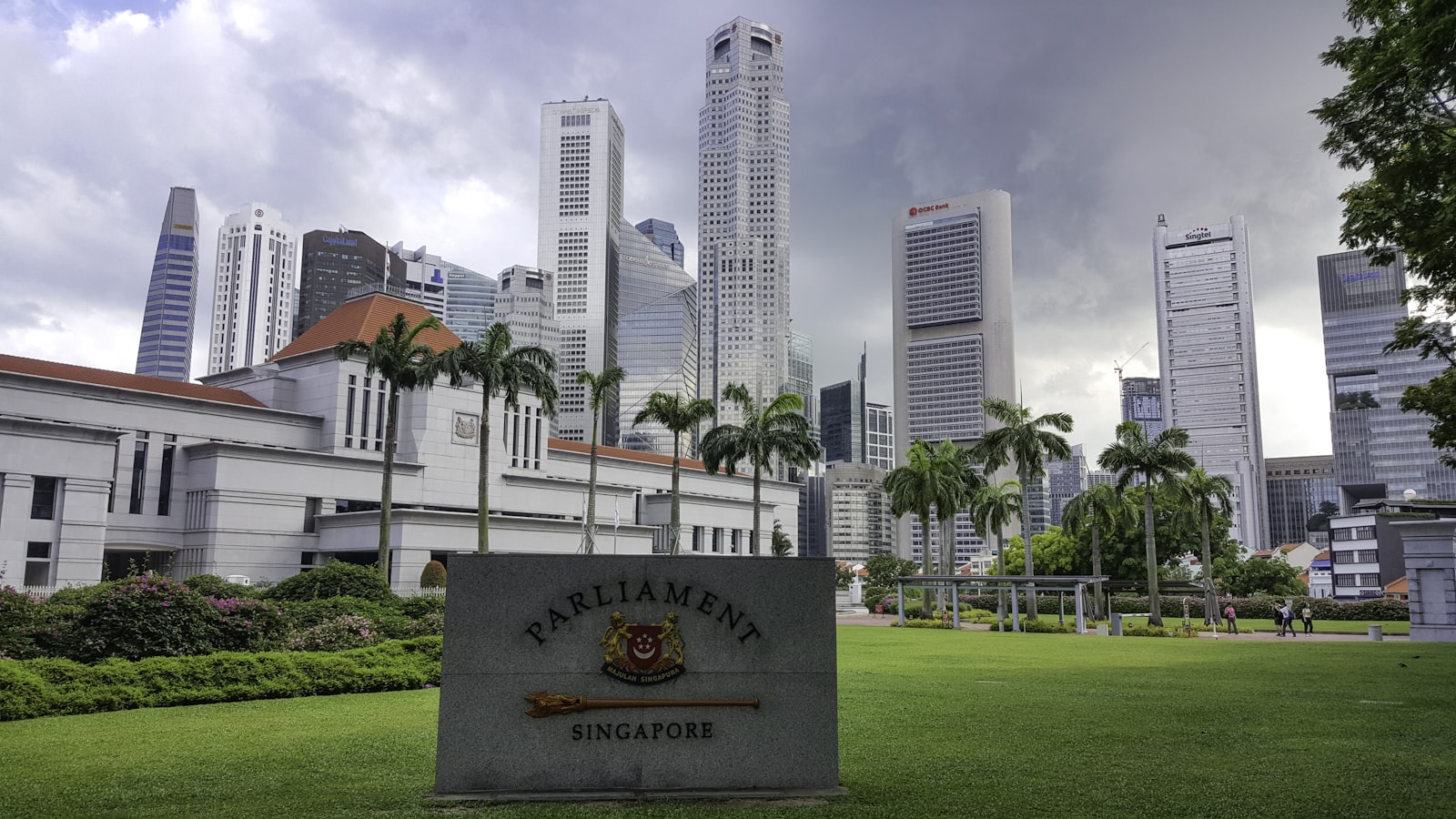
Newcomers from mainland China often arrive with questions about how Singapore actually governs itself. The short answer is that Singapore is a parliamentary republic with a written Constitution, regular elections and a clear separation between those who make laws, those who carry them out and those who judge them. This guide explains how the Singapore Parliament and the wider system of government work, factually and neutrally, so you can understand the institutions rather than the personalities.
Nothing here is a comment on any party or leader. The aim is simply to describe the machinery: who does what, how a law comes to be, and where an ordinary resident fits in.
The three branches of government
Singapore’s system, inherited in form from the British Westminster model and adapted locally, rests on three branches that check and balance one another.
- The Legislature makes the laws. This is Parliament, together with the President.
- The Executive carries out the laws and runs the country day to day. This is the Cabinet, led by the Prime Minister, supported by the civil service and statutory boards.
- The Judiciary interprets the laws and settles disputes. This is the courts, headed by the Supreme Court, which operate independently.
Above the ordinary law sits the Constitution, the supreme law of the land. Any law that conflicts with it can be struck down. There is also an elected President, who acts as head of state, holds certain custodial powers such as safeguarding the national reserves and key public appointments, and performs a largely non-executive role that is distinct from the Prime Minister’s.
What Parliament is and what it does
Parliament is the law-making body. It is where elected representatives debate, scrutinise and pass legislation, approve public spending and hold the government to account through questions and debate. Its members come in a few types, which surprises many newcomers:
- Elected Members of Parliament (MPs), chosen by voters in their constituencies.
- Non-Constituency Members of Parliament (NCMPs), a scheme that brings in a number of the best-performing opposition candidates who did not win a seat, to ensure opposition voices in the House.
- Nominated Members of Parliament (NMPs), appointed rather than elected, to offer independent and expert views outside party politics.
Elected MPs represent two kinds of constituency: Single Member Constituencies (SMCs), where one MP is elected, and Group Representation Constituencies (GRCs), where a team is elected together and must include at least one member from a minority community, a design meant to keep Parliament multiracial.
An MP wears two hats. In Parliament, they debate and vote on national matters. In the constituency, they hold regular Meet-the-People Sessions, where residents can raise personal problems and seek help, a very hands-on part of Singapore politics.
How a law is made
Turning an idea into law follows a set path. The exact procedure is detailed, but in outline a Bill moves through these stages:
- Drafting and introduction. A proposed law, called a Bill, is introduced in Parliament, usually by a minister. This is the First Reading.
- Debate on the principle. At the Second Reading, MPs debate the general merits of the Bill.
- Detailed scrutiny. The Bill is examined clause by clause, sometimes by a committee, and amendments may be made.
- Final approval. At the Third Reading, Parliament votes on the final version.
- Presidential assent. The Bill goes to the President, and once assented to and published, it becomes law.
Some Bills, especially those touching the reserves or the Constitution, involve additional safeguards. Constitutional amendments, for example, generally require a larger majority than an ordinary law. There is also a Presidential Council for Minority Rights, which reviews most Bills to check they do not disadvantage any racial or religious community, a further reflection of Singapore’s multiracial design. For the precise, current process, Parliament’s own website is the authoritative source.
Elections, the President and the citizen’s role
Singapore holds regular General Elections in which citizens vote for their MPs, and separate Presidential Elections for the head of state, subject to the eligibility rules set out in the Constitution. Voting is a duty for citizens on the electoral roll. The independent Elections Department administers the process.
Here is a simple map of who does what.
| Institution | Core role | Chosen how | Note |
|---|---|---|---|
| Parliament | Makes laws, controls spending | Mostly elected | Includes NCMPs and NMPs |
| Cabinet | Runs the government | Appointed from MPs | Led by the Prime Minister |
| President | Head of state, custodial powers | Elected by citizens | Distinct from the PM |
| Judiciary | Interprets law, settles disputes | Appointed | Operates independently |
As a resident, your everyday touchpoints are practical. Citizens vote; all residents can attend a local MP’s Meet-the-People Session for help with municipal or personal matters; and anyone can follow debates, which are public and often broadcast or reported. Between elections, the Town Councils run by the elected MPs manage the upkeep of public-housing estates, which is why your MP is a point of contact for very local issues, from lift maintenance to cleanliness. Newcomers sometimes confuse the President with the Prime Minister, or assume Parliament is only elected, so it helps to remember the appointed and non-constituency members too, as well as the difference between running the estate and running the country.
One more distinction trips people up: the difference between the government and the civil service. The government of the day, the ministers, sets direction and policy, while the permanent civil service and the statutory boards, such as CPF Board, HDB and IRAS, carry that policy out regardless of which party is in power. As a resident, most of your dealings are with the latter, the agencies and portals, rather than with politicians. That professional, continuous administration is a large part of why services keep running smoothly between elections.
To go deeper, rely on official sources rather than hearsay: the Parliament of Singapore website for how the House works, the Elections Department for voting rules, and the Constitution itself for the fundamentals. Understanding these institutions makes Singapore’s civic life far easier to follow, and helps you know exactly which door to knock on when you need something.
Explore more: read understanding self-help groups: CDAC, MENDAKI and SINDA, Total Defence and Racial Harmony Day explained, and getting tickets to the National Day Parade in Singapore.