
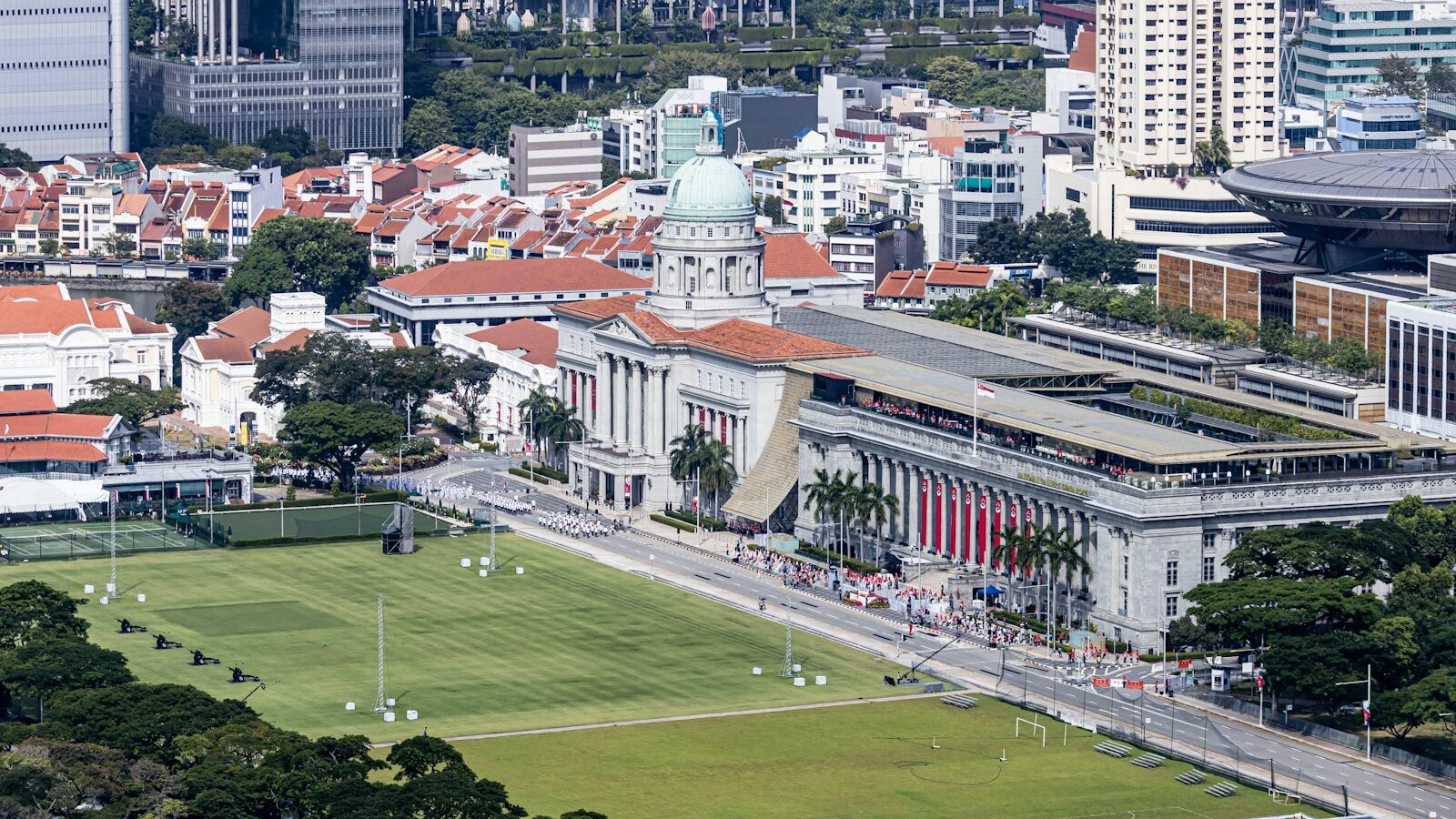
Parliament House Singapore stands at the centre of the nation’s political life, the place where laws are debated and passed and where the elected voice of the country does its work. Set within the historic Civic District beside the Singapore River, it is both a working institution and a piece of national heritage. To understand Parliament House is to understand something of how Singapore governs itself, and how it has carried its colonial-era buildings into an independent future rather than discarding them.
History and Significance
Two structures anchor this story. There is the present Parliament House, the modern home of the legislature, and there is the Old Parliament House, a colonial-era building that once served the same function and now has a new life as an arts venue. The older building is among the more historically layered structures in the district, having been put to several uses across its long existence before becoming a chamber of government. For confirmed dates, architectural details and the precise sequence of its uses, the National Heritage Board and Parliament’s own resources are the authoritative references, and readers should check figures there rather than rely on approximations.
The significance of Parliament House is inseparable from Singapore’s constitutional development. As the country moved from colonial rule through self-government to full independence, the institution of Parliament became the formal expression of representative government. The buildings that housed it therefore carry not just architectural interest but the memory of the debates and decisions that shaped modern Singapore. Keeping the old building standing, and giving it a cultural role, allowed the physical heritage to survive even as the legislature moved into a purpose-built home.
What to See
For most visitors, the experience of Parliament House falls into two parts. The first is the Civic District setting. Parliament House sits among a cluster of historic landmarks near the river, and a walk through the area reveals a concentration of colonial-era architecture, civic buildings and monuments unmatched elsewhere on the island. The proximity of the old and new Parliament buildings lets you read the change from one era to the next in the space of a short stroll.
The second part is access to the workings of Parliament itself. When Parliament is in session, there is provision for members of the public to observe proceedings from a gallery, subject to rules and registration. This is a valuable way to see representative government in action, though the arrangements, timings and requirements are set by Parliament and should be checked in advance. The Old Parliament House, in its current cultural role, offers a different kind of visit centred on the arts and on the building’s own heritage.
Old and New at a Glance
The table below sets out the broad distinction between the two buildings. It is a general guide, and official sources remain authoritative on current functions and access.
| Feature | Old Parliament House | Present Parliament House |
|---|---|---|
| Original role | Earlier seat of the legislature | Current seat of the legislature |
| Present role | Arts and cultural venue | Working home of Parliament |
| Public access | As a cultural venue | Public gallery when in session, with rules |
| Heritage character | Colonial-era landmark | Modern civic building |
| Best for | Arts, history and architecture | Observing government in action |
Always confirm opening arrangements, gallery access, security requirements and any registration steps through official channels, as these can change and are strictly enforced.
Heritage Value
Parliament House matters as heritage on two levels. Physically, the old building is a landmark of the Civic District, part of an ensemble that records Singapore’s colonial and post-colonial development in stone and street layout. Institutionally, Parliament House represents the machinery of democratic government, the place where the country’s laws take shape and where elected representatives are held to public account.
The decision to preserve the older building while purpose-building a new one is itself instructive. It reflects a wider Singapore approach of retaining significant heritage structures and finding fresh uses for them, rather than allowing continuity of function to require the loss of the original fabric. The result is a district where citizens can trace their institutions back through the buildings that housed them.
There is educational value here too. For students and newcomers, the pairing of the two buildings is a ready-made lesson in how a young nation built its institutions on colonial foundations without being trapped by them. The old chamber speaks of earlier assemblies and the long road to representative government, while the present house shows a modern, functioning legislature at work. Together they turn an abstract civics lesson into something you can walk between, and they anchor the story of Singapore’s political development in a place you can actually visit.
Visiting Notes
If you plan to visit the area or to observe proceedings:
- Check official information on sitting dates, public gallery access and any registration or identification requirements before you go.
- Expect security screening and follow all instructions and dress expectations.
- Combine your visit with a wider walk of the Civic District to appreciate the historic setting.
- Observe any restrictions on photography, bags and conduct, particularly inside working areas.
- Be respectful of the fact that Parliament House is a functioning institution, not primarily a tourist attraction.
Because Parliament House lies in the Civic District, it is easy to reach on foot from nearby landmarks and by public transport, making it a natural anchor for a day exploring Singapore’s historic centre.
A Closing Thought
Parliament House is where the abstract idea of self-government becomes a concrete daily practice. In the pairing of the old colonial-era building and its modern successor, Singapore has kept both its heritage and its working democracy visible in the same district. Visit with an understanding of what the place represents, confirm the practical details through official sources, and you will come away with a clearer sense of how the country is governed and how it got here.
Explore more: How Singapore’s Government and Parliament Work · Civic District History of Singapore · National Monuments of Singapore